Dehydration and Diarrhoea for NEET PG Paediatrics: ICMR Plans A, B and C, ORS and Zinc Doses, IV Regimens, Dysentery and Maintenance Fluids
Start Here
🎯 Exam priority: Very high. Expect: classifying dehydration from signs, the ORS volume in Plan B, the IV schedule in Plan C for infants vs older children, zinc doses, reduced-osmolarity ORS composition, definitions of persistent diarrhoea and dysentery, cholera antibiotics, and maintenance fluid by Holliday–Segar.
CBME mapping: PE15, PE23. Fact-checked against the ICMR Standard Treatment Workflow for Acute Diarrhoea (2019) and the MSD Manual.
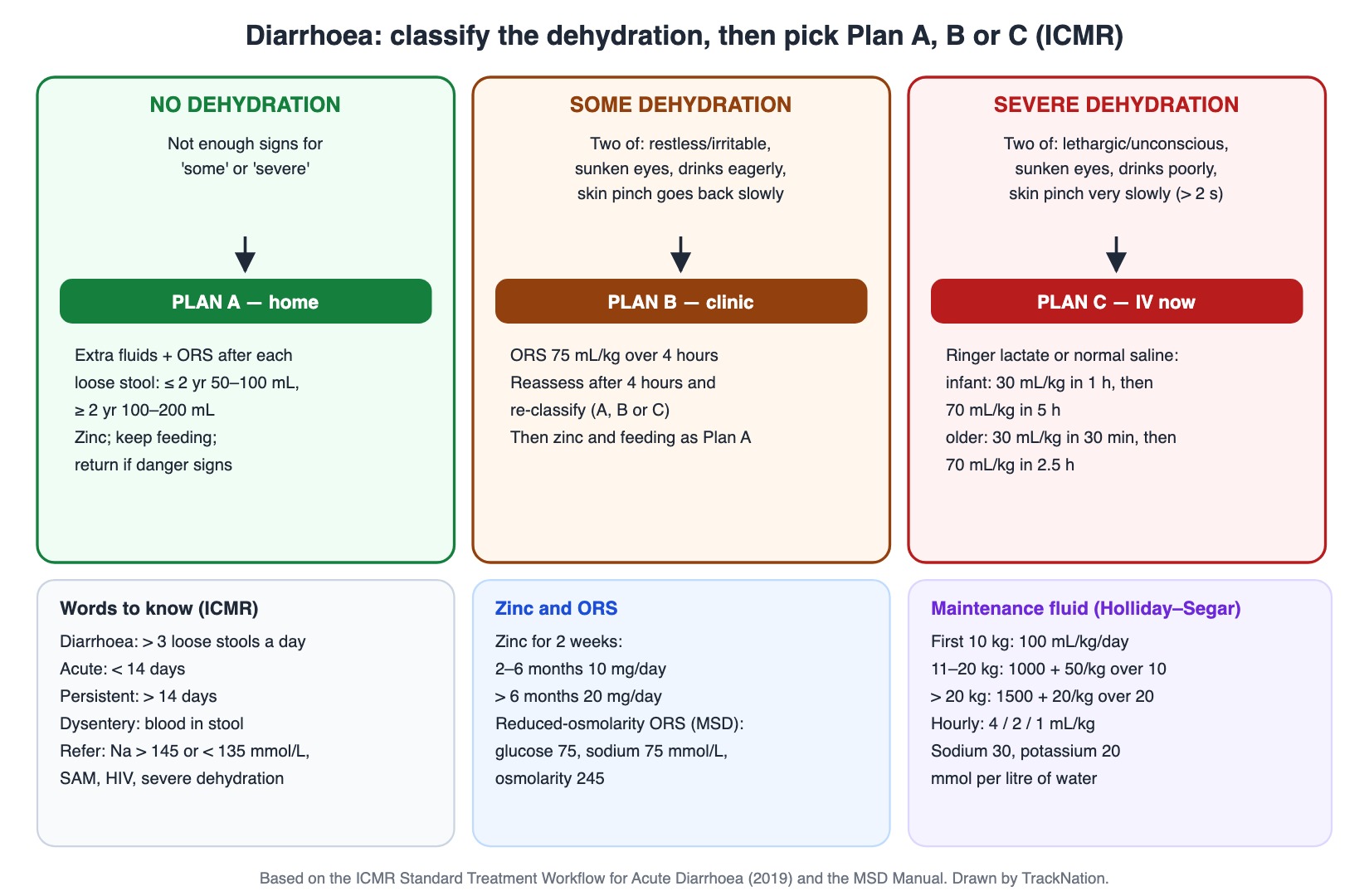
Classify dehydration, then Plan A, B or C; zinc, ORS and maintenance fluids. Drawn by TrackNation.
Assess and Classify (ICMR)
Diarrhoea: >3 loose or watery stools a day. Acute <14 days, persistent >14 days, dysentery = blood in stool.
Skin pinch: on the abdomen halfway between umbilicus and flank, pinch for one second — goes back immediately (normal), slowly, or very slowly (>2 seconds).
Some dehydration — any two of: restless/irritable, sunken eyes, drinks eagerly, skin pinch slow. Severe dehydration — any two of: lethargic/unconscious, sunken eyes, unable to drink or drinks poorly, skin pinch very slow. Otherwise, no dehydration.
Refer: severe dehydration, SAM or HIV, blood in stool with risk factors, Na >145 or <135 mmol/L, persistent diarrhoea with dehydration or serious infection. In hypernatraemia (MSD) the skin and mouth look worse — very dry mucosa, doughy skin — but circulation is better (less tachycardia, better urine output); ICMR notes such children look relatively less ill.
Plans A, B and C (ICMR)
Plan A (no dehydration, home): extra fluids; ORS after each loose stool — up to 2 years 50–100 mL, 2 years or more 100–200 mL; continue (more frequent) breastfeeding; zinc; return for danger signs (many watery stools, repeated vomiting, very thirsty, poor drinking, fever, blood in stool). Good home fluids: salted rice water, salted yoghurt drink, soup; avoid fizzy drinks, commercial juice, sweet tea.
Plan B (some dehydration, clinic): ORS 75 mL/kg over 4 hours; if vomiting, wait 10 minutes and go on slowly; reassess at 4 hours and re-classify.
Plan C (severe, IV now): Ringer lactate (or normal saline; DNS in malnourished) 100 mL/kg: infant — 30 mL/kg in 1 hour, then 70 mL/kg in 5 hours; older child — 30 mL/kg in 30 minutes, then 70 mL/kg in 2.5 hours. Reassess every 15–30 minutes until a strong radial pulse; give ORS by mouth while the drip is set up.
Zinc for 14 days: 10 mg/day at 2–6 months, 20 mg/day above 6 months. Ondansetron 0.15 mg/kg may be used for vomiting.
ORS, Antibiotics and Fluids (ICMR, MSD)
Reduced-osmolarity ORS: glucose 75 and sodium 75 mmol/L, osmolarity 245, using sodium–glucose co-transport. ORS fails in <5%; sports drinks, sodas and juices are unsuitable.
Antibiotics only for specific causes: suspected cholera — doxycycline 300 mg single dose (erythromycin for young children); dysentery — ciprofloxacin 15 mg/kg twice daily, reassess at 2 days, cefixime if no better; amoebiasis — metronidazole; giardiasis — metronidazole. Persistent diarrhoea: zinc 14 days, vitamins, small meals at least 6 times a day.
MSD grading: in infants, mild ≈5%, moderate ≈10% (sunken eyes and fontanelle, little urine, lethargy), severe ≈15% (thready pulse, no tears, delayed capillary refill). Diarrhoea causes metabolic acidosis; vomiting causes alkalosis.
Maintenance (Holliday–Segar): 100 mL/kg/day for the first 10 kg, 1000 + 50/kg for 11–20 kg, 1500 + 20/kg above 20 kg (4/2/1 mL/kg/hour); sodium 30 and potassium 20 mmol per litre.
Traps the Examiner Sets
"Drinks eagerly" means some dehydration; "drinks poorly or not at all" means severe.
Plan B is 75 mL/kg of ORS over 4 hours, not 100 mL/kg.
Infants get the IV 100 mL/kg over 6 hours; older children over 3 hours.
Zinc is 10 mg under 6 months and 20 mg above, for 14 days.
Persistent diarrhoea is more than 14 days; dysentery is any blood in stool.
Memory Hooks & Shortcuts
Shortcuts to lock in this article's numbers and lists. Each one only re-packages facts proven above.
🧠 'Eager = Some, Poor = Severe' — how the child drinks — classification
🧠 Plan B '75 in 4' — Plan B
🧠 Plan C '30-70': infants over 1 + 5 hours, older over ½ + 2½ hours — Plan C
🧠 Zinc 'Ten for tiny, Twenty for the rest — two weeks' — zinc
🧠 Holliday–Segar '100-50-20' per day, '4-2-1' per hour — maintenance
Rapid-Revision Cards
Diarrhoea
> 3 loose stools/day.
Acute / persistent
< 14 / > 14 days.
Dysentery
Blood in stool.
Skin pinch
Very slow = > 2 s.
Some dehydration
2 of: irritable, sunken eyes, drinks eagerly, slow pinch.
Severe
2 of: lethargic, sunken eyes, drinks poorly, very slow pinch.
Plan A ORS
≤ 2 yr 50–100 mL; ≥ 2 yr 100–200 mL per stool.
Plan B
ORS 75 mL/kg over 4 h.
Plan C fluid
Ringer lactate (NS; DNS if SAM).
Plan C infant
30 mL/kg in 1 h, 70 in 5 h.
Plan C older
30 mL/kg in 30 min, 70 in 2.5 h.
Zinc
10 mg (2–6 mo), 20 mg (> 6 mo) × 14 d.
Vomiting
Wait 10 min; ondansetron 0.15 mg/kg.
ORS composition
Glucose 75, Na 75, osmolarity 245.
Bad fluids
Fizzy drinks, commercial juice, sweet tea.
Cholera
Doxycycline 300 mg once; erythromycin if young.
Dysentery Rx
Ciprofloxacin; cefixime if no better at 2 d.
Refer
Na > 145 or < 135; SAM; HIV.
Acid–base
Diarrhoea acidosis; vomiting alkalosis.
Holliday–Segar
100/50/20 mL/kg/day; 4/2/1 mL/kg/h.
Maintenance electrolytes
Na 30, K 20 per litre.
Sources
Facts in this article were checked against these documents.
Standard Treatment Workflow: Management of Acute Diarrhea (paediatrics) — ICMR / Department of Health Research, MoHFW, 2019
MSD Manual Professional: Dehydration in Children; Oral Rehydration Therapy — Merck & Co., 2025–2026 (link)
Test Yourself: Practice Questions
Thirty questions in NEET PG style, many of them ward scenarios.
Practice Questions (NEET PG pattern)
Original questions written in the style of the exam: +4 for a correct answer, −1 for a wrong one. Every answer was checked against the sources listed above. NEET PG papers are not published by NBEMS, so these are not past-paper questions.
Q1. Diarrhoea is defined by ICMR as
(a) more than 10 stools a day
(b) more than 3 loose or watery stools a day
(c) any loose stool
(d) blood in stool
Show answer
Answer: (b) — ICMR.
Q2. Persistent diarrhoea lasts more than
(a) 7 days
(b) 14 days
(c) 30 days
(d) 3 days
Show answer
Answer: (b) — Acute < 14.
Q3. Dysentery means
(a) vomiting with diarrhoea
(b) blood in the stool
(c) watery stool
(d) stool for > 14 days
Show answer
Answer: (b) — ICMR.
Q4. A skin pinch that goes back very slowly takes longer than
(a) 10 seconds
(b) 0.5 second
(c) 1 minute
(d) 2 seconds
Show answer
Answer: (d) — Severe sign.
Q5. A 1-year-old with diarrhoea is irritable, has sunken eyes and drinks eagerly. The classification is
(a) shock
(b) severe dehydration
(c) some dehydration
(d) no dehydration
Show answer
Answer: (c) — Two signs of 'some'.
Q6. A lethargic child with diarrhoea who drinks poorly and has sunken eyes has
(a) no dehydration
(b) severe dehydration
(c) some dehydration
(d) malnutrition only
Show answer
Answer: (b) — Plan C.
Q7. In Plan B, the ORS given over 4 hours is
(a) 20 mL/kg
(b) 75 mL/kg
(c) 10 mL/kg
(d) 150 mL/kg
Show answer
Answer: (b) — Then reassess.
Q8. Under Plan A, a 1-year-old should get after each loose stool about
(a) 10 mL
(b) 200–400 mL
(c) 50–100 mL ORS
(d) 500 mL
Show answer
Answer: (c) — 100–200 mL from 2 years.
Q9. If a child vomits during ORS, the advice is to
(a) stop ORS
(b) wait 10 minutes, then continue slowly
(c) give antibiotics
(d) start IV at once
Show answer
Answer: (b) — ICMR.
Q10. The ideal IV fluid in Plan C is
(a) 5% dextrose
(b) 0.18% saline
(c) colloid
(d) Ringer lactate
Show answer
Answer: (d) — Or normal saline; DNS in malnourished.
Q11. For a severely dehydrated infant, Plan C gives
(a) 100 mL/kg in 1 hour
(b) 20 mL/kg only
(c) 30 mL/kg in 1 hour, then 70 mL/kg in 5 hours
(d) 30 mL/kg in 30 minutes, then 70 mL/kg in 2.5 hours
Show answer
Answer: (c) — Older: faster.
Q12. For a severely dehydrated 5-year-old, the first 30 mL/kg is given over
(a) 1 hour
(b) 24 hours
(c) 30 minutes
(d) 5 hours
Show answer
Answer: (c) — Then 70 mL/kg in 2.5 h.
Q13. During Plan C, reassess every 15–30 minutes until
(a) fever settles
(b) the child sleeps
(c) urine is clear
(d) a strong radial pulse is present
Show answer
Answer: (d) — ICMR.
Q14. Zinc for a 4-month-old with diarrhoea is
(a) 10 mg once
(b) 40 mg/day
(c) 10 mg/day for 14 days
(d) 20 mg/day for 14 days
Show answer
Answer: (c) — 20 mg above 6 months.
Q15. Zinc for a 2-year-old with diarrhoea is
(a) 20 mg once
(b) 10 mg/day for 2 weeks
(c) 5 mg/day
(d) 20 mg/day for 2 weeks
Show answer
Answer: (d) — ICMR.
Q16. A breastfed infant with diarrhoea should
(a) breastfeed more often than usual
(b) take only water
(c) switch to formula
(d) stop breastfeeding
Show answer
Answer: (a) — ICMR.
Q17. Reduced-osmolarity ORS has an osmolarity of
(a) 200
(b) 245
(c) 311
(d) 400
Show answer
Answer: (b) — Glucose 75, sodium 75.
Q18. Reduced-osmolarity ORS contains sodium
(a) 75 mmol/L
(b) 140 mmol/L
(c) 90 mmol/L
(d) 45 mmol/L
Show answer
Answer: (a) — MSD.
Q19. ORS works through
(a) osmotic diarrhoea
(b) sodium–glucose co-transport
(c) bicarbonate absorption
(d) potassium secretion
Show answer
Answer: (b) — MSD.
Q20. Which is an unsuitable fluid for a child with diarrhoea?
(a) vegetable soup with salt
(b) salted rice water
(c) carbonated drinks
(d) salted yoghurt drink
Show answer
Answer: (c) — Also commercial juice, sweet tea.
Q21. In suspected cholera in an older child, ICMR suggests
(a) doxycycline 300 mg single dose
(b) metronidazole
(c) no antibiotic ever
(d) ciprofloxacin for 14 days
Show answer
Answer: (a) — Erythromycin in young children.
Q22. First-line antibiotic for dysentery in the ICMR workflow is
(a) doxycycline
(b) amoxicillin
(c) metronidazole
(d) ciprofloxacin 15 mg/kg twice daily
Show answer
Answer: (d) — Cefixime if no better at 2 days.
Q23. If dysentery does not improve after 2 days of ciprofloxacin, switch to
(a) amoxicillin
(b) erythromycin
(c) albendazole
(d) cefixime
Show answer
Answer: (d) — ICMR.
Q24. A child with diarrhoea should be referred if serum sodium is
(a) 138 mmol/L
(b) 140 mmol/L
(c) above 145 or below 135 mmol/L
(d) 136–144 mmol/L
Show answer
Answer: (c) — Hyper/hyponatraemic.
Q25. A danger sign telling the parent to return immediately is
(a) one loose stool
(b) blood in the stool
(c) sleeping well
(d) good appetite
Show answer
Answer: (b) — Also repeated vomiting, poor drinking.
Q26. Diarrhoea tends to cause
(a) metabolic acidosis
(b) no acid–base change
(c) respiratory alkalosis
(d) metabolic alkalosis
Show answer
Answer: (a) — Vomiting → alkalosis.
Q27. Compared with hyponatraemic dehydration, children with hypernatraemic dehydration have
(a) low serum sodium
(b) doughy skin and very dry mucosa but better haemodynamics
(c) worse tachycardia and poor urine output
(d) normal skin
Show answer
Answer: (b) — Fluid shifts into vessels (MSD).
Q28. Maintenance fluid for the first 10 kg (Holliday–Segar) is
(a) 150 mL/kg/day
(b) 100 mL/kg/day
(c) 50 mL/kg/day
(d) 20 mL/kg/day
Show answer
Answer: (b) — Then 50, then 20.
Q29. Daily maintenance fluid for a 15-kg child is
(a) 1250 mL
(b) 1500 mL
(c) 750 mL
(d) 1000 mL
Show answer
Answer: (a) — 1000 + 50 × 5.
Q30. Oral rehydration therapy fails in about
(a) never
(b) 25%
(c) less than 5% of children
(d) 50%
Show answer
Answer: (c) — MSD.
Active Recall
From memory: define diarrhoea types, classify dehydration from the four signs, describe Plans A, B and C with volumes and timing, zinc doses, ORS composition, when to refer, antibiotics for cholera and dysentery, and Holliday-Segar maintenance fluids.