Iron, Iodine and Anaemia Mukt Bharat for NEET PG Paediatrics: IFA Doses and Colours by Age, Deworming, Iron-Deficiency Anaemia and Goitre
Start Here
🎯 Exam priority: Very high. Expect: the AMB 6x6x6 structure, IFA dose and colour for each age group, the syrup regimen for 6–59 months, the deworming dose, the six interventions, how an anaemic child is treated, lab findings in iron deficiency, what helps and hinders iron absorption, and the effects of iodine deficiency.
CBME mapping: PE13. Fact-checked against MoHFW's Anemia Mukt Bharat guidelines (2018), the MSD Manual and NFHS-5.
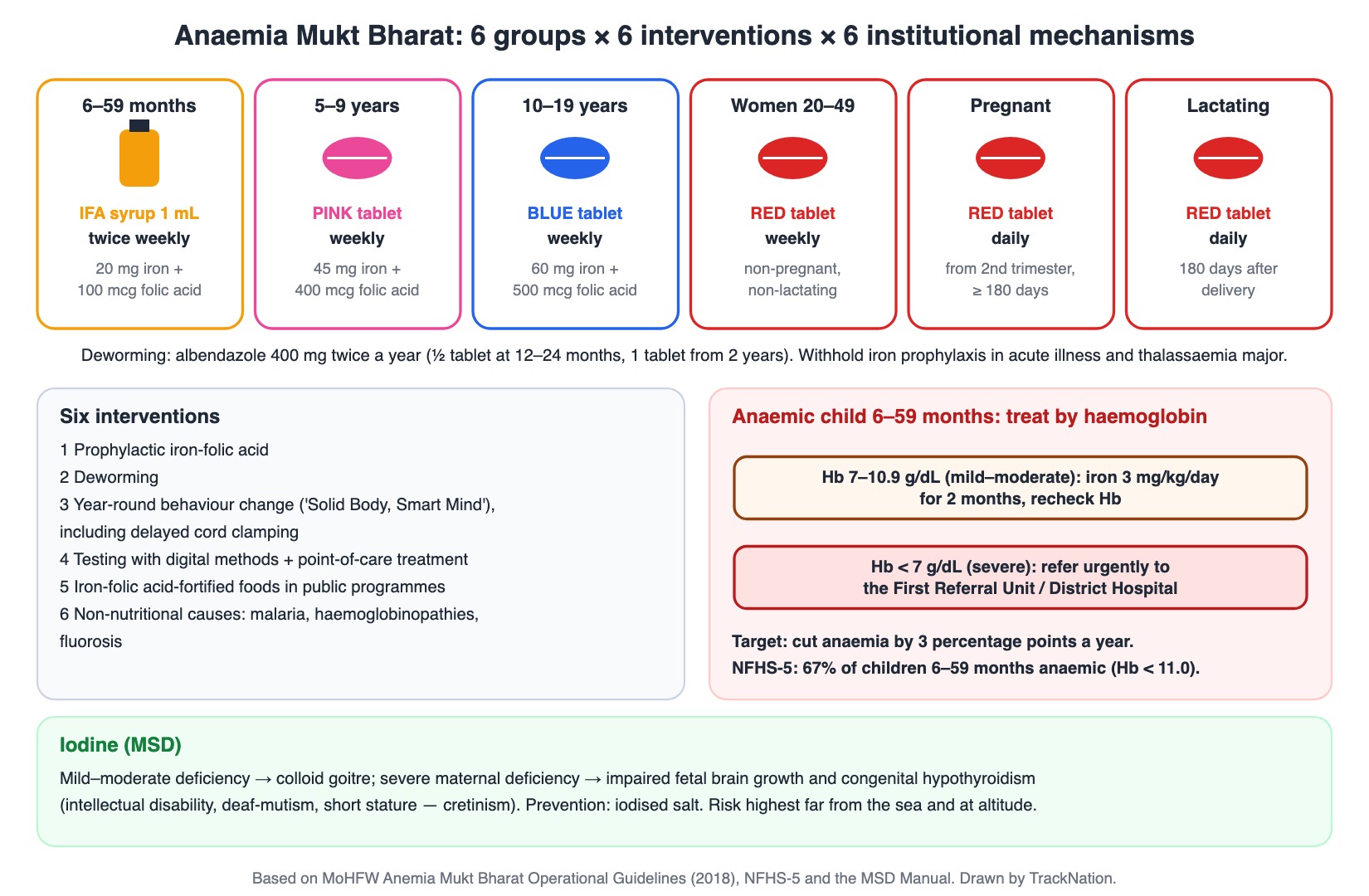
Anaemia Mukt Bharat: IFA by age group, deworming, six interventions, treating anaemic children, and iodine. Drawn by TrackNation.
Anaemia Mukt Bharat: Who Gets What (MoHFW)
6×6×6: six target groups, six interventions, six institutional mechanisms; aim to cut anaemia by 3 percentage points a year. NFHS-5: 67% of children 6–59 months are anaemic (Hb <11.0 g/dL), up from 59% in NFHS-4.
6–59 months: 1 mL IFA syrup twice a week (20 mg iron + 100 mcg folic acid per mL; 50-mL bottle with auto-dispenser), given at home through the ASHA.
5–9 years: weekly pink tablet (45 mg iron + 400 mcg FA). 10–19 years: weekly blue tablet (60 mg + 500 mcg). Women 20–49 (not pregnant or lactating): weekly red tablet. Pregnant women: daily red from the 2nd trimester for ≥180 days; lactating: daily red for 180 days.
Deworming: albendazole 400 mg twice a year — ½ tablet at 12–24 months, 1 tablet from 2 years. Withhold iron during acute illness (fever, diarrhoea, pneumonia) and in thalassaemia major (folic acid only).
Interventions and Treating the Anaemic Child (MoHFW)
Six interventions: (1) prophylactic IFA, (2) deworming, (3) year-round behaviour change — "Solid Body, Smart Mind", including delayed cord clamping, (4) testing with digital haemoglobinometers and point-of-care treatment, (5) IFA-fortified foods in public programmes (fortified salt, wheat flour and oil in ICDS and Mid-day Meals), (6) non-nutritional causes — malaria, haemoglobinopathies, fluorosis.
Institutional mechanisms include intra-ministerial coordination, a National AMB Unit, a centre of excellence, convergence with other ministries, supply chain and the AMB dashboard.
Anaemic child 6–59 months: Hb 7–10.9 g/dL → iron 3 mg/kg/day for 2 months (e.g. 1 mL syrup daily at 6–12 months), recheck; Hb <7 g/dL → refer urgently to the First Referral Unit / District Hospital.
Iron-Deficiency Anaemia and Iodine (MSD)
Iron deficiency is the commonest cause of anaemia; rapid growth in children raises demand. Cells are microcytic, hypochromic; low ferritin and serum iron with high TIBC. Severe cases: pica, koilonychia. Always look for the cause — iron without it is poor practice.
Iron is absorbed in the duodenum and upper jejunum; vitamin C is the only common food that increases non-haem iron absorption; milk, phytates and tea reduce it.
Iodine makes T4 and T3. Deficiency → colloid goitre; severe maternal deficiency → impaired fetal brain growth and congenital hypothyroidism — intellectual disability, deaf-mutism, short stature (cretinism). Prevent with iodised salt; diagnose with TSH. Risk is highest far from the sea and at altitude.
Traps the Examiner Sets
Under-5s get IFA syrup twice a week, not daily tablets.
Pink is for 5–9 years, blue for adolescents, red for women.
Iron prophylaxis is withheld during acute illness and in thalassaemia major.
Hb below 7 g/dL in a child needs urgent referral, not home iron.
Tea reduces iron absorption; vitamin C increases it.
Memory Hooks & Shortcuts
Shortcuts to lock in this article's numbers and lists. Each one only re-packages facts proven above.
🧠 Tablet colours by age 'Pink Primary, Blue Bigger, Red for women' — 5–9, 10–19, mothers — AMB colours
🧠 'Syrup twice a week for the under-fives' — 6–59 months
🧠 'Seven is the line' — Hb < 7 g/dL in a child means refer — treatment
🧠 'C helps, Tea halts' — iron absorption — absorption
🧠 Cretinism 'Dull, Deaf, Dwarf' — intellectual disability, deaf-mutism, short stature — iodine
Rapid-Revision Cards
AMB
6 groups × 6 interventions × 6 mechanisms; −3 points/yr.
6–59 mo
IFA syrup 1 mL twice weekly (20 mg Fe + 100 mcg FA).
5–9 yr
Pink tablet weekly (45 mg + 400 mcg).
10–19 yr
Blue tablet weekly (60 mg + 500 mcg).
WRA 20–49
Red tablet weekly.
Pregnant / lactating
Red daily, ≥180 days each.
Deworming
Albendazole 400 mg twice yearly; ½ tablet 12–24 mo.
Withhold iron
Acute illness; thalassaemia major.
Six interventions
IFA, deworming, BCC, testing, fortification, non-nutritional.
BCC slogan
Solid Body, Smart Mind; delayed cord clamping.
Testing
Digital haemoglobinometers, point-of-care.
Non-nutritional
Malaria, haemoglobinopathies, fluorosis.
Hb 7–10.9 (child)
Iron 3 mg/kg/day × 2 months.
Hb < 7 (child)
Refer urgently to FRU/DH.
NFHS-5 child anaemia
67% (Hb < 11.0).
IDA labs
Low ferritin, low iron, high TIBC; microcytic.
Iron absorption
Duodenum, upper jejunum.
Helps / hinders
Vitamin C / tea, milk, phytates.
Severe IDA signs
Pica, koilonychia.
Iodine deficiency
Colloid goitre; TSH.
Cretinism
ID, deaf-mutism, short stature.
Sources
Facts in this article were checked against these documents.
Anemia Mukt Bharat: Intensified National Iron Plus Initiative (I-NIPI) Operational Guidelines — Ministry of Health & Family Welfare, 2018
MSD Manual Professional: Iron Deficiency Anemia; Iodine Deficiency — Merck & Co., 2025–2026 (link)
National Family Health Survey (NFHS-5) 2019–21: India Report — International Institute for Population Sciences / MoHFW, 2022
Test Yourself: Practice Questions
Thirty questions in NEET PG style, many from India's programme.
Practice Questions (NEET PG pattern)
Original questions written in the style of the exam: +4 for a correct answer, −1 for a wrong one. Every answer was checked against the sources listed above. NEET PG papers are not published by NBEMS, so these are not past-paper questions.
Q1. Anaemia Mukt Bharat is described as a 6x6x6 strategy, meaning
(a) six target groups, six interventions and six institutional mechanisms
(b) six doses over six months in six states
(c) six tests at six ages
(d) six vitamins, six minerals, six foods
Show answer
Answer: (a) — MoHFW 2018.
Q2. Under AMB, children aged 6–59 months receive
(a) 1 mL IFA syrup twice a week
(b) a blue tablet weekly
(c) a pink tablet weekly
(d) daily IFA tablets
Show answer
Answer: (a) — Via ASHA home visits.
Q3. Each mL of AMB IFA syrup contains
(a) 20 mg elemental iron and 100 mcg folic acid
(b) 100 mg iron
(c) 45 mg iron and 400 mcg folic acid
(d) 60 mg iron and 500 mcg folic acid
Show answer
Answer: (a) — MoHFW.
Q4. The IFA tablet for children aged 5–9 years is
(a) red, daily
(b) syrup, twice weekly
(c) blue, weekly
(d) pink, weekly, 45 mg iron + 400 mcg folic acid
Show answer
Answer: (d) — MoHFW.
Q5. School-going adolescents aged 10–19 years receive a weekly
(a) syrup
(b) pink tablet
(c) red tablet
(d) blue IFA tablet (60 mg iron + 500 mcg folic acid)
Show answer
Answer: (d) — MoHFW.
Q6. Pregnant women under AMB take daily IFA
(a) from conception for 1 year
(b) only in the 3rd trimester for 30 days
(c) only if anaemic
(d) from the 2nd trimester for at least 180 days
Show answer
Answer: (d) — Red tablet.
Q7. Iron prophylaxis under AMB should be withheld in
(a) breastfed infants
(b) acute illness and thalassaemia major
(c) children over 2 years
(d) girls
Show answer
Answer: (b) — MoHFW.
Q8. The deworming dose for a child aged 12–24 months under AMB is
(a) mebendazole daily
(b) no deworming under 2 years
(c) albendazole 400 mg monthly
(d) albendazole 200 mg (½ of a 400 mg tablet) twice a year
Show answer
Answer: (d) — 1 tablet from 2 years.
Q9. Deworming under AMB is given
(a) once a month
(b) twice a year
(c) every week
(d) once only
Show answer
Answer: (b) — Biannual.
Q10. An AMB intervention given at birth to reduce anaemia is
(a) BCG
(b) vitamin K
(c) early bathing
(d) delayed cord clamping
Show answer
Answer: (d) — Within behaviour change.
Q11. AMB uses which tool for testing haemoglobin?
(a) digital haemoglobinometers
(b) bone marrow
(c) ferritin only
(d) Sahli only
Show answer
Answer: (a) — Point-of-care.
Q12. The non-nutritional causes of anaemia targeted by AMB in endemic areas are
(a) TB, HIV and leprosy
(b) typhoid and cholera
(c) malaria, haemoglobinopathies and fluorosis
(d) dengue and chikungunya
Show answer
Answer: (c) — Intervention 6.
Q13. AMB's fortification intervention mandates fortified salt, wheat flour and oil in
(a) private restaurants
(b) only hospitals
(c) ICDS and Mid-day Meal schemes
(d) export food
Show answer
Answer: (c) — MoHFW.
Q14. A 3-year-old has Hb 9 g/dL. Under AMB the treatment is
(a) iron 3 mg/kg/day for 2 months
(b) blood transfusion
(c) biweekly syrup only
(d) urgent referral
Show answer
Answer: (a) — Mild–moderate.
Q15. A 2-year-old has Hb 6 g/dL. Under AMB the next step is
(a) home iron for 2 months
(b) deworming only
(c) urgent referral to the FRU or District Hospital
(d) vitamin C
Show answer
Answer: (c) — Severe anaemia.
Q16. AMB's target is to reduce anaemia prevalence by
(a) 3 percentage points per year
(b) 50% in a year
(c) 1% in 10 years
(d) 10 points per year
Show answer
Answer: (a) — MoHFW.
Q17. In NFHS-5, anaemia among children 6–59 months was
(a) 35%
(b) 59%
(c) 90%
(d) 67%
Show answer
Answer: (d) — Up from 59%.
Q18. In children aged 6–59 months, anaemia in NFHS-5 is defined as haemoglobin below
(a) 10 g/dL
(b) 13 g/dL
(c) 12 g/dL
(d) 11.0 g/dL
Show answer
Answer: (d) — NFHS-5.
Q19. In thalassaemia major, AMB recommends
(a) folic acid, not iron
(b) no treatment
(c) iron and deworming
(d) high-dose iron
Show answer
Answer: (a) — Iron withheld.
Q20. The commonest cause of anaemia overall is
(a) aplastic anaemia
(b) thalassaemia
(c) iron deficiency
(d) B12 deficiency
Show answer
Answer: (c) — MSD.
Q21. Typical laboratory findings in iron-deficiency anaemia are
(a) low ferritin, low serum iron, high TIBC
(b) high ferritin, low TIBC
(c) high serum iron
(d) macrocytosis
Show answer
Answer: (a) — Microcytic hypochromic.
Q22. Red cells in iron-deficiency anaemia are
(a) macrocytic
(b) spherocytic
(c) microcytic and hypochromic
(d) normocytic normochromic
Show answer
Answer: (c) — MSD.
Q23. Iron is mainly absorbed in the
(a) stomach
(b) ileum
(c) duodenum and upper jejunum
(d) colon
Show answer
Answer: (c) — MSD.
Q24. The only common food element that increases non-haem iron absorption is
(a) calcium
(b) tea
(c) ascorbic acid
(d) phytates
Show answer
Answer: (c) — MSD.
Q25. Which reduces non-haem iron absorption?
(a) orange juice
(b) meat
(c) tea tannates
(d) vitamin C
Show answer
Answer: (c) — Also milk, phytates.
Q26. Spoon-shaped nails in iron deficiency are called
(a) leukonychia
(b) koilonychia
(c) clubbing
(d) onycholysis
Show answer
Answer: (b) — MSD.
Q27. Mild-to-moderate iodine deficiency typically causes
(a) toxic nodular goitre
(b) thyroid cancer
(c) colloid goitre
(d) hyperthyroidism
Show answer
Answer: (c) — MSD.
Q28. Severe maternal iodine deficiency can cause in the child
(a) rickets
(b) precocious puberty
(c) tall stature
(d) intellectual disability, deaf-mutism and short stature (cretinism)
Show answer
Answer: (d) — MSD.
Q29. Iodine deficiency is most likely in people living
(a) in cities
(b) near rivers
(c) far from the sea and at high altitude
(d) on the coast
Show answer
Answer: (c) — MSD.
Q30. Iodine deficiency is usually diagnosed using
(a) bone age
(b) thyroid function tests, mainly TSH
(c) serum ferritin
(d) urine sugar
Show answer
Answer: (b) — Plus goitre exam.
Active Recall
From memory: explain the Anaemia Mukt Bharat 6x6x6 strategy, the IFA product, colour and regimen for each age group, deworming, the six interventions, how an anaemic child is treated, iron-deficiency lab findings and absorption, and iodine deficiency.