IMNCI for NEET PG Paediatrics: Pink, Yellow and Green Classification, Danger Signs, Fast-Breathing Cut-offs, Young Infant PSBI and Home Visits
Start Here
🎯 Exam priority: Very high (asked in both Paediatrics and PSM). Expect: the colour code, the four general danger signs, fast-breathing cut-offs by age, classifying cough, ear and anaemia, PSBI signs in a young infant, severe jaundice criteria, signs of good attachment, and the home-visit schedule.
Fact-checked against the MoHFW / WHO / UNICEF F-IMNCI chart booklet, India's IMNCI adaptation slides and the WHO AWaRe antibiotic book (2022). The chart booklet we checked is an older edition: this article teaches its assess–classify–treat framework. For drug choices, follow current programme guidance (for example, national malaria treatment guidelines) and, for vaccines, the current UIP schedule (article 11).
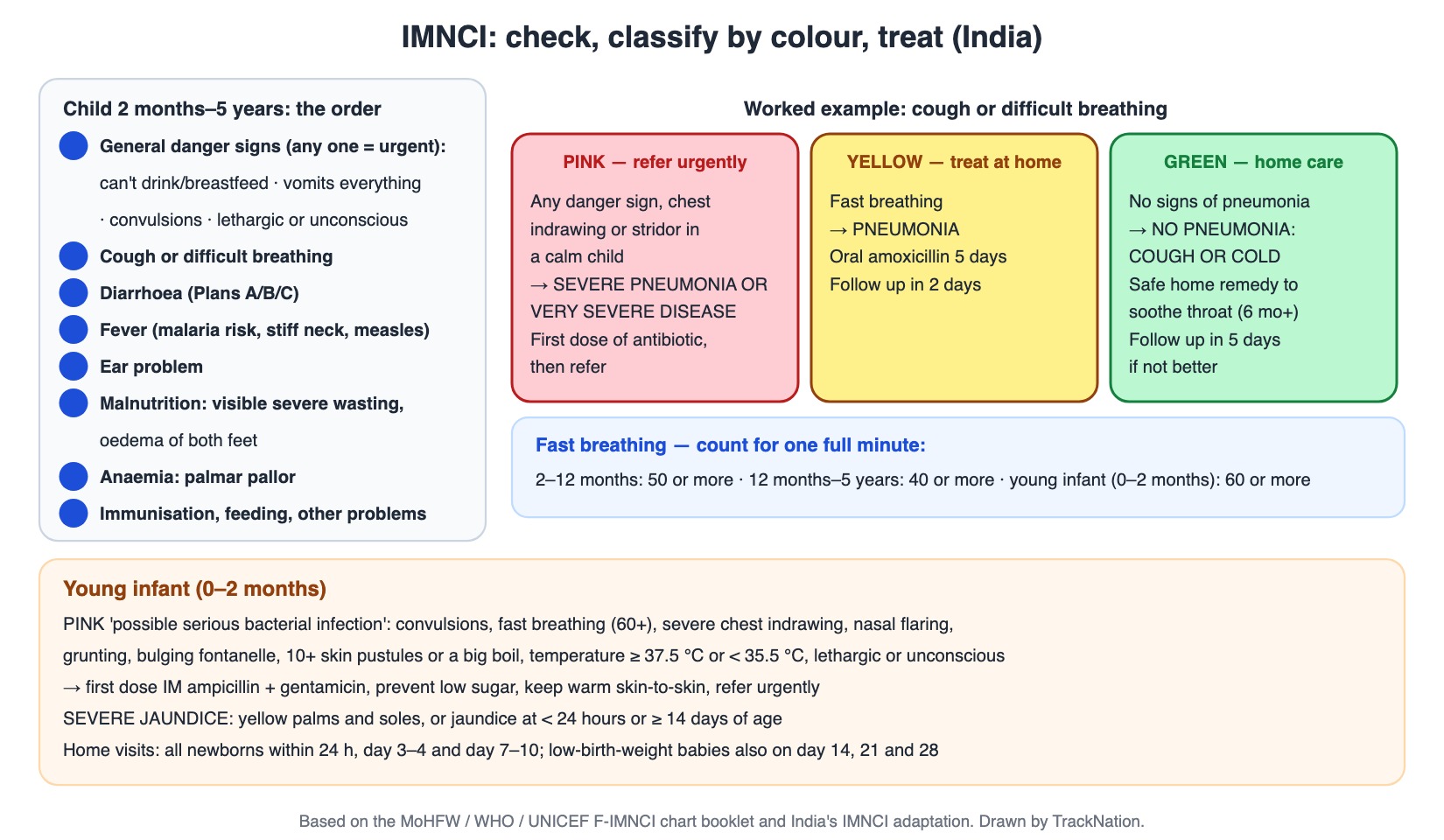
IMNCI: the assessment order, colour-coded classification of cough, fast-breathing cut-offs, and the young infant. Drawn by TrackNation.
What IMNCI Is (India)
Goal: standardised, syndromic case management of sick newborns and children, focused on the commonest causes of death, with nutrition assessment and counselling for every sick child and home care for newborns (exclusive breastfeeding, preventing hypothermia, recognising illness early).
Three components: improve health and nutrition workers' skills · improve health systems · improve family and community practices.
India's major adaptations (IMCI → IMNCI): covers the whole 0–5 years including the first week of life; 50% of training time on young infants (0–2 months); training begins with the young infant; training cut to 8 days, with separate materials for physicians and health workers; home-based care of young infants by health workers added.
Colour code: PINK = needs inpatient care (urgent referral) · YELLOW = specific treatment at home (antibiotic, antimalarial, ORT) · GREEN = no medicine, home care advice.
Home visits for young infants: all newborns — 3 visits: within 24 hours, day 3–4, day 7–10; low-birth-weight babies get 3 more on day 14, 21 and 28.
Young Infant (0–2 Months)
Possible serious bacterial infection (PSBI) — PINK: convulsions, fast breathing 60/min or more, severe chest indrawing, nasal flaring, grunting, bulging fontanelle, 10 or more skin pustules or a big boil, axillary temperature 37.5 °C or above or below 35.5 °C, lethargic or unconscious, less than normal movements. Give first dose of IM ampicillin and gentamicin, prevent low blood sugar, keep warm skin-to-skin if below 36.5 °C, refer urgently.
Local bacterial infection — YELLOW: umbilicus red or draining pus, pus from the ear, or fewer than 10 pustules → oral amoxicillin for 5 days, treat at home, follow up in 2 days.
Severe jaundice — PINK: yellow palms and soles, or jaundice at age under 24 hours or 14 days or more. Otherwise "jaundice": home care, follow up in 2 days.
Low body temperature (35.5–36.4 °C): warm by skin-to-skin contact for one hour and reassess.
Feeding: good attachment needs all four — chin touching breast, mouth wide open, lower lip turned out, more areola visible above than below the mouth. Fewer than 8 breastfeeds in 24 hours is a feeding problem. Follow up a feeding problem or thrush in 2 days, low weight for age in 14 days.
WHO's PSBI definition (AWaRe book 2022) is shorter: not feeding well, convulsions, fast breathing (60 or more in infants under 7 days), severe chest indrawing, fever 38.0 °C or more, temperature below 35.5 °C, movement only on stimulation. Note the different fever cut-off from the Indian chart (37.5 °C axillary).
Child 2 Months to 5 Years
General danger signs (any one → urgent): not able to drink or breastfeed · vomits everything · convulsions · lethargic or unconscious. Refer after the first dose of an appropriate antibiotic — except that Plan C rehydration may resolve the signs so referral is no longer needed.
Cough or difficult breathing: count breaths for one full minute in a calm child. Fast breathing = 50 or more at 2–12 months, 40 or more at 12 months–5 years. Any danger sign, chest indrawing or stridor in a calm child → severe pneumonia or very severe disease (PINK, refer). Fast breathing → pneumonia (YELLOW: amoxicillin for 5 days, follow up in 2 days). Neither → no pneumonia: cough or cold (GREEN: safe home remedy if 6 months or older, follow up in 5 days if not improving). Cough for more than 30 days → refer for assessment.
Diarrhoea: dehydration graded as in article 09 (Plans A/B/C). Diarrhoea for 14 days or more with dehydration = severe persistent diarrhoea (refer); without = persistent diarrhoea (vitamin A, zinc daily for 14 days, follow up in 5 days). Blood in stool = dysentery (ciprofloxacin for 3 days, zinc for 14 days, follow up in 2 days).
Fever (history, feels hot, or axillary 37.5 °C or above; rectal cut-off about 0.5 °C higher): first decide malaria risk. Any danger sign, stiff neck or bulging fontanelle → very severe febrile disease (refer). Fever every day for more than 7 days → refer. Paracetamol in clinic for high fever (38.5 °C or above).
Measles now or in the last 3 months: danger sign, clouding of cornea or deep/extensive mouth ulcers → severe complicated measles (vitamin A, refer). Pus from the eye or mouth ulcers → vitamin A, tetracycline eye ointment, gentian violet for ulcers.
Ear: tender swelling behind the ear = mastoiditis (refer). Pus for less than 14 days or ear pain = acute ear infection (amoxicillin 5 days, dry by wicking). Pus for 14 days or more = chronic ear infection (wicking, topical ciprofloxacin drops for 2 weeks). Both followed up in 5 days.
Malnutrition, Anaemia and Prevention
Severe malnutrition: visible severe wasting or oedema of both feet → single dose of vitamin A, prevent low blood sugar, keep warm, refer urgently.
Very low weight: weight for age below −3 SD → assess and counsel feeding, follow up in 30 days.
Anaemia by palmar pallor: severe pallor → severe anaemia (refer); some pallor → anaemia (iron–folic acid for 14 days, feeding counsel, follow up in 14 days); no pallor → prophylactic IFA if 6 months or older (current dosing under Anaemia Mukt Bharat, article 08).
Prophylactic vitamin A (chart): 100,000 IU at 9 months, then 200,000 IU at 16–18 months and every 6 months to 60 months.
Traps the Examiner Sets
Fast breathing is 60 / 50 / 40: under 2 months, 2–12 months, 12 months–5 years. Count for a full minute; in a young infant, repeat the count if raised.
Pink = refer, yellow = treat at home, green = home care. Colour is the action, not the severity word.
Severe jaundice is about palms and soles and age (<24 hours or ≥14 days), not the bilirubin number.
10 or more pustules (or a big boil) is PSBI; fewer than 10 is a local infection.
Ear discharge: the 14-day line divides acute from chronic. Swelling behind the ear is mastoiditis.
Home visits: 3 for every newborn (24 h, day 3–4, day 7–10) plus 3 for low birth weight (day 14, 21, 28).
Memory Hooks & Shortcuts
Shortcuts to lock in this article's numbers and lists. Each one only re-packages facts proven above.
🧠 Traffic light: Pink = Patient goes (refer), Yellow = You treat at home, Green = Go home — colour code
🧠 '60-50-40' — the breathing cut-off falls by ten at 2 months and at 1 year — fast breathing
🧠 Danger signs 'DVCL': can't Drink, Vomits everything, Convulsions, Lethargic — danger signs
🧠 Home visits '1-3-7' for every baby, then '14-21-28' if small — home visits
🧠 Ten pustules tip it: ≥ 10 = PSBI, < 10 = local — pustules
Rapid-Revision Cards
Pink / Yellow / Green
Refer / treat at home / home care.
Danger signs
Can't drink, vomits all, convulsions, lethargic.
Fast breathing
60 (< 2 mo), 50 (2–12 mo), 40 (1–5 yr).
Severe pneumonia
Danger sign, chest indrawing or stridor when calm.
Pneumonia Rx
Amoxicillin 5 d; follow up 2 d.
Cough or cold
Home remedy; follow up 5 d.
Chronic cough
> 30 days → refer.
PSBI
Convulsions, RR ≥ 60, chest indrawing, flaring, grunting, fontanelle, ≥ 10 pustules, temp ≥ 37.5 or < 35.5.
PSBI Rx
IM ampicillin + gentamicin, keep warm, refer.
Local infection
Umbilicus, ear pus, < 10 pustules → amoxicillin 5 d.
Severe jaundice
Palms/soles yellow; < 24 h or ≥ 14 d.
Low temp
35.5–36.4 °C → skin-to-skin 1 h.
Good attachment
Chin, mouth wide, lower lip out, more areola above.
Feeding problem
< 8 breastfeeds in 24 h.
Home visits
24 h, day 3–4, 7–10; LBW + 14, 21, 28.
India adaptations
0–5 yr incl. week 1; 50% young infant; 8 days.
Ear
Behind-ear swelling = mastoiditis; < 14 d acute; ≥ 14 d chronic.
Fever
≥ 37.5 °C axillary; daily > 7 d → refer.
Severe measles
Danger sign, corneal clouding, deep mouth ulcers.
Severe malnutrition
Visible severe wasting or bilateral pedal oedema.
Anaemia
Severe pallor refer; some → IFA 14 d.
Sources
Facts in this article were checked against these documents.
Integrated Management of Neonatal and Childhood Illness: Chart Booklet (F-IMNCI) — MoHFW, Government of India / WHO / UNICEF, older edition (link)
Adaptation of the IMNCI Strategy for India (training slides) — MoHFW, Government of India,
The WHO AWaRe (Access, Watch, Reserve) antibiotic book — World Health Organization, 2022
Test Yourself: Practice Questions
Thirty questions in NEET PG style, many of them clinic scenarios.
Practice Questions (NEET PG pattern)
Original questions written in the style of the exam: +4 for a correct answer, −1 for a wrong one. Every answer was checked against the sources listed above. NEET PG papers are not published by NBEMS, so these are not past-paper questions.
Q1. In IMNCI, a PINK classification means the child needs
(a) no medicine
(b) inpatient care (urgent referral)
(c) treatment at home
(d) follow-up in 30 days
Show answer
Answer: (b) — Yellow = home treatment; green = home care.
Q2. A YELLOW classification in IMNCI means
(a) specific treatment given at home
(b) no treatment needed
(c) admission to ICU
(d) urgent referral
Show answer
Answer: (a) — E.g. antibiotic, antimalarial, ORT.
Q3. Which is NOT one of the IMNCI general danger signs?
(a) fever
(b) vomits everything
(c) not able to drink or breastfeed
(d) convulsions
Show answer
Answer: (a) — Fourth sign: lethargic or unconscious.
Q4. A 6-month-old with cough has a respiratory rate of 52/min, no chest indrawing and no danger sign. The IMNCI classification is
(a) pneumonia
(b) severe pneumonia
(c) very severe disease
(d) no pneumonia: cough or cold
Show answer
Answer: (a) — Cut-off 50 at 2–12 months.
Q5. A 3-year-old with cough breathes 42/min with no danger signs or chest indrawing. The classification is
(a) severe pneumonia
(b) no pneumonia
(c) pneumonia
(d) wheeze only
Show answer
Answer: (c) — Cut-off 40 from 12 months to 5 years.
Q6. In a child aged 2 months to 5 years with cough, which sign makes it severe pneumonia or very severe disease?
(a) runny nose
(b) respiratory rate 45 in a 2-year-old
(c) stridor in a calm child
(d) cough for 3 days
Show answer
Answer: (c) — Also chest indrawing or any danger sign.
Q7. IMNCI treatment for pneumonia (fast breathing only) is
(a) home remedy only
(b) refer urgently
(c) amoxicillin for 5 days, follow up in 2 days
(d) IV antibiotics for 10 days
Show answer
Answer: (c) — Yellow.
Q8. A child with cough or cold and no pneumonia is followed up in
(a) 14 days
(b) 5 days if not improving
(c) 30 days
(d) 2 days
Show answer
Answer: (b) — Green.
Q9. IMNCI says a child coughing for more than how long should be referred for assessment?
(a) 3 days
(b) 30 days
(c) 14 days
(d) 7 days
Show answer
Answer: (b) — Chart booklet.
Q10. Fast breathing in a young infant (under 2 months) is
(a) 30 or more
(b) 40 or more
(c) 60 breaths per minute or more
(d) 50 or more
Show answer
Answer: (c) — 60 / 50 / 40.
Q11. A 3-week-old has 12 skin pustules. IMNCI classifies this as
(a) no infection
(b) local bacterial infection
(c) possible serious bacterial infection
(d) jaundice
Show answer
Answer: (c) — 10 or more (or a big boil) = PSBI.
Q12. A 4-week-old has a red umbilicus with pus and no other signs. Treatment is
(a) refer urgently
(b) no treatment
(c) oral amoxicillin for 5 days and follow up in 2 days
(d) IV ceftriaxone for 14 days
Show answer
Answer: (c) — Local bacterial infection.
Q13. Pre-referral treatment for a young infant with PSBI is
(a) oral amoxicillin
(b) oral ciprofloxacin
(c) paracetamol only
(d) first dose of IM ampicillin and gentamicin
Show answer
Answer: (d) — Plus prevent low sugar, keep warm.
Q14. Which axillary temperature makes a young infant PSBI under the Indian IMNCI chart?
(a) 37.5 °C or above
(b) 36.8 °C
(c) 37.0 °C
(d) 36.0 °C
Show answer
Answer: (a) — Or below 35.5 °C.
Q15. A 3-day-old with jaundice is classified as severe jaundice if
(a) palms and soles are yellow
(b) the baby feeds well
(c) only the face is yellow
(d) jaundice appeared on day 3
Show answer
Answer: (a) — Or age < 24 h or ≥ 14 days.
Q16. Jaundice is severe in IMNCI at any extent if it is seen at
(a) day 5
(b) day 3
(c) age 14 days or more
(d) day 7
Show answer
Answer: (c) — Also < 24 hours.
Q17. A young infant's temperature is 36.0 °C with no other problem. IMNCI advises
(a) refer urgently
(b) no action
(c) IV antibiotics
(d) skin-to-skin warming for one hour and reassess
Show answer
Answer: (d) — Low body temperature 35.5–36.4 °C.
Q18. Which is NOT a sign of good attachment at the breast?
(a) lower lip turned outward
(b) mouth wide open
(c) more areola visible below than above the mouth
(d) chin touching breast
Show answer
Answer: (c) — More areola above than below.
Q19. A feeding problem in a young infant includes breastfeeding fewer than
(a) 4 times in 24 hours
(b) 8 times in 24 hours
(c) 12 times in 24 hours
(d) 2 times in 24 hours
Show answer
Answer: (b) — Chart booklet.
Q20. Under IMNCI home visits, a normal-weight newborn is visited
(a) on day 7, 14 and 28
(b) within 24 hours, on day 3–4 and day 7–10
(c) daily for a week
(d) once at 6 weeks
Show answer
Answer: (b) — LBW: 3 more on 14, 21, 28.
Q21. Low-birth-weight babies get extra IMNCI home visits on
(a) day 5, 6 and 7
(b) day 10, 20 and 30
(c) day 42 only
(d) day 14, 21 and 28
Show answer
Answer: (d) — Six visits in all.
Q22. Which was one of India's major adaptations of IMCI into IMNCI?
(a) training time was increased to 21 days
(b) nutrition counselling was dropped
(c) the first week of life was included
(d) young infants were excluded
Show answer
Answer: (c) — Also 50% training time on young infants.
Q23. In India's IMNCI training, the share of time spent on young infants (0–2 months) is
(a) 75%
(b) 25%
(c) 50%
(d) 10%
Show answer
Answer: (c) — Training begins with young infants.
Q24. A child has a tender swelling behind the ear. IMNCI classifies it as
(a) mastoiditis
(b) chronic ear infection
(c) no ear infection
(d) acute ear infection
Show answer
Answer: (a) — Pink: refer.
Q25. Ear discharge for 14 days or more is classified as
(a) mastoiditis
(b) acute ear infection
(c) no ear infection
(d) chronic ear infection
Show answer
Answer: (d) — Wicking + topical ciprofloxacin drops for 2 weeks.
Q26. A child with fever and a stiff neck is classified as
(a) fever – malaria unlikely
(b) malaria
(c) measles
(d) very severe febrile disease
Show answer
Answer: (d) — Refer urgently.
Q27. In IMNCI, a child with fever present every day for more than 7 days should
(a) get vitamin A
(b) be referred for assessment
(c) be reviewed in 30 days
(d) get paracetamol only
Show answer
Answer: (b) — Chart booklet.
Q28. Measles within the last 3 months with clouding of the cornea is classified as
(a) measles
(b) severe complicated measles
(c) no measles
(d) measles with eye complications
Show answer
Answer: (b) — Vitamin A and refer.
Q29. IMNCI classifies 'severe malnutrition' on
(a) weight for age below −2 SD
(b) visible severe wasting or oedema of both feet
(c) low haemoglobin
(d) MUAC 13 cm
Show answer
Answer: (b) — Refer after vitamin A.
Q30. A child with some palmar pallor is given
(a) iron–folic acid for 14 days and followed up in 14 days
(b) urgent referral
(c) nothing
(d) a blood transfusion
Show answer
Answer: (a) — Severe pallor → refer.
Active Recall
From memory: explain the IMNCI colour code and India's adaptations, list the general danger signs, give fast-breathing cut-offs and classify cough, list PSBI signs and their treatment, define severe jaundice, signs of good attachment, the home-visit schedule, and the ear, fever, malnutrition and anaemia rows.