Severe Acute Malnutrition and Obesity for NEET PG Paediatrics: MUAC and Z-Score Criteria, ICMR Management, F-75 and F-100, Marasmus vs Kwashiorkor
Start Here
🎯 Exam priority: Very high. Expect: the MUAC and z-score cut-offs for SAM and MAM, who can be treated at home, the hypoglycaemia and hypothermia thresholds, F-75 vs F-100, when to start iron, the failure criteria, marasmus vs kwashiorkor, refeeding syndrome and obesity definitions.
CBME mapping: PE10, PE11. Fact-checked against the ICMR Standard Treatment Workflow for SAM (2019), the MSD Manual and NFHS-6.
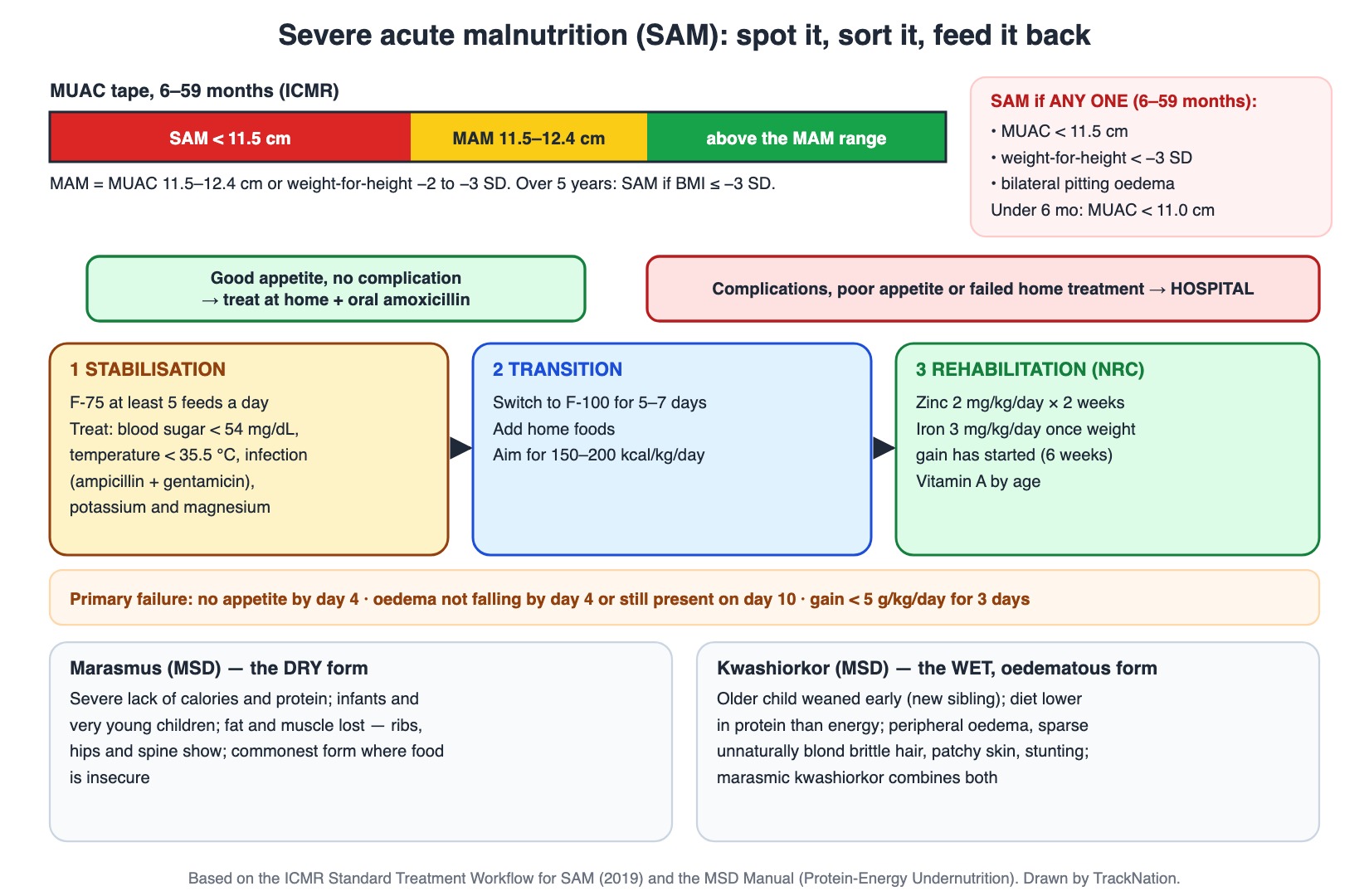
SAM criteria, triage, the three phases of treatment, failure signs and marasmus versus kwashiorkor. Drawn by TrackNation.
Diagnosing SAM and MAM (ICMR)
6–59 months — SAM if any one: MUAC <11.5 cm, weight-for-height <−3 SD, or bilateral pitting oedema. MAM: MUAC 11.5–12.4 cm or weight-for-height −2 to −3 SD.
Under 6 months: consider SAM if MUAC <11.0 cm (look for faulty feeding, no exclusive breastfeeding, bottle feeding). Over 5 years: SAM if BMI ≤ −3 SD (severe thinness); MAM if ≤ −2 SD.
Triage: SAM with good appetite and no complication → home treatment + oral amoxicillin; SAM with complications, poor appetite or failed home treatment → hospital.
India (NFHS-6, provisional): severe wasting in under-5s fell from 7.7% to 5.2%.
Treating SAM in Hospital (ICMR)
Stabilisation: treat hypoglycaemia (blood sugar <54 mg/dL) — 50 mL of 10% dextrose orally if conscious, 5 mL/kg of 10% dextrose IV if unconscious; hypothermia (<35.5 °C) — skin-to-skin care or a warmer; infection empirically with ampicillin plus gentamicin (ceftriaxone if no response in 48 h); oral potassium and magnesium; transfuse if Hb <4 g/dL. Keep a high threshold for invasive procedures.
Feeds: F-75 at least 5 times a day, building to 150–200 kcal/kg/day, then F-100 for 5–7 days with home foods. Under 6 months, return to exclusive breastfeeding wherever possible.
Micronutrients: zinc 2 mg/kg/day and copper for 2 weeks; iron 3 mg/kg/day only once weight gain has started (6 weeks); vitamin A by age (over 12 months 2 lakh IU, 6–12 months 1 lakh IU). Rehabilitation continues at a Nutritional Rehabilitation Centre (NRC).
Primary failure: no appetite by day 4; oedema not falling by day 4 or still there on day 10; weight gain <5 g/kg/day for 3 days → look for congenital, metabolic, immune or organ disease. Discharge when well, oedema resolving and eating ≥75% of target calories.
Marasmus, Kwashiorkor, Refeeding and Obesity (MSD)
Marasmus (dry form): severe lack of calories and protein in infants and very young children; fat and muscle gone — ribs, hips and spine visible; the commonest form where food is insecure.
Kwashiorkor (wet, oedematous form): older child, often weaned early when a sibling arrives; diet poorer in protein than energy; leaky cell membranes → peripheral oedema, stunting, unnaturally blond sparse brittle hair, patchy skin. Marasmic kwashiorkor has features of both.
Refeeding syndrome: fluid overload, electrolyte deficits, hyperglycaemia, arrhythmias and diarrhoea as complications of treatment.
Obesity (child/adolescent): overweight = BMI 85th–<95th percentile, obesity = ≥95th; adolescent obesity tends to persist into adulthood. NFHS-6: 1.3% of Indian under-5s are overweight (3.4% in NFHS-5).
Traps the Examiner Sets
Any one criterion makes SAM — MUAC <11.5 cm, weight-for-height <−3 SD or bilateral oedema.
Iron is not started in stabilisation — only once weight gain begins.
F-75 comes first; F-100 is the catch-up feed.
Kwashiorkor children are older than marasmic ones and have oedema.
A child with SAM, good appetite and no complication can be treated at home.
Memory Hooks & Shortcuts
Shortcuts to lock in this article's numbers and lists. Each one only re-packages facts proven above.
🧠 'Eleven-and-a-half is the Red line' — MUAC < 11.5 cm = SAM — MUAC
🧠 SAM 'MOW': MUAC, Oedema, Weight-for-height — any one — criteria
🧠 'Seventy-five before a hundred' — F-75 stabilises, F-100 rebuilds — feeds
🧠 'Iron waits for weight' — no iron until the child starts gaining — iron
🧠 'Marasmus = Muscle and fat gone (dry); Kwashiorkor = Ka-swelling (wet)' — PEU forms
Rapid-Revision Cards
SAM 6–59 mo
MUAC < 11.5 cm / WHZ < −3 SD / bilateral oedema.
MAM
MUAC 11.5–12.4 / WHZ −2 to −3.
< 6 months
SAM if MUAC < 11.0 cm.
> 5 years
SAM BMI ≤ −3 SD; MAM ≤ −2 SD.
Home treatment
Good appetite, no complication + amoxicillin.
Hospital
Complications, poor appetite, failed home Rx.
Hypoglycaemia
< 54 mg/dL; 10% dextrose.
Hypothermia
< 35.5 °C; skin-to-skin, warmer.
Antibiotics
Ampicillin + gentamicin; ceftriaxone if no response.
Transfuse
Hb < 4 g/dL.
F-75
Stabilisation; ≥ 5 feeds/day.
F-100
5–7 days + home food.
Calorie target
150–200 kcal/kg/day.
Zinc / copper
2 mg/kg/day × 2 wk.
Iron
3 mg/kg/day after weight gain starts.
Vitamin A
> 12 mo 2 lakh; 6–12 mo 1 lakh IU.
Failure
No appetite d4; oedema d4/d10; < 5 g/kg/day.
Marasmus
Dry; infants; fat + muscle loss; commonest.
Kwashiorkor
Wet; older; oedema, blond hair, patchy skin.
Refeeding syndrome
Fluid overload, electrolytes, arrhythmia.
Obesity
BMI ≥ 95th; overweight 85th–< 95th.
Sources
Facts in this article were checked against these documents.
Standard Treatment Workflow: Management of Severe Acute Malnutrition with Complications — ICMR / Department of Health Research, MoHFW, 2019
MSD Manual Professional: Protein-Energy Undernutrition; Obesity in Adolescents — Merck & Co., 2025–2026 (link)
National Family Health Survey (NFHS-6) 2023–24: India Fact Sheet (provisional) — International Institute for Population Sciences / MoHFW, 2026
Test Yourself: Practice Questions
Thirty questions in NEET PG style, many of them ward scenarios.
Practice Questions (NEET PG pattern)
Original questions written in the style of the exam: +4 for a correct answer, −1 for a wrong one. Every answer was checked against the sources listed above. NEET PG papers are not published by NBEMS, so these are not past-paper questions.
Q1. In a child aged 6–59 months, SAM is diagnosed by MUAC below
(a) 11.5 cm
(b) 13.5 cm
(c) 12.5 cm
(d) 10.0 cm
Show answer
Answer: (a) — Or WHZ < −3 SD or bilateral oedema.
Q2. A 2-year-old has MUAC 12.0 cm and no oedema. This is
(a) moderate acute malnutrition
(b) stunting
(c) normal
(d) severe acute malnutrition
Show answer
Answer: (a) — MAM = 11.5–12.4 cm.
Q3. SAM is diagnosed by a weight-for-height z-score below
(a) +2 SD
(b) −2 SD
(c) −3 SD
(d) −1 SD
Show answer
Answer: (c) — MAM −2 to −3.
Q4. A child has bilateral pitting pedal oedema with normal MUAC. Under ICMR criteria the child has
(a) MAM
(b) SAM
(c) no malnutrition
(d) only stunting
Show answer
Answer: (b) — Any one criterion is enough.
Q5. For children over 5 years, SAM (severe thinness) is defined by BMI
(a) ≤ −1 SD
(b) ≤ −3 SD
(c) ≥ +2 SD
(d) ≤ −2 SD
Show answer
Answer: (b) — MAM ≤ −2 SD.
Q6. A child with SAM, good appetite and no complications should be
(a) given IV fluids
(b) admitted to ICU
(c) referred for surgery
(d) treated at home with oral amoxicillin
Show answer
Answer: (d) — ICMR.
Q7. In SAM, hypoglycaemia is defined as blood sugar below
(a) 54 mg/dL
(b) 100 mg/dL
(c) 70 mg/dL
(d) 40 mg/dL
Show answer
Answer: (a) — ICMR.
Q8. An unconscious hypoglycaemic child with SAM should receive
(a) 25% dextrose 10 mL/kg
(b) insulin
(c) 50 mL sugar water orally
(d) 5 mL/kg of 10% dextrose IV
Show answer
Answer: (d) — Conscious: 50 mL 10% dextrose orally.
Q9. Hypothermia in SAM is a temperature below
(a) 36.5 °C
(b) 34 °C
(c) 35.5 °C
(d) 37 °C
Show answer
Answer: (c) — Skin-to-skin or warmer.
Q10. Empirical antibiotics for complicated SAM are
(a) no antibiotics
(b) oral amoxicillin alone
(c) vancomycin
(d) ampicillin plus gentamicin
Show answer
Answer: (d) — Ceftriaxone if no response in 48 h.
Q11. In SAM, blood transfusion is indicated if haemoglobin is below
(a) 8 g/dL
(b) 6.5 g/dL in every case
(c) 4 g/dL
(d) 10 g/dL
Show answer
Answer: (c) — Or 4–6.5 with respiratory distress.
Q12. The starter feed in the stabilisation phase is
(a) whole cow's milk
(b) F-100
(c) RUTF
(d) F-75
Show answer
Answer: (d) — F-100 is the catch-up feed.
Q13. F-75 is given at least
(a) twice a day
(b) 5 times a day
(c) every 6 hours only
(d) once a day
Show answer
Answer: (b) — ICMR.
Q14. The calorie target in SAM rehabilitation is
(a) 150–200 kcal/kg/day
(b) 300 kcal/kg/day
(c) 100 kcal/kg/day
(d) 50–80 kcal/kg/day
Show answer
Answer: (a) — ICMR.
Q15. After F-75, the child is switched to F-100 for
(a) 48 hours only
(b) 6 months
(c) 1 day
(d) 5–7 days with home foods
Show answer
Answer: (d) — ICMR.
Q16. Iron is started in SAM
(a) on day 1
(b) before antibiotics
(c) only once weight gain has started
(d) never
Show answer
Answer: (c) — 3 mg/kg/day for 6 weeks.
Q17. Zinc in SAM is given at
(a) 2 mg/kg/day for 2 weeks
(b) 20 mg/kg/day
(c) once only
(d) 10 mg/kg/day for 6 months
Show answer
Answer: (a) — With copper.
Q18. The vitamin A dose for a child over 12 months with SAM is
(a) 50,000 IU
(b) 2 lakh IU
(c) 10,000 IU
(d) 1 lakh IU
Show answer
Answer: (b) — 6–12 months: 1 lakh IU.
Q19. Primary treatment failure includes failure to regain appetite by
(a) day 1
(b) day 30
(c) day 4
(d) day 14
Show answer
Answer: (c) — ICMR.
Q20. Oedema still present on day ___ indicates primary failure
(a) 2
(b) 30
(c) 4
(d) 10
Show answer
Answer: (d) — Not falling by day 4 also counts.
Q21. Failure to gain at least ___ g/kg/day for 3 days on catch-up diet is a failure sign
(a) 5
(b) 50
(c) 1
(d) 20
Show answer
Answer: (a) — ICMR.
Q22. A child can be discharged from hospital to outpatient care when taking at least
(a) 100% of adult needs
(b) 50 kcal/kg/day
(c) 25% of target
(d) 75% of the target calories
Show answer
Answer: (d) — Plus clinically well, oedema resolving.
Q23. The dry form of protein-energy undernutrition is
(a) marasmic kwashiorkor
(b) starvation oedema
(c) marasmus
(d) kwashiorkor
Show answer
Answer: (c) — Infants; fat and muscle loss.
Q24. The commonest form of PEU in children where food is insecure is
(a) rickets
(b) marasmus
(c) kwashiorkor
(d) obesity
Show answer
Answer: (b) — MSD.
Q25. A 2-year-old weaned early after a sibling's birth has oedema, sparse unnaturally blond hair and patchy skin. The diagnosis is
(a) marasmus
(b) kwashiorkor
(c) nephrotic syndrome
(d) hypothyroidism
Show answer
Answer: (b) — Wet, oedematous form.
Q26. Oedema in kwashiorkor results from
(a) kidney failure
(b) leaky cell membranes with loss of fluid and protein
(c) heart failure
(d) excess salt
Show answer
Answer: (b) — MSD.
Q27. Compared with marasmus, children with kwashiorkor tend to be
(a) the same age
(b) younger
(c) older
(d) only infants
Show answer
Answer: (c) — MSD.
Q28. Complications of refeeding a severely malnourished child include
(a) fluid overload, electrolyte deficits, hyperglycaemia and arrhythmias
(b) jaundice only
(c) none
(d) hypercalcaemia only
Show answer
Answer: (a) — Refeeding syndrome.
Q29. In children and adolescents, obesity is a BMI at or above the
(a) 99th percentile
(b) 95th percentile
(c) 85th percentile
(d) 75th percentile
Show answer
Answer: (b) — Overweight 85th–<95th.
Q30. In NFHS-6 (provisional), severe wasting in Indian under-5s was
(a) 7.7%
(b) 19.0%
(c) 5.2%
(d) 1.3%
Show answer
Answer: (c) — 7.7% in NFHS-5.
Active Recall
From memory: give the SAM and MAM criteria by age, who is treated at home, how hypoglycaemia, hypothermia and infection are managed, the F-75 and F-100 phases and micronutrients, failure criteria, marasmus versus kwashiorkor, refeeding syndrome and obesity cut-offs.