Vitamins for NEET PG Paediatrics: Vitamin A and Xerophthalmia, Rickets, Vitamin K and Newborn Bleeding, Beriberi, Pellagra, Scurvy and B12
Start Here
🎯 Exam priority: Very high. Expect: the earliest sign of vitamin A deficiency, vitamin A doses (treatment and UIP prophylaxis), the signs of rickets by age, vitamin D for breastfed babies, timing and prevention of haemorrhagic disease of the newborn, infantile beriberi, the 3 Ds of pellagra, scurvy in children, B6-dependent seizures, and why folate must not replace B12.
CBME mapping: PE12. Fact-checked against the MSD Manual and the MoHFW immunisation schedule (2026).
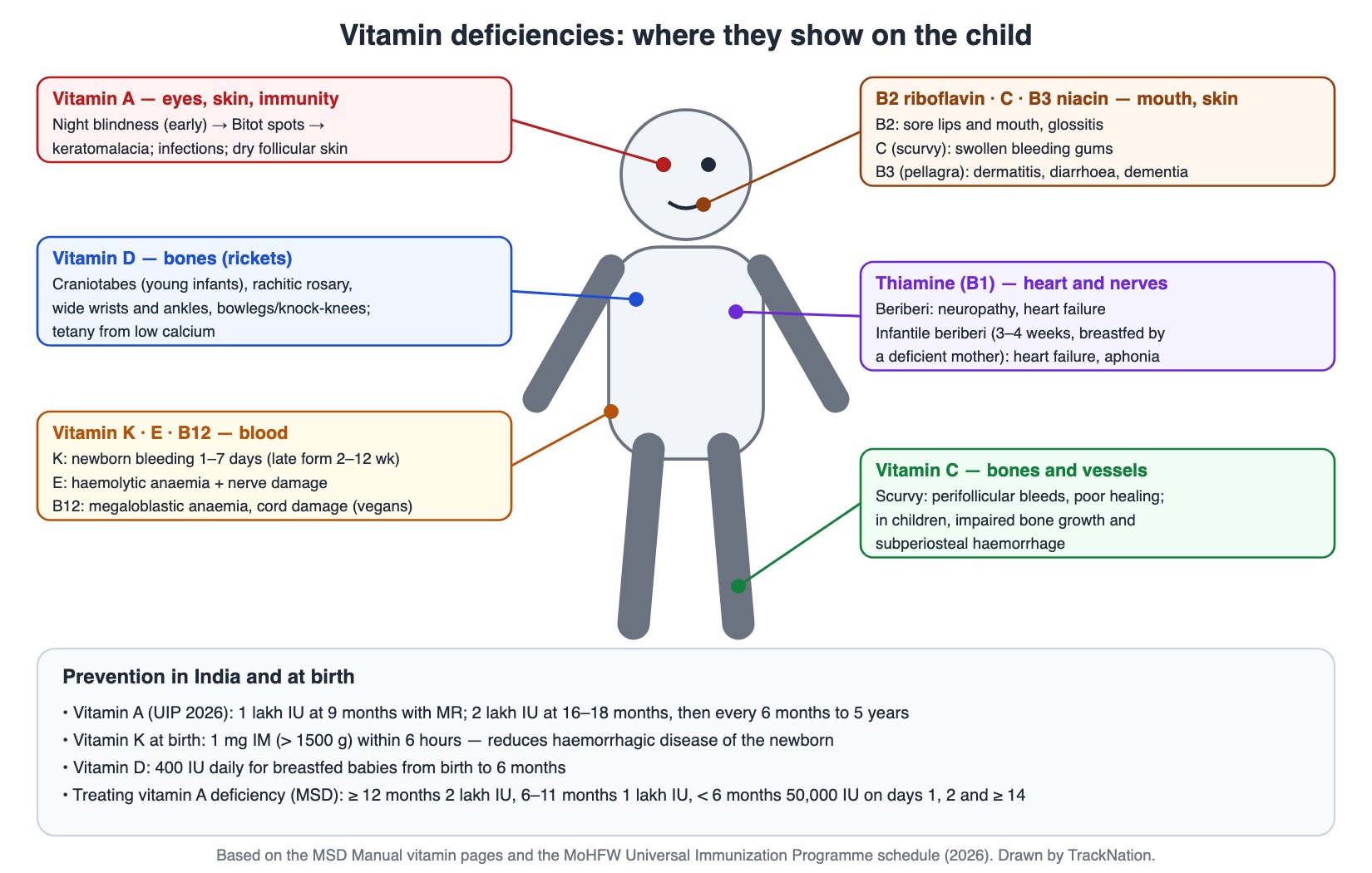
Where each vitamin deficiency shows on the child, and India's vitamin A, K and D prevention. Drawn by TrackNation.
Fat-Soluble: A, D, E, K (MSD, UIP)
Vitamin A makes rhodopsin. Night blindness is the earliest sign, then dry conjunctiva with Bitot spots, then corneal destruction (keratomalacia); immunity falls. Treatment: ≥12 months 2 lakh IU, 6–11 months 1 lakh IU, <6 months 50,000 IU — on days 1 and 2 and again after ≥2 weeks. UIP prophylaxis: 1 lakh IU at 9 months (with MR), 2 lakh IU at 16–18 months, then every 6 months to 5 years (9 doses).
Vitamin D: rickets in children. Young infants — craniotabes; older infants — delayed sitting, late fontanelle closure, skull bossing, rachitic rosary; 1–4 years — wide wrists and ankles, delayed walking; later — bowlegs or knock-knees; tetany from low calcium. Diagnose with serum 25(OH)D; give all breastfed babies 400 IU daily from birth to 6 months. Toxicity causes hypercalcaemia.
Vitamin E: fragile red cells (haemolytic anaemia) and degeneration of peripheral axons and posterior columns.
Vitamin K: common in breastfed babies. Haemorrhagic disease of the newborn at 1–7 days; late form at 2–12 weeks in breastfed babies without prophylaxis. Give 1 mg IM (>1500 g; 0.3–0.5 mg/kg if ≤1500 g) within 6 hours of birth.
Water-Soluble: B Complex and C (MSD)
Thiamine (B1): beriberi in those living on white rice/refined carbohydrate — neuropathy, heart failure, Wernicke–Korsakoff. Infantile beriberi: by 3–4 weeks in babies breastfed by thiamine-deficient mothers — sudden heart failure, aphonia, absent reflexes.
Riboflavin (B2): sore lips and mouth, glossitis, conjunctivitis, seborrhoeic dermatitis. Niacin (B3): pellagra — dermatitis, diarrhoea, dementia; tryptophan can make niacin. B6: neuropathy and, in infants, seizures that may not respond to antiseizure drugs.
B12: megaloblastic anaemia plus spinal cord and brain white-matter damage; at risk — vegans without supplements. Never give folate instead of B12 — the anaemia improves but the nerve damage progresses. Folate: megaloblastic anaemia; maternal deficiency raises neural tube defect risk.
Vitamin C (collagen; helps iron absorption): scurvy — perifollicular bleeds, coiled hair, swollen bleeding gums, poor healing; in children impaired bone growth and subperiosteal haemorrhages that later calcify.
Vitamin A toxicity (often accidental ingestion by children): headache and raised intracranial pressure; birth defects in a fetus.
Traps the Examiner Sets
Night blindness, not Bitot spots, is the earliest sign of vitamin A deficiency.
Craniotabes is the early rickets sign in young infants; bowlegs come later.
Classic haemorrhagic disease of the newborn appears at 1–7 days; the late form at 2–12 weeks.
Folate alone in B12 deficiency lets neurological damage progress.
The first UIP vitamin A dose (1 lakh IU) goes with MR at 9 months.
Memory Hooks & Shortcuts
Shortcuts to lock in this article's numbers and lists. Each one only re-packages facts proven above.
🧠 Vitamin A eye ladder 'Night, Bitot, Melt' — night blindness, Bitot spots, keratomalacia — vitamin A
🧠 UIP vitamin A '1 lakh at 9, 2 lakh every 6 to 5' — UIP
🧠 Rickets by age 'Skull, Ribs, Wrists, Legs' — craniotabes, rosary, wide wrists, bowlegs — rickets
🧠 'K at birth, Klots for life' — 1 mg IM within 6 hours — vitamin K
🧠 Pellagra's 3 Ds 'Dermatitis, Diarrhoea, Dementia' — niacin
Rapid-Revision Cards
Vit A earliest sign
Night blindness.
Vit A eye ladder
Night blindness → Bitot spots → keratomalacia.
Vit A treatment
≥12 mo 2 lakh; 6–11 mo 1 lakh; <6 mo 50k IU; d1, d2, ≥2 wk.
UIP vit A
1 lakh at 9 mo (MR); 2 lakh 16–18 mo, then 6-monthly to 5 yr.
Rickets infant
Craniotabes; bossing; late fontanelle.
Rickets 1–4 yr
Rosary; wide wrists/ankles; late walking.
Rickets older
Bowlegs / knock-knees; tetany.
Vit D test
Serum 25(OH)D.
Vit D for breastfed
400 IU/day, birth–6 months.
Vit D toxicity
Hypercalcaemia.
Vit E
Haemolytic anaemia; posterior column/axon damage.
HDN classic
Days 1–7.
HDN late
2–12 wk; breastfed, no prophylaxis.
Vit K at birth
1 mg IM within 6 h (>1500 g).
Infantile beriberi
3–4 wk; heart failure, aphonia; deficient mother.
Pellagra
Dermatitis, diarrhoea, dementia; tryptophan → niacin.
Riboflavin
Lips, mouth, glossitis, seb. dermatitis.
B6
Seizures not responding to antiseizure drugs.
B12 vs folate
Never folate alone — nerves worsen.
Scurvy
Gums, perifollicular bleeds; poor bone growth in children.
Vit A toxicity
Raised ICP; teratogenic.
Sources
Facts in this article were checked against these documents.
MSD Manual Professional: Vitamin A, D, E, K Deficiency; Thiamine, Riboflavin, Niacin, Vitamin B6, B12, Folate and Vitamin C Deficiency; Vitamin A and D Toxicity — Merck & Co., 2025–2026 (link)
Universal Immunization Programme: National Immunization Schedule — Ministry of Health & Family Welfare, 2026
Test Yourself: Practice Questions
Thirty questions in NEET PG style, many of them clinic scenarios.
Practice Questions (NEET PG pattern)
Original questions written in the style of the exam: +4 for a correct answer, −1 for a wrong one. Every answer was checked against the sources listed above. NEET PG papers are not published by NBEMS, so these are not past-paper questions.
Q1. The earliest symptom of vitamin A deficiency is
(a) night blindness (impaired dark adaptation)
(b) corneal ulcer
(c) Bitot spots
(d) keratomalacia
Show answer
Answer: (a) — Then Bitot spots, keratomalacia.
Q2. Keratinised patches on the dry conjunctiva in vitamin A deficiency are
(a) Bitot spots
(b) Brushfield spots
(c) Roth spots
(d) Koplik spots
Show answer
Answer: (a) — MSD.
Q3. Destruction of the cornea in severe vitamin A deficiency is called
(a) keratoconus
(b) pterygium
(c) keratomalacia
(d) band keratopathy
Show answer
Answer: (c) — MSD.
Q4. The treatment dose of vitamin A for a 2-year-old with xerophthalmia is
(a) 25,000 IU
(b) 50,000 IU
(c) 100,000 IU
(d) 200,000 IU
Show answer
Answer: (d) — 6–11 m: 100,000; < 6 m: 50,000.
Q5. Treatment doses of vitamin A are given
(a) on 2 consecutive days and again at least 2 weeks later
(b) daily for a month
(c) once only
(d) weekly for 6 weeks
Show answer
Answer: (a) — MSD.
Q6. Under the UIP, the first prophylactic dose of vitamin A is
(a) 50,000 IU at 6 weeks
(b) 2 lakh IU at birth
(c) 1 lakh IU at 9 months with MR
(d) 2 lakh IU at 5 years
Show answer
Answer: (c) — UIP 2026.
Q7. Under the UIP, vitamin A doses after the first are given
(a) monthly
(b) 2 lakh IU every 6 months up to 5 years
(c) only once more at 16 months
(d) 1 lakh IU yearly
Show answer
Answer: (b) — 2nd to 9th dose.
Q8. Softening of the skull bones in a young infant with rickets is
(a) frontal bossing
(b) craniotabes
(c) rachitic rosary
(d) Harrison sulcus
Show answer
Answer: (b) — MSD.
Q9. Bead-like costochondral swellings in rickets are called
(a) pectus carinatum
(b) scorbutic rosary
(c) Bitot beads
(d) rachitic rosary
Show answer
Answer: (d) — MSD.
Q10. Rickets in children aged 1–4 years causes enlargement of
(a) the liver
(b) the skull only
(c) the thyroid
(d) the lower ends of the radius, ulna, tibia and fibula
Show answer
Answer: (d) — Widened wrists, ankles.
Q11. Vitamin D status is best assessed by serum
(a) 25(OH)D
(b) phosphate alone
(c) calcitonin
(d) 1,25(OH)2D
Show answer
Answer: (a) — MSD.
Q12. All breastfed infants should receive vitamin D
(a) 60,000 IU monthly
(b) only if dark-skinned
(c) after 1 year
(d) 400 IU daily from birth to 6 months
Show answer
Answer: (d) — MSD.
Q13. Tetany in vitamin D deficiency is caused by
(a) hypokalaemia
(b) hypocalcaemia
(c) hypoglycaemia
(d) hypernatraemia
Show answer
Answer: (b) — MSD.
Q14. Vitamin D toxicity causes
(a) hypocalcaemia
(b) hypercalcaemia
(c) rickets
(d) night blindness
Show answer
Answer: (b) — Bone resorption, gut absorption up.
Q15. Vitamin E deficiency causes
(a) bleeding
(b) night blindness
(c) haemolytic anaemia and neurological deficits
(d) scurvy
Show answer
Answer: (c) — Fragile red cells, posterior columns.
Q16. Classic haemorrhagic disease of the newborn usually occurs at
(a) 1–7 days
(b) 6 months
(c) 2 years
(d) the first hour
Show answer
Answer: (a) — Late form 2–12 weeks.
Q17. Late haemorrhagic disease of the newborn typically affects
(a) formula-fed babies at birth
(b) breastfed babies aged 2–12 weeks without vitamin K prophylaxis
(c) adolescents
(d) preterm babies only
Show answer
Answer: (b) — MSD.
Q18. Vitamin K prophylaxis for a 3-kg newborn is
(a) 1 mg IM within 6 hours of birth
(b) not needed if breastfed
(c) 10 mg oral weekly
(d) 0.1 mg IV at 1 month
Show answer
Answer: (a) — 0.3–0.5 mg/kg if ≤ 1500 g.
Q19. A 3-week-old breastfed by a mother with a diet of polished white rice develops sudden heart failure, aphonia and absent reflexes. The likely deficiency is
(a) vitamin C
(b) thiamine (infantile beriberi)
(c) vitamin K
(d) iron
Show answer
Answer: (b) — MSD.
Q20. The 3 Ds of pellagra are
(a) dermatitis, deafness, diabetes
(b) dryness, deafness, dementia
(c) dermatitis, diarrhoea and dementia
(d) diarrhoea, dehydration, death
Show answer
Answer: (c) — Niacin.
Q21. Niacin can be made in the body from
(a) glycine
(b) tryptophan
(c) phenylalanine
(d) tyrosine
Show answer
Answer: (b) — MSD.
Q22. Sore lips and mouth, glossitis and seborrhoeic dermatitis suggest deficiency of
(a) vitamin D
(b) vitamin K
(c) vitamin A
(d) riboflavin
Show answer
Answer: (d) — B2.
Q23. Infant seizures that do not respond to antiseizure drugs may be due to
(a) vitamin E deficiency
(b) vitamin B6 deficiency or dependency
(c) vitamin C deficiency
(d) vitamin A deficiency
Show answer
Answer: (b) — MSD.
Q24. B12 deficiency in a child of vegan parents causes
(a) rickets
(b) microcytic anaemia only
(c) megaloblastic anaemia and spinal cord white-matter damage
(d) scurvy
Show answer
Answer: (c) — MSD.
Q25. Why should folate not be given instead of B12 in B12 deficiency?
(a) Anaemia improves but neurological damage progresses
(b) Folate is toxic
(c) It causes bleeding
(d) It worsens anaemia
Show answer
Answer: (a) — MSD.
Q26. Maternal folate deficiency increases the risk of
(a) cleft lip only
(b) neural tube defects
(c) cataract
(d) deafness
Show answer
Answer: (b) — MSD.
Q27. Swollen, purple, spongy bleeding gums with perifollicular haemorrhages suggest
(a) scurvy
(b) pellagra
(c) rickets
(d) beriberi
Show answer
Answer: (a) — Vitamin C.
Q28. In children, vitamin C deficiency additionally causes
(a) tetany
(b) craniotabes
(c) night blindness
(d) impaired bone growth
Show answer
Answer: (d) — Subperiosteal haemorrhages.
Q29. Vitamin C helps absorption of
(a) iron
(b) vitamin B12
(c) calcium only
(d) fat
Show answer
Answer: (a) — MSD.
Q30. Acute vitamin A toxicity in a child who swallowed supplements causes
(a) megaloblastic anaemia
(b) bleeding
(c) hypocalcaemia
(d) headache and raised intracranial pressure
Show answer
Answer: (d) — MSD.
Active Recall
From memory: describe vitamin A deficiency signs, treatment and UIP doses, rickets by age and vitamin D supplementation, haemorrhagic disease of the newborn and vitamin K prophylaxis, beriberi, pellagra, riboflavin, B6, B12 and folate deficiency, scurvy, and toxicity.