Neonatal Jaundice, Hypoglycaemia and Seizures for NEET PG Paediatrics: Kramer Zones, Phototherapy, Glucose Rules and the ICMR Seizure Ladder
Start Here
🎯 Exam priority: Very high. Expect: physiological vs pathological jaundice by timing, breastfeeding vs breast-milk jaundice, Kramer zones, what makes jaundice "serious", phototherapy wavelength and don'ts, exchange volume, the hypoglycaemia cut-off and bolus, GIR, and the order of drugs in neonatal seizures.
CBME mapping: PE19. Fact-checked against ICMR Standard Treatment Workflows (Neonatal Jaundice, Neonatal Hypoglycemia, Neonatal Seizures, 2020) and the MSD Manual.
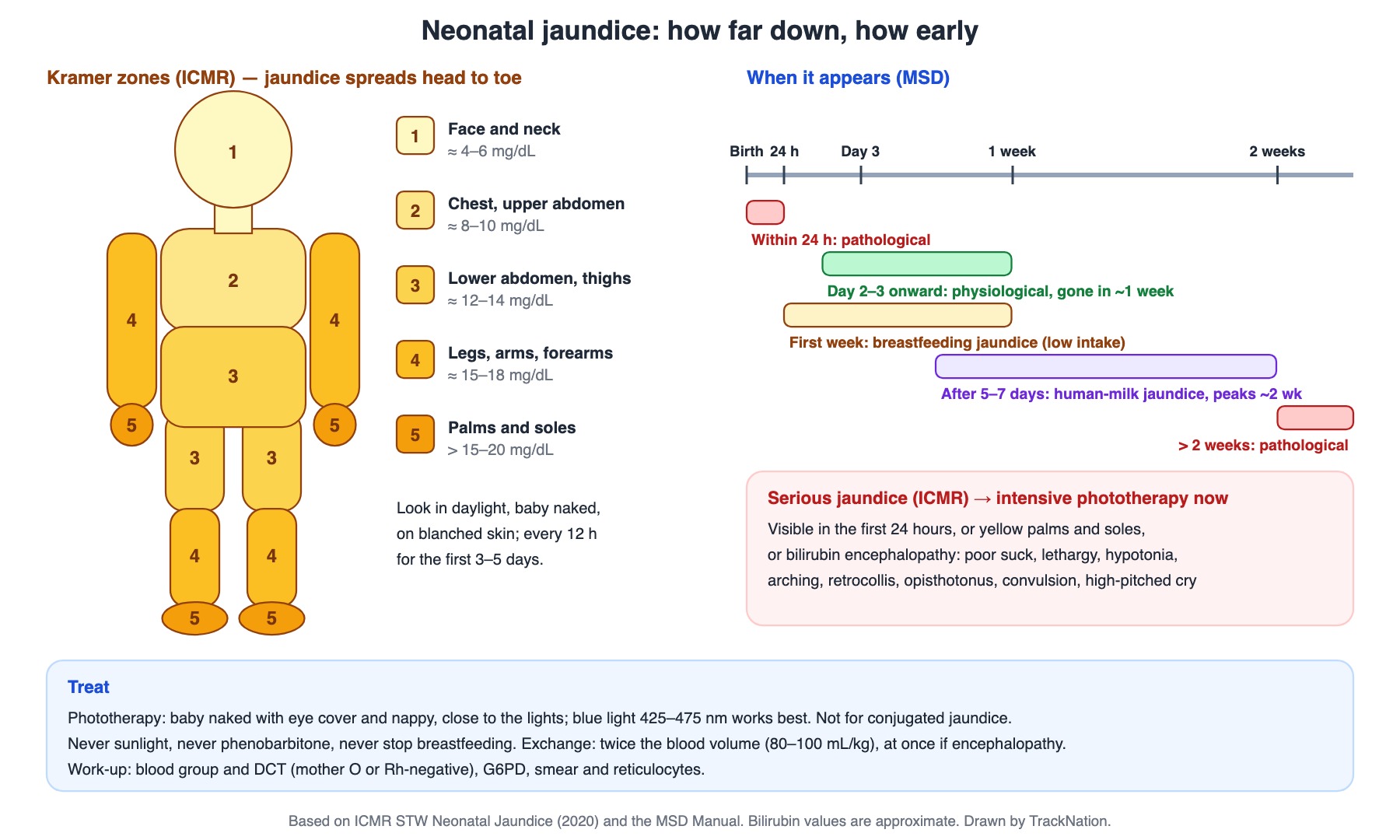
Kramer zones, when each type of jaundice appears, serious jaundice and treatment rules. Drawn by TrackNation.
Why Newborns Turn Yellow (MSD)
Almost all early neonatal jaundice is unconjugated. Physiological causes: shorter red-cell life span (more bilirubin), low UGT activity (less conjugation) and more enterohepatic circulation. It appears after 2–3 days and resolves within about a week.
Pathological until proved otherwise: jaundice in the first 24–48 hours or lasting > 2 weeks.
Breastfeeding jaundice: in about one in six breastfed babies, in the first week, from low milk intake — prevented by more frequent feeds. Human-milk (breast-milk) jaundice: starts after 5–7 days, peaks about 2 weeks, linked to beta-glucuronidase in milk.
Only unconjugated bilirubin causes chronic bilirubin encephalopathy (formerly kernicterus). Conjugated jaundice points to cholestasis — phototherapy does not help it.
Jaundice: Assess and Treat (ICMR)
Risk factors: gestation < 38 weeks, a sibling who needed treatment, ABO/Rh incompatibility, G6PD-prevalent area, exclusive breastfeeding with weight loss > 3%/day or > 10% total, high-risk-zone bilirubin.
Kramer zones (daylight, naked baby, blanched skin, every 12 h for 3–5 days): face/neck ≈ 4–6; chest ≈ 8–10; lower abdomen/thighs ≈ 12–14; limbs ≈ 15–18; palms/soles > 15–20 mg/dL.
Serious jaundice → start intensive phototherapy at once: visible in the first 24 h, yellow palms and soles, or signs of acute bilirubin encephalopathy (poor feeding, lethargy, hypotonia, arching, retrocollis, opisthotonus, convulsion, high-pitched cry). Measure TSB if jaundice in the first 24 h or > 12–14 mg/dL visually after 24 h.
Phototherapy: naked with eye cover and nappy, close to the lights, feeds allowed; blue light 425–475 nm works best (MSD). Repeat TSB 6–8-hourly in haemolysis, 12–24-hourly otherwise; stop when TSB falls below 13–14 mg/dL or 2 below the cut-off.
Exchange transfusion: at once for encephalopathy or TSB above the cut-off; volume = twice the blood volume (80–100 mL/kg). Work-up: blood group and DCT, G6PD, smear and reticulocytes.
Never: sunlight, phenobarbitone, stopping breastfeeding, or trusting visual/TcB readings under phototherapy. Avoid naphthalene balls. Discharged before 72 h → review at 48–72 h.
Neonatal Hypoglycaemia (ICMR)
Screen: preterm, LBW, SGA, LGA, infant of diabetic mother, sick babies, after exchange, on IV fluids — at 2, 6, 12, 24, 48 and 72 hours. Do not screen healthy term AGA babies.
Cut-off: blood glucose < 45 mg/dL. Signs: lethargy, limpness, jitteriness, convulsions, apnoea or cyanosis, weak high-pitched cry, poor feeding.
Asymptomatic: supervised feed (breast or measured EBM), recheck in 1 hour; IV glucose if still < 45 or symptoms appear. Symptomatic or < 20 mg/dL: 2 mL/kg of 10% dextrose IV, then infusion at GIR 6 mg/kg/min, rising by 2 up to 12.
Refractory: GIR > 12 for 24 h or need > 7 days → hydrocortisone 5 mg/kg/day (others: diazoxide, glucagon, octreotide) and refer. Never feed dextrose instead of milk; avoid > 12.5–15% dextrose in a peripheral vein.
Causes (MSD): low glycogen stores, delayed feeding, hyperinsulinism (diabetic mother, Beckwith–Wiedemann). Both symptomatic and asymptomatic hypoglycaemia can cause permanent brain damage.
Neonatal Seizures (ICMR)
At risk: asphyxia, sepsis, meningitis, preterm, SGA, metabolic disturbance, major bleeding.
Often subtle: pedalling, rowing or cycling limbs; lip pouting, mouthing, repeated sucking; vacant stare, eye deviation, nystagmoid movements; unexplained apnoea or swings in heart rate.
Investigate all: glucose, electrolytes, ionised calcium, blood count, renal and liver tests, blood gas, cranial ultrasound; CSF if sepsis is suspected; EEG.
Ladder: TABC + IV line → glucose < 45? 2 mL/kg 10% dextrose → 2 mL/kg 10% calcium gluconate (diluted, over 10 min, on a monitor) → phenobarbitone 20 mg/kg (+10 mg/kg once) → phenytoin/fosphenytoin 20 mg/kg PE → lorazepam 0.05 mg/kg → midazolam infusion or levetiracetam 40 mg/kg.
Duration: no maintenance after a single brief seizure needing one phenobarbitone load; after 72 h seizure-free stop the others one by one; stop phenobarbitone at 1 week or discharge if examination and EEG are normal. Follow up development and hearing.
Traps the Examiner Sets
Jaundice in the first 24 hours is never physiological.
Breastfeeding jaundice = early, low intake, feed more; breast-milk jaundice = late (after day 5–7), peaks 2 weeks.
Phototherapy uses blue light (425–475 nm); sunlight and phenobarbitone are not treatments.
Hypoglycaemia threshold in the ICMR workflow is 45 mg/dL; bolus is 2 mL/kg of 10% (not 25%) dextrose.
In a seizing newborn, correct glucose and calcium before phenobarbitone; phenobarbitone is the first antiseizure drug.
Memory Hooks & Shortcuts
Shortcuts to lock in this article's numbers and lists. Each one only re-packages facts proven above.
🧠 'Day 1 yellow = danger' — jaundice in the first 24 hours is never physiological — jaundice timing
🧠 BReastFeeding = Bad intake, first week; breast-MILK = Much later, 2 weeks — two breast jaundices
🧠 Kramer '4-8-12-15-20' as yellow walks head to toe — Kramer zones
🧠 Glucose: '45 is the line, 2 of 10 is the bolus, 6 is the drip' — hypoglycaemia
🧠 Seizure ladder 'Sugar, Salt (calcium), then the Barb' — then phenytoin, then lorazepam — seizures
Rapid-Revision Cards
Early jaundice
Unconjugated.
Physiological causes
Short RBC life, low UGT, enterohepatic.
Pathological timing
< 24–48 h or > 2 weeks.
Breastfeeding jaundice
Week 1, low intake; feed more.
Breast-milk jaundice
After day 5–7; peaks 2 wk; beta-glucuronidase.
Kramer 1→5
Face 4–6, chest 8–10, thighs 12–14, limbs 15–18, palms > 15–20.
Serious jaundice
< 24 h, palms/soles, ABE signs.
Phototherapy light
Blue 425–475 nm.
Stop phototherapy
< 13–14 or 2 below cut-off.
Exchange
2 × blood volume (80–100 mL/kg).
Don'ts
Sunlight, phenobarbitone, stop breastfeeding.
Glucose screening
At-risk only: 2, 6, 12, 24, 48, 72 h.
Hypoglycaemia
< 45 mg/dL.
Asymptomatic
Feed, recheck 1 h.
Symptomatic / < 20
2 mL/kg D10 then GIR 6.
GIR
Up by 2 to max 12 mg/kg/min.
Refractory
> 12 for 24 h or > 7 d → hydrocortisone.
Subtle seizures
Pedalling, mouthing, eye deviation, apnoea.
Seizure ladder
Glucose → Ca gluconate → phenobarbitone → phenytoin → lorazepam.
Phenobarbitone load
20 mg/kg (+10).
Stop drugs
Others after 72 h seizure-free; phenobarbitone at 1 wk/discharge.
Sources
Facts in this article were checked against these documents.
Standard Treatment Workflows: Neonatal Jaundice in Infants ≥ 35 Weeks; Neonatal Hypoglycemia; Neonatal Seizures — ICMR / Department of Health Research, MoHFW, 2020
MSD Manual Professional: Neonatal Hyperbilirubinemia; Neonatal Hypoglycemia — Merck & Co., 2025–2026 (link)
Test Yourself: Practice Questions
Thirty questions in NEET PG style, many of them nursery scenarios.
Practice Questions (NEET PG pattern)
Original questions written in the style of the exam: +4 for a correct answer, −1 for a wrong one. Every answer was checked against the sources listed above. NEET PG papers are not published by NBEMS, so these are not past-paper questions.
Q1. Most jaundice in the first days of life is
(a) mixed
(b) unconjugated
(c) obstructive
(d) conjugated
Show answer
Answer: (b) — MSD.
Q2. Which does NOT contribute to physiological jaundice?
(a) increased UGT activity
(b) shorter red-cell life span
(c) increased enterohepatic circulation
(d) low UGT activity
Show answer
Answer: (a) — UGT is deficient.
Q3. Jaundice noticed at 18 hours of life is
(a) physiological
(b) pathological
(c) breast-milk jaundice
(d) normal
Show answer
Answer: (b) — First 24–48 h → pathological.
Q4. Physiological jaundice usually resolves within
(a) 6 weeks
(b) 24 hours
(c) 3 months
(d) about 1 week
Show answer
Answer: (d) — MSD.
Q5. Breastfeeding jaundice is due to
(a) biliary atresia
(b) haemolysis
(c) beta-glucuronidase in milk after day 7
(d) low milk intake in the first week
Show answer
Answer: (d) — Feed more often.
Q6. Breast-milk (human-milk) jaundice typically peaks at about
(a) day 4
(b) 3 months
(c) 2 weeks
(d) day 2
Show answer
Answer: (c) — Starts after 5–7 days.
Q7. Breast-milk jaundice is linked to which enzyme in milk?
(a) UGT
(b) lipase
(c) lactase
(d) beta-glucuronidase
Show answer
Answer: (d) — Deconjugates bilirubin.
Q8. The most effective light for intensive phototherapy is
(a) white sunlight
(b) red, 650 nm
(c) blue, 425–475 nm
(d) ultraviolet B
Show answer
Answer: (c) — MSD.
Q9. Phototherapy is NOT useful for
(a) ABO incompatibility
(b) breast-milk jaundice
(c) physiological jaundice
(d) conjugated hyperbilirubinaemia
Show answer
Answer: (d) — MSD.
Q10. Jaundice reaching the lower abdomen and thighs (Kramer zone 3) suggests bilirubin of about
(a) 12–14 mg/dL
(b) > 20 mg/dL
(c) 8–10 mg/dL
(d) 4–6 mg/dL
Show answer
Answer: (a) — ICMR.
Q11. Yellow palms and soles correspond to Kramer zone
(a) 5
(b) 1
(c) 3
(d) 4
Show answer
Answer: (a) — > 15–20 mg/dL; serious.
Q12. Which makes jaundice 'serious' in the ICMR workflow?
(a) visible jaundice in the first 24 hours
(b) jaundice at day 5 to the chest
(c) jaundice on day 4 limited to the face
(d) jaundice in a feeding baby on day 3
Show answer
Answer: (a) — Also palms/soles or ABE signs.
Q13. Which is a risk factor for significant jaundice listed by ICMR?
(a) birth weight 3.5 kg
(b) gestation < 38 weeks
(c) female sex
(d) caesarean birth
Show answer
Answer: (b) — Also sibling, ABO/Rh, G6PD.
Q14. In haemolytic jaundice under phototherapy, TSB is repeated every
(a) 6–8 hours
(b) 24 hours
(c) 2 hours
(d) 48 hours
Show answer
Answer: (a) — 12–24 h if non-haemolytic.
Q15. Phototherapy can be stopped when TSB falls below
(a) 13–14 mg/dL or 2 mg/dL below the cut-off
(b) 20 mg/dL
(c) the first value
(d) 5 mg/dL
Show answer
Answer: (a) — ICMR.
Q16. The volume of a double-volume exchange transfusion is about
(a) 500 mL
(b) the blood volume once
(c) twice the blood volume (80–100 mL/kg each)
(d) 10 mL/kg
Show answer
Answer: (c) — ICMR.
Q17. Which is recommended in neonatal jaundice?
(a) phenobarbitone
(b) continue breastfeeding
(c) sunlight exposure
(d) stop breastfeeding
Show answer
Answer: (b) — ICMR don'ts.
Q18. Under phototherapy, bilirubin should be judged by
(a) skin colour
(b) transcutaneous meter
(c) serum bilirubin, not visual or TcB
(d) urine colour
Show answer
Answer: (c) — ICMR.
Q19. Which newborn does NOT need routine glucose monitoring?
(a) preterm baby
(b) infant of a diabetic mother
(c) healthy term AGA baby
(d) SGA baby
Show answer
Answer: (c) — ICMR.
Q20. In the ICMR workflow, neonatal hypoglycaemia is blood glucose below
(a) 60 mg/dL
(b) 30 mg/dL
(c) 45 mg/dL
(d) 70 mg/dL
Show answer
Answer: (c) — Confirm in lab, don't delay.
Q21. An asymptomatic at-risk baby has glucose 38 mg/dL. First step is
(a) IV bolus of 25% dextrose
(b) hydrocortisone
(c) supervised feed and recheck in 1 hour
(d) glucagon
Show answer
Answer: (c) — ICMR.
Q22. A jittery newborn has glucose 25 mg/dL. The bolus is
(a) 10 mL/kg normal saline
(b) oral glucose water
(c) 2 mL/kg of 10% dextrose IV
(d) 5 mL/kg of 25% dextrose
Show answer
Answer: (c) — Then GIR 6.
Q23. After the bolus, dextrose infusion starts at a GIR of
(a) 20 mg/kg/min
(b) 2 mg/kg/min
(c) 12 mg/kg/min
(d) 6 mg/kg/min
Show answer
Answer: (d) — Increase by 2 up to 12.
Q24. Refractory hypoglycaemia is a GIR requirement above 12 mg/kg/min for 24 h or need beyond
(a) 3 days
(b) 7 days
(c) 24 hours
(d) 1 month
Show answer
Answer: (b) — Consider drugs, refer.
Q25. A common cause of transient neonatal hypoglycaemia due to hyperinsulinism is
(a) maternal hypothyroidism
(b) physiological jaundice
(c) breastfeeding
(d) maternal diabetes
Show answer
Answer: (d) — MSD.
Q26. Which is a subtle neonatal seizure?
(a) sneezing
(b) repeated lip smacking or sucking
(c) startle to sound
(d) hiccups
Show answer
Answer: (b) — Also pedalling, eye deviation, apnoea.
Q27. In a seizing newborn with normal glucose, the next step per ICMR is
(a) lorazepam
(b) phenytoin
(c) 10% calcium gluconate 2 mL/kg IV under monitoring
(d) observe
Show answer
Answer: (c) — Then phenobarbitone.
Q28. The first antiseizure drug in the ICMR neonatal workflow is
(a) diazepam 0.5 mg/kg
(b) phenobarbitone 20 mg/kg
(c) phenytoin 20 mg/kg
(d) levetiracetam
Show answer
Answer: (b) — Extra 10 mg/kg once if needed.
Q29. If seizures persist after phenobarbitone, ICMR's next drug is
(a) midazolam infusion
(b) carbamazepine
(c) phenytoin or fosphenytoin 20 mg/kg PE
(d) valproate
Show answer
Answer: (c) — Then lorazepam.
Q30. Phenobarbitone can be stopped
(a) never
(b) only after 1 year
(c) at 1 week or discharge if examination and EEG are normal
(d) after the first dose always
Show answer
Answer: (c) — ICMR.
Active Recall
From memory: explain physiological and pathological jaundice, the two breast jaundices, Kramer zones, serious jaundice and phototherapy and exchange rules; who to screen for hypoglycaemia, the cut-off and treatment steps; and the forms and ICMR drug ladder of neonatal seizures.