Immunisation (UIP) for NEET PG Paediatrics: National Schedule 2024, Maximum Ages, Routes, Cold Chain, Open Vial Policy, AEFI and HPV
Start Here
🎯 Exam priority: Very high (Paediatrics and PSM). Expect: what is given at each visit, maximum ages, the BCG dose below 1 month, the route and site of each vaccine, fIPV-3, freeze-sensitive vaccines, open vial policy exclusions, VVM, AEFI categories, and the 2026 HPV campaign.
Fact-checked against MoHFW's Routine Immunization handbook for medical officers (2024), the MoHFW UIP page and the NHM HPV vaccination campaign guidelines (February 2026). This is the government (UIP) schedule; the IAP schedule for private practice is not covered.
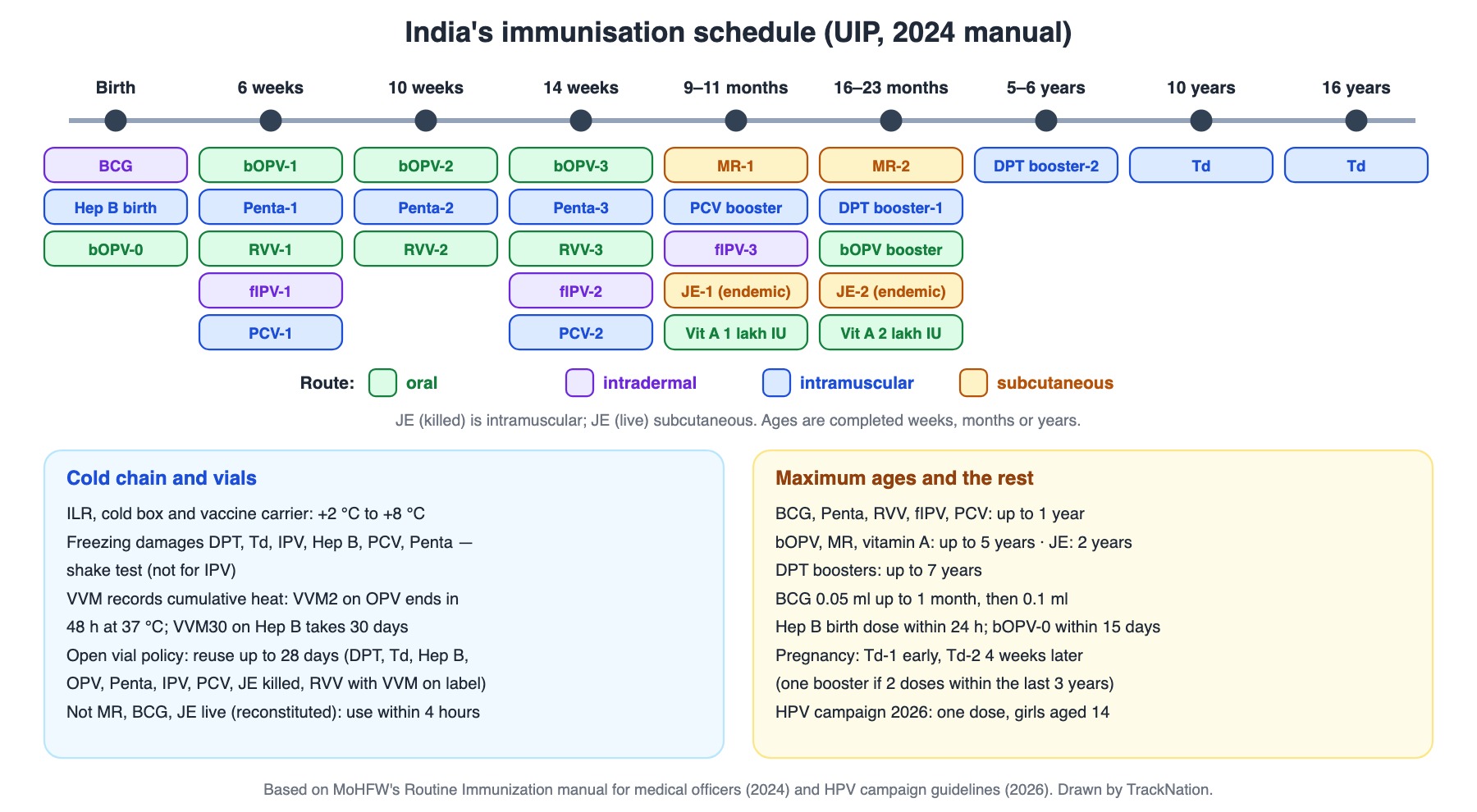
India's schedule from birth to 16 years, coloured by route, with cold chain and maximum ages. Drawn by TrackNation.
The Programme
1978 Expanded Programme on Immunization → renamed Universal Immunization Programme in 1985. UIP now protects free against 12 diseases: 11 nationally (diphtheria, pertussis, tetanus, polio, measles, rubella, severe childhood TB, rotavirus diarrhoea, hepatitis B, Hib meningitis and pneumonia, pneumococcal pneumonia) and Japanese encephalitis in endemic districts.
Milestones: polio-free certification 2014; tOPV → bOPV switch (25 April 2016) and fractional IPV nationwide; MR campaign (9 months–15 years) from 2017 replacing measles vaccine; Td replaced TT (2019); fIPV-3 at 9–11 months (2023); U-WIN digital registry (2023).
Mission Indradhanush (December 2014) targets 90% full immunisation coverage. NFHS-5 full immunisation: 76.4%.
Definitions: full immunisation = BCG, 3 OPV, 3 pentavalent and 1 MR by the first birthday; complete immunisation = all UIP vaccines by 2 years; left-out = no UIP vaccine; drop-out = started but not completed; zero-dose children are counted as surviving infants minus those who got Penta-1.
The Schedule (2024)
Birth: BCG (intradermal, left upper arm; 0.05 mL below 1 month, 0.1 mL from 1 month; up to 1 year), Hep B birth dose within 24 hours (IM, thigh), bOPV-0 within 15 days.
6, 10, 14 weeks: bOPV 1-2-3, pentavalent 1-2-3 (DPT + Hep B + Hib, IM thigh), rotavirus 1-2-3 (oral, 5 drops or 2 mL by product). fIPV (0.1 mL intradermal) and PCV (IM) at 6 and 14 weeks only.
9–11 months: MR-1 (subcutaneous, right upper arm), PCV booster, fIPV-3, JE-1 (endemic districts), vitamin A 1 lakh IU.
16–23 months: MR-2, DPT booster-1, bOPV booster, JE-2, vitamin A 2 lakh IU (then every 6 months to 5 years — 9 doses in all).
5–6 years: DPT booster-2. 10 and 16 years: Td. Pregnancy: Td-1 early, Td-2 four weeks later, or one Td booster if two doses were given in a pregnancy within the last 3 years.
Maximum ages: BCG, pentavalent, rotavirus, fIPV, PCV — 1 year; bOPV, MR, vitamin A — 5 years; JE — 2 years; DPT boosters — 7 years; Td — 16 years.
Cold Chain and Vials
Vaccines are kept at +2 °C to +8 °C in the ice-lined refrigerator (ILR), cold box and vaccine carrier; diluents go into the ILR at least 24 hours before use.
Freezing damages DPT, Td, IPV, Hep B, PCV and pentavalent. Discard if frozen or if floccules appear after shaking (shake test — not applicable to IPV).
Vaccine vial monitor (VVM) records cumulative heat exposure. VVM2 (OPV) reaches its end-point in 48 hours at 37 °C; VVM30 (Hep B, PCV, Td) takes 30 days. VVM14: BCG, DPT, MR, pentavalent, JE.
Open vial policy: opened multi-dose vials of DPT, Td, Hep B, OPV, pentavalent, IPV, PCV, JE (killed) and RVV with VVM on the label may be reused for up to 28 days if dated, in date, VVM usable, kept cold and not submerged. Not for MR, BCG, JE (live) or RVV with VVM on the cap — use these within 4 hours of reconstitution or opening.
AEFI, Contraindications and Catch-up
AEFI = any untoward medical event after immunisation, not necessarily caused by the vaccine. Minor: local pain or swelling (about 10%, up to 50% with pentavalent or Td), fever; MR gives fever or rash in 5–15%. Severe: clinically severe but not admitted and fully recovered (seizures, hypotonic-hyporesponsive episode, prolonged crying). Serious: death, hospitalisation, disability, congenital anomaly, clusters, or community/media concern.
Reporting: no upper time limit; serious and severe cases are notified at once and the case form reaches the district immunisation officer within 24 hours. Every session site keeps adrenaline 1:1000 (anaphylaxis kit) and syrup paracetamol 125 mg/5 mL.
Contraindications are few: serious allergy to a vaccine or its components; no live vaccines in immunodeficient children; pentavalent not before 6 weeks or after a severe reaction, and deferred in moderate or severe acute illness. Minor illness (URI) is not a contraindication; malnourished children are vaccinated on schedule.
Catch-up and FAQs: no BCG repeat if no scar; BCG only up to 1 year because most children acquire natural TB infection by then; a child with one pentavalent dose before the first birthday completes the due doses at 4-week intervals; rotavirus dose 1 by 1 year, products are interchangeable, and a spat-out dose is repeated at the same visit.
HPV Vaccine (2026 Campaign)
Three-month campaign for a single-age cohort of girls aged 14 (14th birthday passed, 15th not), using one dose of the quadrivalent Gardasil vaccine — an off-label single-dose schedule recommended by WHO and NTAGI.
Voluntary, with mandatory parental consent (on U-WIN), at designated government health facilities only.
WHO's primary target is girls aged 9–14 years. Licensed in India: Cervarix, Gardasil, Gardasil-9 and Cervavac.
Traps the Examiner Sets
fIPV and PCV are at 6 and 14 weeks — not 10 weeks. fIPV-3 and the PCV booster come at 9–11 months.
BCG dose is 0.05 mL below 1 month of age; given up to 1 year; no repeat for a missing scar.
Freeze-sensitive: DPT, Td, Hep B, Penta, PCV and IPV — but the shake test does not apply to IPV.
Open vial policy excludes the reconstituted vaccines: MR, BCG, JE live — 4 hours.
Full immunisation is by 1 year; complete immunisation by 2 years.
Any hospitalisation after a vaccine makes it a serious AEFI, whatever the clinical severity.
Memory Hooks & Shortcuts
Shortcuts to lock in this article's numbers and lists. Each one only re-packages facts proven above.
🧠 '6-10-14' for drops and Penta; '6-14' for the fractional pair (fIPV, PCV) — schedule
🧠 BCG: 'half a dose for the first month' — 0.05 then 0.1 mL — BCG
🧠 'One-Five-Seven': Penta/RVV/PCV/BCG die at 1, OPV/MR/vit A at 5, DPT boosters at 7 — maximum ages
🧠 Reconstituted = '4-hour' vaccines: MR, BCG, JE-live; the rest can wait 28 days — open vial
🧠 Freeze kills 'DT-HePP' — DPT, Td, Hep B, Penta, PCV — and IPV — cold chain
Rapid-Revision Cards
EPI → UIP
1978 → 1985.
Diseases
12 (11 national + JE in endemic districts).
Birth
BCG, Hep B (≤ 24 h), bOPV-0 (≤ 15 d).
6-10-14 weeks
bOPV, Penta, RVV.
6 & 14 weeks only
fIPV, PCV.
9–11 months
MR-1, PCV booster, fIPV-3, JE-1, vit A 1 lakh.
16–23 months
MR-2, DPT B1, bOPV B, JE-2, vit A 2 lakh.
Later
DPT B2 5–6 yr; Td 10 & 16 yr.
BCG dose
0.05 mL < 1 month; 0.1 mL after; ID left arm.
Max 1 year
BCG, Penta, RVV, fIPV, PCV.
Max 5 / 7 years
bOPV, MR, vit A / DPT boosters.
Full vs complete
BCG, 3 OPV, 3 Penta, MR by 1 yr / all by 2 yr.
Zero-dose
Surviving infants − Penta-1 recipients.
Cold chain
+2 to +8 °C (ILR, cold box, carrier).
Freeze-sensitive
DPT, Td, IPV, Hep B, PCV, Penta.
VVM
Cumulative heat; VVM2 OPV, VVM30 Hep B/PCV/Td.
Open vial
28 days; not MR, BCG, JE live, RVV-cap (4 h).
AEFI serious
Death, admission, disability, cluster, concern.
AEFI severe
Not admitted, full recovery (seizure, HHE).
Contraindications
Serious allergy; live vaccines in immunodeficiency.
HPV 2026
Girls aged 14, one dose quadrivalent, consent.
Sources
Facts in this article were checked against these documents.
Immunization Handbook for Medical Officers (Routine Immunization) — Ministry of Health and Family Welfare, Government of India, 2024
Universal Immunization Programme — Ministry of Health and Family Welfare, Government of India, 2026
Operational Guidelines for Roll-out of HPV Vaccination Campaign — National Health Mission, MoHFW, February 2026
Test Yourself: Practice Questions
Thirty questions in NEET PG style, many of them clinic scenarios.
Practice Questions (NEET PG pattern)
Original questions written in the style of the exam: +4 for a correct answer, −1 for a wrong one. Every answer was checked against the sources listed above. NEET PG papers are not published by NBEMS, so these are not past-paper questions.
Q1. The Expanded Programme on Immunization in India was renamed the Universal Immunization Programme in
(a) 1985
(b) 2005
(c) 1992
(d) 1978
Show answer
Answer: (a) — EPI 1978.
Q2. Under UIP, the vaccine given only in endemic districts is against
(a) rotavirus
(b) hepatitis B
(c) Japanese encephalitis
(d) rubella
Show answer
Answer: (c) — 12 diseases in all.
Q3. The dose of BCG for a 2-week-old is
(a) 0.1 mL intradermal
(b) 0.1 mL subcutaneous
(c) 0.5 mL IM
(d) 0.05 mL intradermal
Show answer
Answer: (d) — 0.1 mL from 1 month.
Q4. BCG is given under UIP up to
(a) 6 weeks
(b) 5 years
(c) 2 years
(d) 1 year of age
Show answer
Answer: (d) — Most children acquire natural TB infection by 1 year.
Q5. A child shows no BCG scar at 6 months. The correct action is
(a) repeat BCG
(b) Mantoux then BCG
(c) give BCG at 1 year
(d) no revaccination
Show answer
Answer: (d) — RI manual FAQ.
Q6. The hepatitis B birth dose should be given within
(a) 24 hours of birth
(b) 15 days
(c) 1 year
(d) 6 weeks
Show answer
Answer: (a) — Within 24 hours.
Q7. bOPV-0 can be given up to
(a) 6 weeks
(b) 15 days of age
(c) 1 year
(d) 24 hours
Show answer
Answer: (b) — Later doses till 5 years.
Q8. Fractional IPV (fIPV) is given under UIP at
(a) only at 9 months
(b) birth and 6 weeks
(c) 6 weeks, 14 weeks and 9–11 months
(d) 6, 10 and 14 weeks
Show answer
Answer: (c) — fIPV-3 added in 2023.
Q9. The dose and route of fIPV are
(a) 2 drops oral
(b) 0.1 mL intradermal
(c) 0.5 mL subcutaneous
(d) 0.5 mL IM
Show answer
Answer: (b) — Right arm for fIPV-1 and -2.
Q10. PCV under UIP is given as
(a) primary doses at 6 and 14 weeks and a booster at 9–11 months
(b) three doses at 6, 10, 14 weeks
(c) one dose at 9 months
(d) at birth and 6 weeks
Show answer
Answer: (a) — 2 + 1.
Q11. The maximum age for pentavalent vaccine under UIP is
(a) 7 years
(b) 1 year
(c) 2 years
(d) 5 years
Show answer
Answer: (b) — RI manual maximum age.
Q12. The maximum age for the DPT boosters is
(a) 7 years
(b) 10 years
(c) 2 years
(d) 5 years
Show answer
Answer: (a) — RI manual.
Q13. MR vaccine is given by which route and site?
(a) IM thigh
(b) intradermal left arm
(c) subcutaneous, right upper arm
(d) oral
Show answer
Answer: (c) — 0.5 mL.
Q14. The first dose of vitamin A under UIP is
(a) 2 lakh IU at 9 months
(b) 1 lakh IU at 9 months with MR-1
(c) 2 lakh IU at birth
(d) 1 lakh IU at 6 weeks
Show answer
Answer: (b) — Then 2 lakh IU every 6 months to 5 years.
Q15. Td is given to children at
(a) 10 and 16 years
(b) only at 16 years
(c) 12 and 18 years
(d) 5 and 10 years
Show answer
Answer: (a) — Replaced TT in 2019.
Q16. A pregnant woman who received two Td doses in a pregnancy 2 years ago now needs
(a) no Td
(b) two Td doses
(c) three Td doses
(d) one Td booster
Show answer
Answer: (d) — Within last 3 years.
Q17. 'Full immunisation' in UIP means, by the first birthday,
(a) 3 pentavalent only
(b) BCG and MR only
(c) BCG, 3 OPV, 3 pentavalent and 1 MR
(d) all UIP vaccines including boosters
Show answer
Answer: (c) — Complete = all by 2 years.
Q18. Zero-dose children are estimated as surviving infants minus those who received
(a) MR-1
(b) Penta-1
(c) BCG
(d) OPV-0
Show answer
Answer: (b) — RI manual.
Q19. Mission Indradhanush aimed to raise full immunisation coverage to
(a) 60%
(b) 90%
(c) 100%
(d) 75%
Show answer
Answer: (b) — Launched December 2014.
Q20. Vaccines in an ice-lined refrigerator are kept at
(a) +8 °C to +15 °C
(b) 0 °C to +4 °C
(c) −15 °C to −25 °C
(d) +2 °C to +8 °C
Show answer
Answer: (d) — Also cold box and carrier.
Q21. Which vaccine is damaged by freezing?
(a) MR
(b) pentavalent
(c) BCG
(d) OPV
Show answer
Answer: (b) — Also DPT, Td, IPV, Hep B, PCV.
Q22. The shake test is NOT applicable to
(a) Hep B
(b) Td
(c) DPT
(d) IPV
Show answer
Answer: (d) — RI manual.
Q23. A vaccine vial monitor shows
(a) expiry date
(b) cumulative heat exposure
(c) contamination
(d) freezing
Show answer
Answer: (b) — Freezing needs the shake test.
Q24. Under the open vial policy, an opened DPT vial can be used for up to
(a) 28 days
(b) 4 hours
(c) 7 days
(d) 6 months
Show answer
Answer: (a) — If conditions met.
Q25. Open vial policy does NOT apply to
(a) PCV
(b) OPV
(c) Hep B
(d) MR
Show answer
Answer: (d) — Also BCG, JE live, RVV with VVM on cap — use within 4 hours.
Q26. An infant is admitted with fever the day after pentavalent and recovers fully. The AEFI is classed as
(a) not an AEFI
(b) severe
(c) minor
(d) serious
Show answer
Answer: (d) — Any hospitalisation = serious.
Q27. A hypotonic-hyporesponsive episode managed without admission, with full recovery, is reported as
(a) severe AEFI
(b) minor AEFI
(c) no AEFI
(d) serious AEFI
Show answer
Answer: (a) — Severe examples.
Q28. Which is NOT a contraindication to vaccination?
(a) live vaccine in an immunodeficient child
(b) a mild upper respiratory infection
(c) anaphylaxis to a previous dose
(d) pentavalent before 6 weeks
Show answer
Answer: (b) — RI manual FAQ.
Q29. The upper age limit for the first dose of rotavirus vaccine under UIP is
(a) 15 weeks
(b) 1 year
(c) 2 years
(d) 6 months
Show answer
Answer: (b) — Then complete at 4-week intervals.
Q30. India's 2026 HPV campaign vaccinates
(a) women 15–45 with three doses
(b) girls 9–14 with two doses
(c) girls aged 14 with one dose of quadrivalent vaccine
(d) boys and girls aged 12
Show answer
Answer: (c) — Single-dose, off-label, per WHO and NTAGI.
Active Recall
From memory: give the UIP schedule from birth to 16 years and in pregnancy with routes, the BCG dose, maximum ages, definitions of full and complete immunisation, cold chain and freeze-sensitive vaccines, VVM, open vial policy, AEFI categories, contraindications and the HPV campaign.