Neonatal Sepsis and Prematurity for NEET PG Paediatrics: ICMR Red and Yellow Flags, RDS vs TTN vs MAS, Apnoea, BPD, NEC and ROP
Start Here
🎯 Exam priority: Very high. Expect: red vs yellow flags, durations of antibiotics, early- vs late-onset organisms, gestational-age cut-offs, RDS vs TTN on X-ray, SpO₂ targets and ROP, apnoea definition and caffeine, BPD definition, NEC X-ray signs, ROP screening criteria.
CBME mapping: PE19–PE20. Fact-checked against ICMR Standard Treatment Workflows (Sepsis in Neonates; Respiratory Distress in Neonates, 2020) and the MSD Manual.
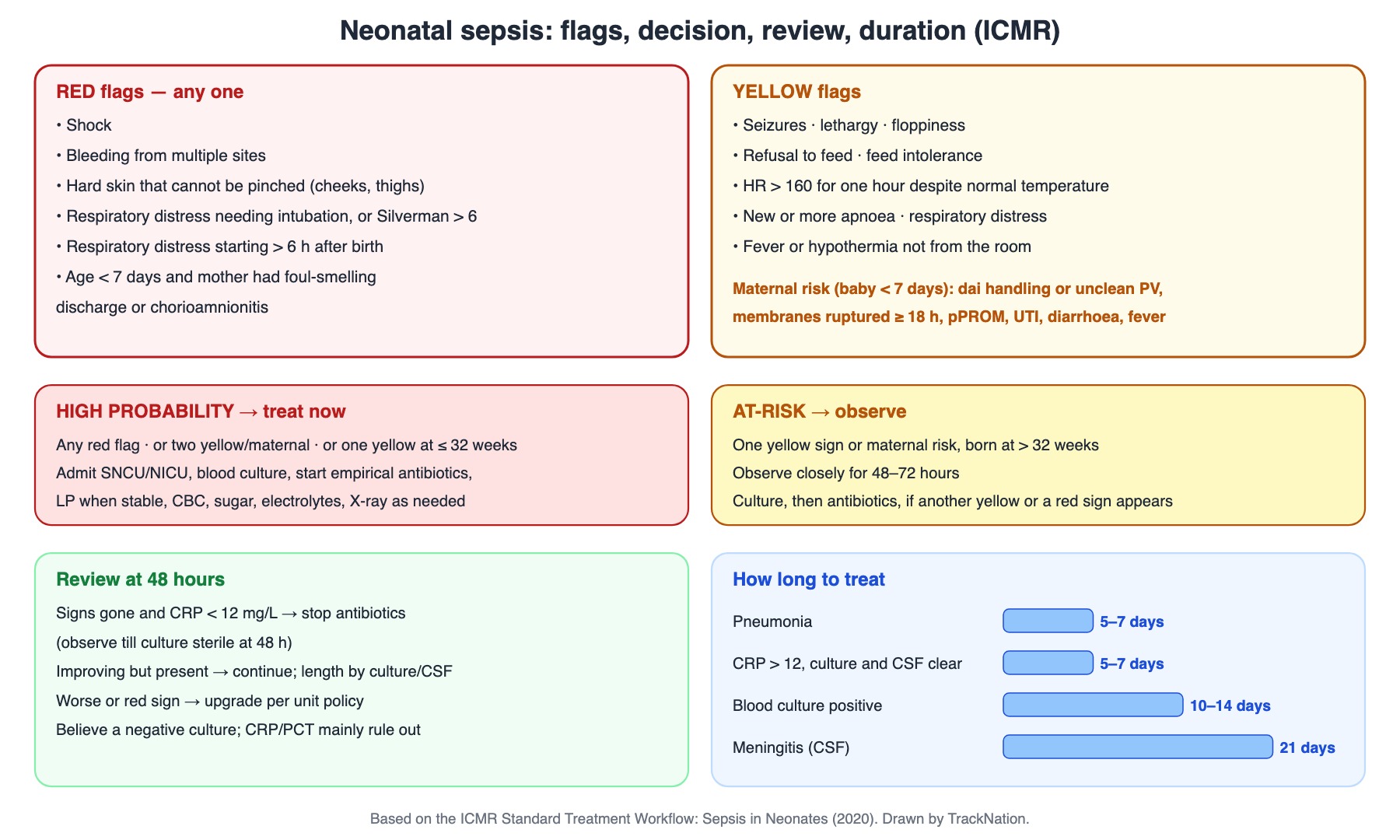
ICMR neonatal sepsis: red and yellow flags, decision, 48-hour review and antibiotic duration. Drawn by TrackNation.
Neonatal Sepsis
Signs are non-specific: poor activity and sucking, apnoea, bradycardia, temperature instability, distress, vomiting, distension, jaundice, seizures.
ICMR red flags (any one = treat): shock, bleeding from many sites, hard skin that cannot be pinched (look at cheeks and thighs), distress needing intubation or Silverman > 6, distress starting > 6 h after birth, or baby < 7 days with maternal foul discharge/chorioamnionitis.
Yellow flags: seizures, lethargy, floppiness, refusal to feed or feed intolerance, HR > 160 for an hour with normal temperature, apnoea, distress, fever or hypothermia not from the room. Maternal risks (baby < 7 days): dai handling/unclean PV, rupture of membranes ≥ 18 h, pPROM, UTI, diarrhoea, fever.
High probability (any red, two yellow/maternal, or one yellow at ≤ 32 weeks): admit, blood culture, empirical antibiotics, LP when stable. At risk (one yellow, > 32 weeks): observe 48–72 h. Review at 48 h: well and CRP < 12 mg/L → stop.
Duration: pneumonia 5–7 days; culture-negative with CRP > 12 — 5–7 days; culture-positive 10–14 days; meningitis 21 days. CRP and procalcitonin mainly help to rule out sepsis.
Organisms (MSD): early-onset — acquired in labour, mostly GBS and E. coli, symptoms usually within 6 h; empirical ampicillin + gentamicin. Late-onset GBS (3 days–12 weeks) often brings meningitis; coagulase-negative staph with a line in > 72 h → vancomycin.
Prematurity and Size (MSD)
Preterm < 37 weeks; late preterm 34–36⁶⁄₇; postterm ≥ 42. WHO: extremely preterm < 28 weeks, very preterm 28–31⁶⁄₇.
SGA = weight < 10th percentile for gestation. Symmetric (weight, length, head all small) → early fetal problem; asymmetric (brain spared) → placental or maternal problem later in pregnancy.
Preterm problems: germinal-matrix haemorrhage into the ventricles (IVH), RDS, apnoea, BPD, NEC, ROP, metabolic bone disease, and transient hypothyroxinaemia (low T4, normal TSH — thyroxine does not help).
Respiratory Distress: RDS, TTN, MAS
ICMR: distress = RR > 60, chest retractions, flaring, grunting or cyanosis; score with Silverman–Anderson. Keep SpO₂ 91–95% — above 95% raises the risk of ROP. Oxygen by nasal prongs 0.5–1 L/min; early CPAP if < 32 weeks; X-ray only if distress lasts beyond 6 h or worsens.
RDS (hyaline membrane disease): surfactant deficiency; surfactant is adequate only by 34–36 weeks. Grunting, retractions, flaring soon after birth; X-ray ground-glass with air bronchograms and low volumes. High risk < 30 weeks, especially without antenatal steroids. Treat with CPAP and early selective surfactant within 1–2 hours.
TTN: delayed clearance of fetal lung fluid — elective caesarean, preterm; X-ray perihilar streaks, fluid in the fissures, normal or hyperinflated lungs; settles in 2–3 days.
Meconium aspiration: meconium-stained liquor in 4–22% of births, more after term; CPAP or ventilation; surfactant can cut the need for ECMO but not deaths.
Apnoea, BPD, NEC and ROP
Apnoea of prematurity: pause > 20 seconds, or shorter with bradycardia < 100, cyanosis or SpO₂ < 85%, in babies < 37 weeks. Oral caffeine is the drug of choice. Periodic breathing (5–20 s breathing with pauses < 20 s) is different.
BPD: needing oxygen after 28 days of age or at 36 weeks postmenstrual age; fewer, larger alveoli with thick interstitium.
NEC: the commonest neonatal GI emergency, mainly preterm; rare before enteral feeds and less in breastfed babies. Diagnostic X-ray: pneumatosis intestinalis and portal-vein gas. Perforation most often in the terminal ileum; strictures in the left colon. Treat with nasogastric suction, IV fluids and nutrition, antibiotics, surgery if needed.
ROP: screen all < 1500 g or < 30 weeks, starting at about 31 weeks; risk rises with excess oxygen; treat severe disease with laser or anti-VEGF (bevacizumab).
Traps the Examiner Sets
One yellow sign makes sepsis "high probability" only in babies born at ≤ 32 weeks.
Meningitis = 21 days; culture-positive sepsis = 10–14 days.
RDS: ground glass + air bronchograms. TTN: perihilar streaks + fissure fluid after elective caesarean.
Target SpO₂ 91–95% in newborns on oxygen; higher is not better (ROP).
NEC's pathognomonic sign is pneumatosis intestinalis; it seldom starts before feeds.
Memory Hooks & Shortcuts
Shortcuts to lock in this article's numbers and lists. Each one only re-packages facts proven above.
🧠 Sepsis course '7-14-21': pneumonia ~7, bacteraemia 14, meningitis 21 — durations
🧠 '32 is the line': one yellow flag treats at ≤ 32 weeks; CPAP early below 32 — thresholds
🧠 Oxygen '91 to 95 — stay alive, don't blind' (ROP above 95) — SpO₂
🧠 RDS = Glass (ground glass); TTN = Wet (fissure fluid) — 'Caesar keeps the lungs wet' — X-rays
🧠 ROP '1500-30-31': screen < 1500 g or < 30 weeks, start at 31 — ROP
Rapid-Revision Cards
Red flags
Shock, bleeding, hard unpinchable skin, Silverman > 6 / intubation, RD > 6 h, maternal chorioamnionitis.
Yellow flags
Seizures, lethargy, floppy, feed refusal, HR > 160 × 1 h, apnoea, RD, temp.
Maternal risk
ROM ≥ 18 h, pPROM, fever, UTI, dai, diarrhoea.
High probability
Any red; 2 yellow; 1 yellow if ≤ 32 wk.
At risk
1 yellow, > 32 wk → observe 48–72 h.
Stop at 48 h
Well + CRP < 12 mg/L.
Durations
Pneumonia 5–7; culture + 10–14; meningitis 21.
EOS organisms
GBS, E. coli; ampicillin + gentamicin.
Line > 72 h
CoNS → vancomycin.
GA cut-offs
Preterm < 37; extremely < 28; late preterm 34–36⁶⁄₇.
SGA
< 10th centile; asymmetric = placental.
SpO₂ target
91–95% (> 95% → ROP).
Early CPAP
< 32 weeks.
RDS
Surfactant lack; ground glass + air bronchograms.
RDS prevention
Antenatal steroids; early surfactant 1–2 h.
TTN
Lung fluid; elective LSCS; perihilar streaks; 2–3 d.
Apnoea
> 20 s (or shorter + brady/desat); caffeine.
BPD
O₂ beyond 28 d or 36 wk PMA.
NEC
Pneumatosis + portal gas; terminal ileum.
ROP screen
< 1500 g or < 30 wk; start ~31 wk.
ROP treatment
Laser or bevacizumab.
Sources
Facts in this article were checked against these documents.
Standard Treatment Workflows: Sepsis in Neonates; Respiratory Distress in Neonates — ICMR / Department of Health Research, MoHFW, 2020
MSD Manual Professional: Neonatal Sepsis; Gestational Age; Preterm Infants; RDS; TTN; Meconium Aspiration; Apnea of Prematurity; BPD; NEC; ROP — Merck & Co., 2025–2026 (link)
Test Yourself: Practice Questions
Thirty questions in NEET PG style, many of them NICU scenarios.
Practice Questions (NEET PG pattern)
Original questions written in the style of the exam: +4 for a correct answer, −1 for a wrong one. Every answer was checked against the sources listed above. NEET PG papers are not published by NBEMS, so these are not past-paper questions.
Q1. Which is a RED flag for neonatal sepsis in the ICMR workflow?
(a) refusal to feed
(b) heart rate 170 for 10 minutes
(c) single episode of apnoea
(d) hardening of skin that cannot be pinched
Show answer
Answer: (d) — ICMR red flag.
Q2. Respiratory distress is a red flag when it begins
(a) at birth
(b) more than 6 hours after birth
(c) only after 72 hours
(d) within 1 hour
Show answer
Answer: (b) — ICMR.
Q3. A term baby has one yellow flag sign only. ICMR advises
(a) LP at once
(b) antibiotics at once
(c) close observation for 48–72 hours
(d) discharge
Show answer
Answer: (c) — > 32 weeks = at risk.
Q4. A baby born at 30 weeks has one yellow flag. The category is
(a) no sepsis
(b) high probability of sepsis
(c) at risk — observe
(d) only if CRP raised
Show answer
Answer: (b) — ≤ 32 weeks.
Q5. Which maternal factor is a sepsis risk in the ICMR workflow?
(a) caesarean section
(b) maternal age > 35
(c) maternal anaemia
(d) rupture of membranes ≥ 18 hours
Show answer
Answer: (d) — Also pPROM, fever, UTI.
Q6. Antibiotics can be stopped at 48 hours if the baby is well and CRP is below
(a) 100 mg/L
(b) 1 mg/L
(c) 12 mg/L
(d) 50 mg/L
Show answer
Answer: (c) — ICMR.
Q7. Culture-proven neonatal sepsis without meningitis is treated for
(a) 5–7 days
(b) 10–14 days
(c) 21 days
(d) 3 days
Show answer
Answer: (b) — ICMR.
Q8. Neonatal meningitis is treated for
(a) 7 days
(b) 6 weeks
(c) 21 days
(d) 10 days
Show answer
Answer: (c) — ICMR.
Q9. The main use of CRP and procalcitonin in neonatal sepsis is to
(a) choose the antibiotic
(b) rule out sepsis
(c) confirm sepsis
(d) replace blood culture
Show answer
Answer: (b) — ICMR.
Q10. The commonest organisms of early-onset neonatal sepsis (MSD) are
(a) Staph epidermidis and Candida
(b) group B streptococcus and E. coli
(c) Pseudomonas and Klebsiella only
(d) Listeria alone
Show answer
Answer: (b) — Intrapartum.
Q11. Empirical therapy for early-onset sepsis (MSD) is
(a) vancomycin alone
(b) amphotericin
(c) meropenem alone
(d) ampicillin plus gentamicin
Show answer
Answer: (d) — Covers GBS, Listeria, E. coli.
Q12. A preterm with a central line for 5 days develops late-onset sepsis. Empirical therapy should include
(a) vancomycin
(b) metronidazole
(c) fluconazole only
(d) ampicillin only
Show answer
Answer: (a) — CoNS.
Q13. Extremely preterm (WHO) means born before
(a) 28 weeks
(b) 34 weeks
(c) 32 weeks
(d) 37 weeks
Show answer
Answer: (a) — Very preterm 28–31⁶⁄₇.
Q14. Late preterm means
(a) 37 to 38 weeks
(b) 28 to 32 weeks
(c) 32 to 34 weeks
(d) 34 to 36⁶⁄₇ weeks
Show answer
Answer: (d) — MSD.
Q15. Asymmetric growth restriction with head sparing usually results from
(a) chromosomal disorders in the first trimester
(b) placental or maternal problems late in pregnancy
(c) genetic short stature
(d) congenital infection early
Show answer
Answer: (b) — Symmetric = early fetal problem.
Q16. SGA is defined as birth weight below the
(a) 50th percentile
(b) 2500 g
(c) 3rd percentile
(d) 10th percentile for gestational age
Show answer
Answer: (d) — MSD.
Q17. ICMR target SpO₂ for a newborn on oxygen is
(a) 85–90%
(b) 88–92%
(c) 91–95%
(d) 96–100%
Show answer
Answer: (c) — > 95% risks ROP.
Q18. Why should SpO₂ not exceed 95% in a preterm on oxygen?
(a) risk of retinopathy of prematurity
(b) risk of NEC
(c) risk of hypoglycaemia
(d) risk of jaundice
Show answer
Answer: (a) — ICMR.
Q19. RDS of the preterm is due to
(a) meconium
(b) infection
(c) retained lung fluid
(d) surfactant deficiency
Show answer
Answer: (d) — Surfactant adequate by 34–36 weeks.
Q20. Chest X-ray in RDS typically shows
(a) a normal film
(b) ground-glass lungs with air bronchograms and low volumes
(c) patchy infiltrates with hyperinflation
(d) perihilar streaks with fissure fluid
Show answer
Answer: (b) — MSD.
Q21. Which most lowers the risk of RDS in a baby born at 29 weeks?
(a) delayed feeding
(b) antenatal corticosteroids to the mother
(c) elective caesarean
(d) phototherapy
Show answer
Answer: (b) — MSD.
Q22. Transient tachypnoea of the newborn is due to
(a) delayed resorption of fetal lung fluid
(b) surfactant deficiency
(c) meconium
(d) pneumothorax
Show answer
Answer: (a) — Elective caesarean.
Q23. A term baby born by elective caesarean is tachypnoeic; X-ray shows perihilar streaks and fluid in the fissures. Diagnosis?
(a) meconium aspiration
(b) congenital pneumonia
(c) transient tachypnoea of the newborn
(d) RDS
Show answer
Answer: (c) — Settles in 2–3 days.
Q24. Apnoea of prematurity is a pause in breathing longer than
(a) 20 seconds
(b) 60 seconds
(c) 5 seconds
(d) 10 seconds
Show answer
Answer: (a) — Or shorter with bradycardia/desaturation.
Q25. Drug of choice for apnoea of prematurity is
(a) doxapram
(b) aminophylline IV only
(c) naloxone
(d) caffeine
Show answer
Answer: (d) — MSD.
Q26. BPD is diagnosed when a preterm needs oxygen
(a) after 2 years
(b) at 24 hours
(c) after 28 days of age or at 36 weeks postmenstrual age
(d) at 7 days
Show answer
Answer: (c) — MSD.
Q27. The diagnostic X-ray sign of NEC is
(a) football sign only
(b) double bubble
(c) pneumatosis intestinalis
(d) string sign
Show answer
Answer: (c) — Also portal-vein gas.
Q28. NEC is less common in babies who are
(a) sick
(b) preterm
(c) formula-fed
(d) breastfed
Show answer
Answer: (d) — Rare before enteral feeds.
Q29. Retinopathy of prematurity screening (MSD) is for all babies
(a) < 37 weeks
(b) < 2500 g
(c) on any oxygen
(d) < 1500 g or < 30 weeks at birth
Show answer
Answer: (d) — Starts ~31 weeks.
Q30. ROP screening begins at about
(a) 40 weeks
(b) 6 months
(c) birth
(d) 31 weeks' gestational age
Show answer
Answer: (d) — Onset usually 32–34 weeks.
Active Recall
From memory: list ICMR red and yellow flags and the decision rules, the 48-hour review and antibiotic durations, early- and late-onset organisms, gestational-age and SGA definitions, oxygen targets, RDS vs TTN vs MAS, apnoea and caffeine, BPD, NEC signs and ROP screening.