Normal Newborn for NEET PG Paediatrics: APGAR, Essential Newborn Care, Resuscitation Basics, Thermal Care, Newborn Exam and HBNC Visits
Start Here
🎯 Exam priority: Very high. Expect: APGAR items and cut-offs, when to start PPV and compressions, the 3:1 ratio, delayed cord clamping, vitamin K dose, ICMR hypothermia bands and what to do for each, caput vs cephalhaematoma, normal weight loss, first urine and meconium, levels of newborn care and the HBNC visit days.
CBME mapping: PE19. Fact-checked against the ICMR Standard Treatment Workflow for Thermal Care of Newborn (2020), MoHFW's Facility Based Newborn Care guidelines (2025) and HBNC guidelines (2014), and the MSD Manual (resuscitation, newborn care and examination).
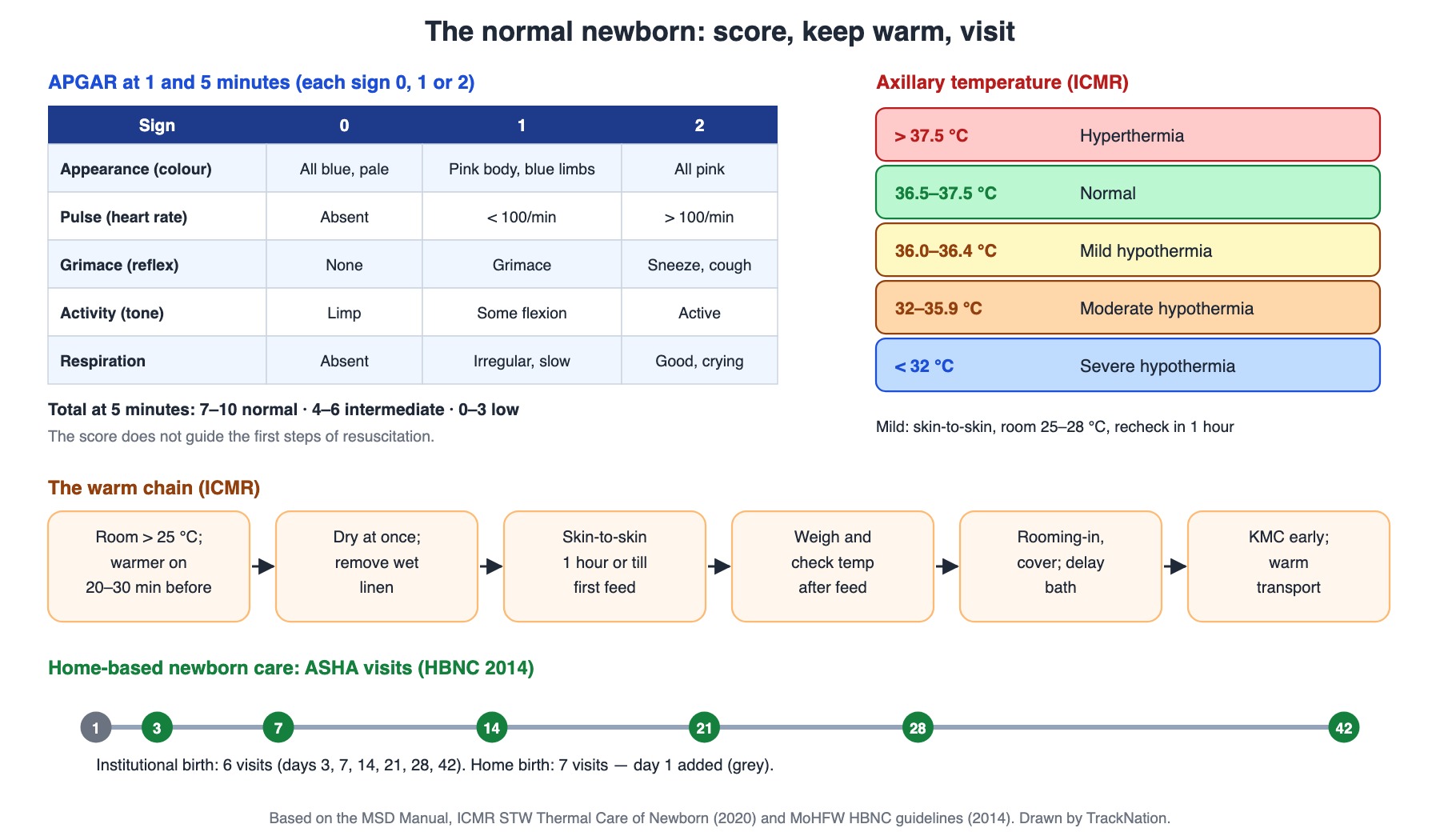
APGAR, ICMR temperature bands, the warm chain and HBNC visit days. Drawn by TrackNation.
At Birth: Essential Care and APGAR
Essential newborn care (MoHFW) — what every baby needs wherever born: delayed cord clamping, skin-to-skin contact, maintaining the airway, support for breathing, and early initiation of exclusive breastfeeding.
Delayed cord clamping (MSD): at least 30 seconds benefits vigorous term and late-preterm babies and preterms who need no resuscitation; evidence is insufficient when resuscitation is needed.
APGAR at 1 and 5 minutes: Appearance, Pulse, Grimace, Activity, Respiration, each 0–2. At 5 minutes 7–10 normal, 4–6 intermediate, 0–3 low. The score itself does not drive the first steps of resuscitation. Acrocyanosis is common and can last 24–48 hours.
Vitamin K (MSD): 1 mg IM if > 1500 g, 0.3–0.5 mg/kg IM if ≤ 1500 g, within 6 hours of birth. Hep B birth dose within 24 hours (article 11). Eye prophylaxis with erythromycin is a US practice.
Resuscitation Thresholds (MSD)
The golden minute: by one minute after birth the baby should be breathing well — or receiving ventilation.
Stimulate by drying, rubbing the back or flicking the soles; routine suction is not a way to stimulate.
Heart rate 60–100 with apnoea, gasping or poor breathing → positive pressure ventilation, starting with room air (21%) at ≥ 35 weeks. Success is judged mainly by a rising heart rate.
Heart rate < 60 despite good ventilation → chest compressions, two-thumb encircling, 3:1 (90 compressions + 30 breaths a minute); reassess after 60 seconds; if still < 60, give adrenaline through an umbilical venous or intraosseous line.
Thermal Care (ICMR)
Measure axillary temperature with a digital thermometer (tip parallel to the trunk); at-risk babies with the mother — LBW and preterm — every 4 hours.
Bands: normal 36.5–37.5 °C; mild hypothermia 36.0–36.4; moderate 32–35.9; severe < 32; hyperthermia > 37.5.
Mild: room 25–28 °C, skin-to-skin, continue breastfeeding, recheck in 1 hour (still < 36.5 → treat as moderate). Moderate: radiant warmer in servo mode, oxygen if SpO₂ < 91%, check sugar (< 45 mg/dL → hypoglycaemia workflow), recheck every 15 minutes. Severe: as moderate plus nil by mouth, IV fluids, vitamin K, refer if shock or respiratory failure.
Warm chain: delivery room > 25 °C, warmer on 20–30 minutes before birth, dry at once and remove wet linen, skin-to-skin for 1 hour or till the first feed, weigh after the feed, rooming-in, delay the bath till after discharge, early KMC, never a naked baby on a trolley without a heat source; skin-to-skin is a valid way to transport.
Hyperthermia vs sepsis: trunk and limbs both hot → environment; hot trunk with cold limbs → think sepsis.
Normal Course and Examination (MSD)
Weight: babies lose 3–9% of birth weight in the first days and may take 2–3 weeks to regain it.
Urine: most void within 24 hours (average first void 7–9 hours); a boy who cannot void may have posterior urethral valves. Meconium: reassess if not passed in the first 24 hours. The cord clamp can come off when dry, usually at 24 hours.
Caput succedaneum = scalp swelling and bruising from vaginal delivery. Cephalhaematoma = blood under the periosteum, so it does not cross suture lines, appears as the oedema settles and fades over months.
Benign findings: Epstein pearls (inclusion cysts on the palate); erythema toxicum (white or yellow papules on a red base).
Levels of Care and HBNC (MoHFW)
NBCC (newborn care corner): space in every labour room and obstetric OT for essential care and resuscitation. NBSU: 4–6 beds at CHC/FRU for first-level care. SNCU: at least 12 beds at the district hospital for sick and small babies not needing surgery or ventilation. MNCU keeps mother and baby together ("no separation"). NICU = tertiary.
HBNC (ASHA home visits): institutional birth — 6 visits on days 3, 7, 14, 21, 28 and 42; home birth — 7 visits (day 1 added). LBW babies are followed up for 2 years and SNCU graduates for 1 year. (IMNCI's own schedule is different — article 10.)
Traps the Examiner Sets
APGAR "1" for pulse is < 100, not < 60. APGAR does not decide when to start PPV.
PPV for HR 60–100 with poor breathing; compressions only when HR stays < 60 after effective ventilation; ratio 3:1.
36.0–36.4 °C is mild hypothermia (cold stress) — skin-to-skin first.
Cephalhaematoma stops at sutures; caput does not.
HBNC is 6 visits (institutional) or 7 (home); IMNCI home visits are 3 (+3 for LBW).
Memory Hooks & Shortcuts
Shortcuts to lock in this article's numbers and lists. Each one only re-packages facts proven above.
🧠 APGAR = Appearance, Pulse, Grimace, Activity, Respiration — '7 or more at 5 is fine' — APGAR
🧠 '60-100 breathe it, under 60 squeeze it' — PPV, then compressions at 3:1 — resuscitation
🧠 Temperature ladder '36.5 is the floor': 36 mild, 32 moderate, below 32 severe — hypothermia
🧠 'Seph stops at the seams' — cephalhaematoma does not cross sutures — scalp swellings
🧠 HBNC '3-7-14-21-28-42' — add day 1 if born at home — HBNC
Rapid-Revision Cards
ENC
Delayed clamping, skin-to-skin, airway, breathing, early breastfeeding.
Delayed clamping
≥ 30 s if vigorous.
APGAR timing
1 and 5 min.
APGAR bands
7–10 / 4–6 / 0–3.
Pulse score
Absent 0; < 100 = 1; > 100 = 2.
Golden minute
Breathing or ventilated by 60 s.
PPV
HR 60–100 + apnoea/gasping; room air at ≥ 35 wk.
Compressions
HR < 60 after good PPV; 3:1; 90 + 30/min.
Adrenaline route
Umbilical vein or intraosseous.
Vitamin K
1 mg IM (> 1500 g) within 6 h.
Normal temp
36.5–37.5 °C axillary.
Mild / moderate / severe
36.0–36.4 / 32–35.9 / < 32 °C.
Mild Rx
STS, room 25–28 °C, recheck 1 h.
Moderate Rx
Servo warmer, O₂ if SpO₂ < 91%, sugar, recheck 15 min.
Warm chain
DR > 25 °C, dry, STS 1 h, delay bath, KMC.
Hot trunk, cold limbs
Think sepsis.
Weight loss
3–9%; regain in 2–3 weeks.
First urine / meconium
Within 24 h.
Cephalhaematoma
Subperiosteal; stops at sutures.
Care levels
NBCC → NBSU (4–6) → SNCU (≥ 12) → NICU.
HBNC
3, 7, 14, 21, 28, 42 (+ day 1 if home birth).
Sources
Facts in this article were checked against these documents.
Standard Treatment Workflow: Thermal Care of Newborn — ICMR / Department of Health Research, MoHFW, 2020
Facility Based Newborn Care: Operational Guidelines — Ministry of Health and Family Welfare, Government of India, 2025
Home Based Newborn Care: Operational Guidelines — Ministry of Health and Family Welfare, Government of India, 2014
MSD Manual Professional: Neonatal Resuscitation; Initial Evaluation and Preventive Care; Care of the Healthy Term Newborn; Physical Examination of the Newborn — Merck & Co., 2025–2026 (link)
Test Yourself: Practice Questions
Thirty questions in NEET PG style, many of them labour-room scenarios.
Practice Questions (NEET PG pattern)
Original questions written in the style of the exam: +4 for a correct answer, −1 for a wrong one. Every answer was checked against the sources listed above. NEET PG papers are not published by NBEMS, so these are not past-paper questions.
Q1. Which is NOT part of essential newborn care as defined by MoHFW?
(a) early initiation of exclusive breastfeeding
(b) delayed cord clamping
(c) routine oronasal suction of every baby
(d) skin-to-skin contact
Show answer
Answer: (c) — Suction is not a way to stimulate.
Q2. The APGAR score is assigned at
(a) 30 seconds
(b) birth and 10 minutes
(c) 5 and 15 minutes
(d) 1 and 5 minutes
Show answer
Answer: (d) — MSD.
Q3. A newborn with heart rate 90/min scores, for pulse,
(a) 0
(b) 3
(c) 2
(d) 1
Show answer
Answer: (d) — < 100 = 1; > 100 = 2.
Q4. A 5-minute APGAR of 5 is
(a) low
(b) intermediate
(c) critical
(d) normal
Show answer
Answer: (b) — 7–10 normal, 4–6 intermediate, 0–3 low.
Q5. A baby with pink body and blue extremities scores, for appearance,
(a) 1
(b) 0
(c) 2
(d) not scored
Show answer
Answer: (a) — All pink = 2.
Q6. By the end of the 'golden minute' a baby should be
(a) given vitamin K
(b) bathed
(c) breathing well or receiving ventilation
(d) weighed
Show answer
Answer: (c) — MSD.
Q7. Delayed cord clamping in a vigorous term baby means waiting at least
(a) 10 minutes
(b) 5 seconds
(c) 30 seconds
(d) 5 minutes
Show answer
Answer: (c) — MSD.
Q8. A newborn is apnoeic with heart rate 80/min after initial steps. Next step is
(a) chest compressions
(b) positive pressure ventilation
(c) adrenaline
(d) observe
Show answer
Answer: (b) — HR 60–100 with apnoea → PPV.
Q9. PPV in a term newborn starts with oxygen at
(a) 60%
(b) 100%
(c) 40%
(d) 21% (room air)
Show answer
Answer: (d) — 21–30% if < 35 weeks.
Q10. The main sign that ventilation is working is
(a) pink colour
(b) chest rise alone
(c) a rising heart rate
(d) crying
Show answer
Answer: (c) — MSD.
Q11. Chest compressions in a newborn are started when the heart rate stays below
(a) 80/min
(b) 120/min
(c) 100/min
(d) 60/min despite adequate ventilation
Show answer
Answer: (d) — MSD.
Q12. The compression-to-ventilation ratio in newborn resuscitation is
(a) 30:2
(b) 15:2
(c) 5:1
(d) 3:1
Show answer
Answer: (d) — 90 compressions + 30 breaths/min.
Q13. Vitamin K for a 3-kg newborn (MSD) is
(a) 1 mg IM within 6 hours
(b) 10 mg IM
(c) 0.1 mg oral
(d) 5 mg IV
Show answer
Answer: (a) — 0.3–0.5 mg/kg if ≤ 1500 g.
Q14. Normal axillary temperature of a newborn (ICMR) is
(a) 37.0–38.0 °C
(b) 36.0–37.0 °C
(c) 36.5–37.5 °C
(d) 35.5–36.5 °C
Show answer
Answer: (c) — ICMR.
Q15. A newborn's axillary temperature is 36.2 °C. This is
(a) moderate hypothermia
(b) normal
(c) mild hypothermia
(d) severe hypothermia
Show answer
Answer: (c) — 36.0–36.4.
Q16. Moderate hypothermia (ICMR) is
(a) < 32 °C
(b) 30–32 °C
(c) 32–35.9 °C
(d) 36.0–36.4 °C
Show answer
Answer: (c) — Radiant warmer in servo mode.
Q17. First management of mild hypothermia is
(a) IV fluids
(b) refer
(c) skin-to-skin contact and recheck in 1 hour
(d) nil by mouth
Show answer
Answer: (c) — Room 25–28 °C, continue breastfeeding.
Q18. In moderate hypothermia, ICMR says to start oxygen if SpO₂ is below
(a) 80%
(b) 91%
(c) 85%
(d) 95%
Show answer
Answer: (b) — Also check sugar.
Q19. A newborn with severe hypothermia (< 32 °C) should
(a) be bathed in warm water
(b) be breastfed only
(c) be sent home
(d) be kept nil by mouth and given IV fluids
Show answer
Answer: (d) — Also vitamin K, refer if shock.
Q20. The delivery-room temperature should be kept above
(a) 18 °C
(b) 20 °C
(c) 25 °C
(d) 30 °C
Show answer
Answer: (c) — Warmer on 20–30 min before.
Q21. Under the ICMR warm chain, the newborn's first bath should be
(a) given at once
(b) delayed till after discharge
(c) given at 6 hours
(d) given at 1 hour
Show answer
Answer: (b) — ICMR.
Q22. A febrile newborn has a hot trunk and cold extremities. Think of
(a) sepsis
(b) overclothing
(c) normal transition
(d) hot room
Show answer
Answer: (a) — Both hot → environment.
Q23. A healthy term newborn typically loses how much birth weight in the first days?
(a) 0%
(b) 25%
(c) 15–20%
(d) 3–9%
Show answer
Answer: (d) — Regained in 2–3 weeks.
Q24. A term boy has not passed urine by 30 hours. A cause to consider is
(a) excess breastfeeding
(b) normal until 72 hours
(c) hypothyroidism
(d) posterior urethral valves
Show answer
Answer: (d) — Most void within 24 h.
Q25. A scalp swelling that does not cross suture lines is
(a) caput succedaneum
(b) subgaleal haemorrhage
(c) moulding
(d) cephalhaematoma
Show answer
Answer: (d) — Subperiosteal blood.
Q26. Small white inclusion cysts on the palate of a newborn are
(a) Epstein pearls
(b) natal teeth
(c) Koplik spots
(d) oral thrush
Show answer
Answer: (a) — Benign.
Q27. A newborn has white-yellow papules on a red base, well baby. Most likely
(a) erythema toxicum
(b) neonatal pustular sepsis
(c) scabies
(d) herpes
Show answer
Answer: (a) — Benign rash.
Q28. A Newborn Stabilization Unit (NBSU) has
(a) 12 beds at district hospital
(b) a ventilator unit
(c) 4–6 beds at CHC/FRU
(d) 1 bed in the labour room
Show answer
Answer: (c) — SNCU ≥ 12 beds.
Q29. Under HBNC, a baby born in a facility gets ASHA home visits on
(a) monthly for a year
(b) days 3, 7, 14, 21, 28 and 42
(c) days 1, 3, 7
(d) days 7, 14, 28
Show answer
Answer: (b) — Home birth: day 1 added.
Q30. Under HBNC, LBW babies are followed up monthly for
(a) 5 years
(b) 6 months
(c) 1 year
(d) 2 years
Show answer
Answer: (d) — SNCU discharges for 1 year.
Active Recall
From memory: list the parts of essential newborn care, score APGAR and its bands, give resuscitation thresholds and the compression ratio, vitamin K dose, ICMR temperature bands with management, the warm chain, the normal newborn course and benign findings, levels of care and HBNC visits.