GI Bleeding, Peptic Ulcer and Inflammatory Bowel Disease for NEET PG Medicine: ICMR Bleed Protocol, H. pylori, Crohn vs UC
Start Here
🎯 Exam priority: High. Expect: high-risk features and transfusion threshold in GI bleed, PPI and terlipressin doses, endoscopy timing, band ligation vs glue, causes of upper and lower GI bleed, duodenal ulcer pain pattern, H. pylori tests and therapy, perforation, Crohn vs UC differences, extraintestinal features and toxic colitis.
CBME mapping: GM 15.1–15.18. Ulcer and IBD pathology are in Pathology; portal hypertension in article 12; GI surgery in Surgery.
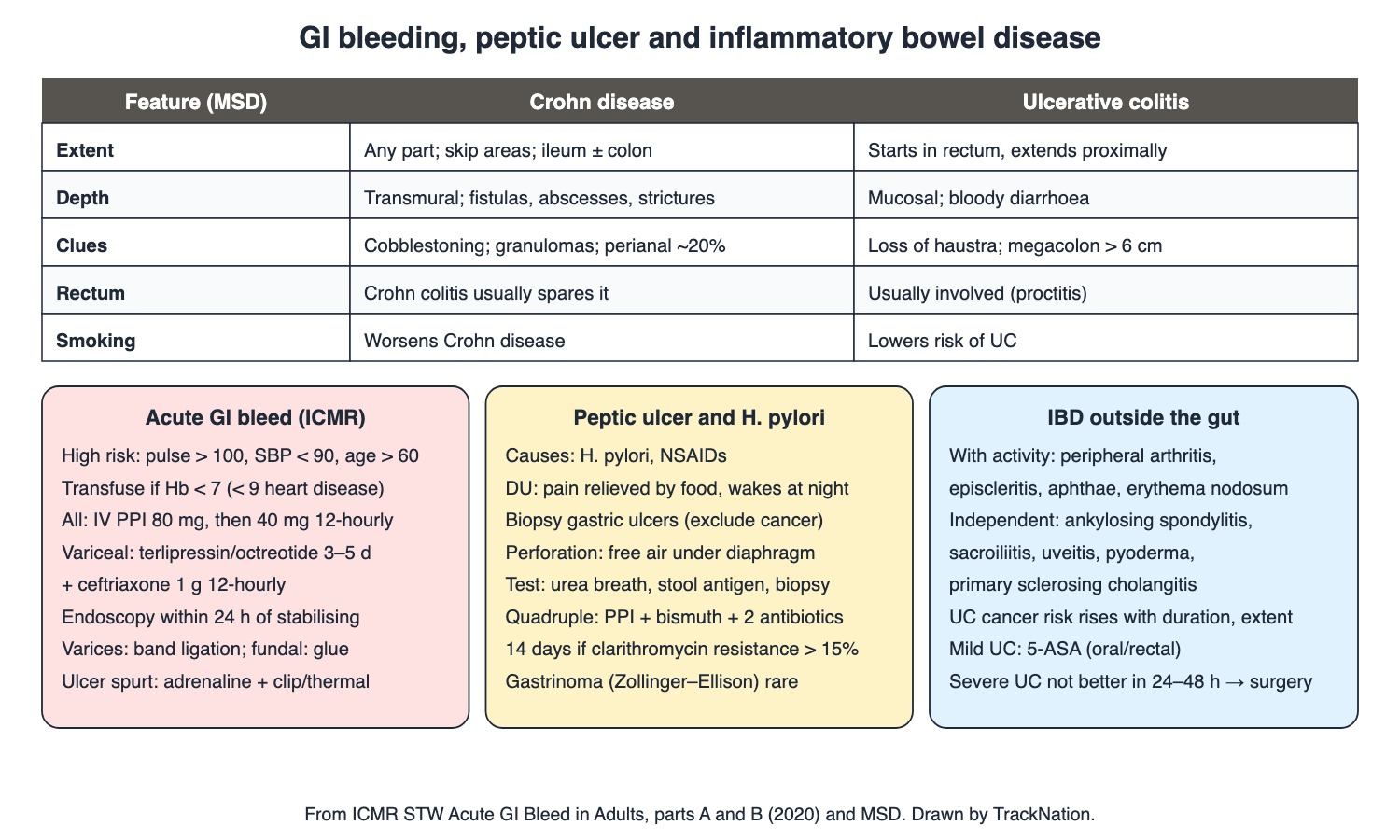
Crohn vs UC, ICMR GI bleed management, peptic ulcer and IBD extraintestinal features. Drawn by TrackNation.
Acute GI Bleeding
Haematemesis or melaena points upper; fresh blood or maroon stools lower. Alcohol, jaundice, ascites or splenomegaly → think varices; epigastric pain, NSAIDs or antiplatelets → ulcer. Up to 15% of upper GI bleeds have no blood in the NG aspirate.
Upper GI causes: duodenal ulcer, gastric ulcer, varices, Mallory–Weiss tear, erosions. In older adults, peptic ulcer, diverticular disease and angiodysplasia cause most major bleeds; haemorrhoids and colorectal cancer most minor ones. In the elderly, always rule out malignancy.
Terlipressin is avoided with heart disease or peripheral vascular disease. Refractory variceal bleeding: covered oesophageal stent or TIPS. Resume low-dose aspirin on day 1 after control.
Step (ICMR STW 2020) | What to do |
High risk (any) | Pulse > 100, SBP < 90, syncope, SpO2 < 90%, altered sensorium, age > 60, significant comorbidity |
Resuscitate | ≥ 1 IV cannula (18 G), crystalloids; O2 if shocked; stop antiplatelets/anticoagulants |
Transfuse | Packed RBC if Hb < 7 g/dL (< 9 with heart disease) |
All patients | IV pantoprazole/esomeprazole 80 mg, then 40 mg 12-hourly (stop if variceal) |
Suspected varices | Terlipressin 2 mg then 1 mg 6-hourly, or somatostatin/octreotide, 3–5 days + ceftriaxone 1 g 12-hourly |
Endoscopy | Within 24 h of stabilisation; varices → band ligation (glue for fundal); ulcer → adrenaline 1:10000 + clip/thermal |
Discharge | Varices: propranolol to HR 60, EVL every 2–3 weeks; ulcer: PPI 4 weeks, test for H. pylori |
Peptic Ulcer and H. pylori
Causes: H. pylori and NSAIDs; gastrinoma (Zollinger–Ellison) is rare.
Duodenal ulcer: pain absent on waking, appears mid-morning, relieved by food, recurs 2–3 h after meals; night pain is highly suggestive. Posterior ulcers penetrate the pancreas (back pain).
Biopsy gastric ulcers to exclude cancer. Perforation: free air on X-ray or CT — absence does not exclude it.
H. pylori: causes gastritis, ulcer, gastric adenocarcinoma and MALT lymphoma. Tests: urea breath test, stool antigen, biopsy. Bismuth quadruple therapy (PPI + bismuth + 2 antibiotics) for 14 days where clarithromycin resistance exceeds 15%.
Autoimmune atrophic gastritis: antibodies against parietal cells → low acid and intrinsic factor → B12 deficiency; treat with parenteral B12.
Crohn Disease and Ulcerative Colitis
Crohn: transmural, anywhere in the gut (usually distal ileum and colon), skip areas, cobblestoning, non-caseating granulomas, fistulas, abscesses, strictures; perianal disease in 20%; Crohn colitis usually spares the rectum. Smoking worsens it and increases recurrence.
UC: mucosal disease that begins in the rectum and extends proximally; bloody diarrhoea; loss of haustra. Toxic colitis with transverse colon > 6 cm is an emergency — avoid barium enema. Colon cancer risk rises with duration and extent. Smoking and appendectomy lower the risk of UC.
Extraintestinal features that follow activity: peripheral arthritis, episcleritis, aphthous ulcers, erythema nodosum. Independent of activity: ankylosing spondylitis (HLA-B27), sacroiliitis, uveitis, pyoderma gangrenosum, primary sclerosing cholangitis (raised ALP and GGT).
Treatment: mild UC — oral and/or rectal 5-ASA; moderate–severe — steroids, biologics or small molecules; severe UC not improving in 24–48 h → surgery. pANCA and ASCA do not reliably separate UC from Crohn disease.
Traps the Examiner Sets
Transfuse at Hb < 7 (not 10); < 9 if heart disease.
Endoscopy within 24 h of stabilisation — not before resuscitation.
Oesophageal varices → band ligation; fundal varices → cyanoacrylate glue.
Duodenal ulcer: food relieves; gastric ulcers need biopsy.
Smoking: bad for Crohn, protective for UC.
Memory Hooks & Shortcuts
Shortcuts to lock in this article's numbers and lists. Each one only re-packages facts proven above.
🧠 GI bleed '100-90-60': pulse > 100, SBP < 90, age > 60 = high risk — high risk
🧠 Transfuse at 7, heart at 9 — transfusion
🧠 Varices: Band the Oesophagus, Glue the Fundus — endotherapy
🧠 Duodenal ulcer: Dinner Delivers relief; Gastric ulcer: Get a biopsy — ulcer pain
🧠 Crohn = Cobblestones, Clefts (fistulas), Chunks skipped, Cigarettes worsen — Crohn
🧠 UC = Up from the rectum, Continuous — UC
Rapid-Revision Cards
GI bleed high risk
Pulse > 100, SBP < 90, syncope, SpO2 < 90, confusion, age > 60.
Transfusion threshold
Hb < 7 (< 9 heart disease).
PPI in bleed
80 mg IV, then 40 mg 12-hourly.
Terlipressin
2 mg then 1 mg 6-hourly × 3–5 d; avoid in IHD/PVD.
Octreotide
50 µg bolus + 50 µg/h × 3–5 d.
Variceal antibiotic
Ceftriaxone 1 g 12-hourly.
Endoscopy timing
Within 24 h of stabilisation.
Oesophageal varices
Band ligation.
Fundal varices
Cyanoacrylate glue.
Ulcer haemostasis
Adrenaline 1:10000 + clip/thermal; PPI 72 h.
Post-variceal
Propranolol to HR 60; EVL q2–3 wk.
Aspirin after bleed
Resume day 1.
Major bleed (elderly)
Ulcer, diverticula, angiodysplasia.
Duodenal ulcer
Relieved by food; night pain.
Gastric ulcer
Biopsy to exclude cancer.
Perforation
Free air; absence doesn't exclude.
H. pylori tests
Urea breath, stool antigen, biopsy.
H. pylori Rx
Bismuth quadruple × 14 d.
Autoimmune gastritis
Parietal cell → B12 deficiency.
Crohn
Transmural, skip, cobblestone, granulomas, fistulas.
UC
Rectum upward, mucosal, bloody diarrhoea.
Toxic colitis
Transverse colon > 6 cm; no barium.
Smoking and IBD
Worse Crohn; less UC.
IBD independent of activity
AS, uveitis, pyoderma, PSC.
Sources
Facts in this article were checked against these documents.
Standard Treatment Workflow: Acute Gastrointestinal Bleed in Adults, Parts A and B — Indian Council of Medical Research, DHR, 2020 (link)
MSD Manual Professional: Overview of GI Bleeding; Varices; Peptic Ulcer Disease; H. pylori Infection; Autoimmune Metaplastic Atrophic Gastritis; Overview of IBD; Crohn Disease; Ulcerative Colitis — Merck & Co. (MSD Manuals), reviewed 2025–26 (link)
Competency Based Undergraduate Curriculum, General Medicine (GM 15) — National Medical Commission, 2024
Test Yourself: Practice Questions
Thirty questions in NEET PG style, most of them clinical vignettes.
Practice Questions (NEET PG pattern)
Original questions written in the style of the exam: +4 for a correct answer, −1 for a wrong one. Every answer was checked against the sources listed above. NEET PG papers are not published by NBEMS, so these are not past-paper questions.
Q1. A man with haematemesis has pulse 118/min and BP 84/50 mm Hg. Under the ICMR workflow he is
(a) low risk — discharge with PPI
(b) high risk only if Hb < 5
(c) high risk — resuscitate and refer after stabilisation
(d) not a GI bleed
Show answer
Answer: (c) — Pulse > 100 or SBP < 90 = high risk.
Q2. In acute GI bleeding without heart disease, packed red cells are given when haemoglobin falls below
(a) 7 g/dL
(b) 10 g/dL
(c) 5 g/dL
(d) 12 g/dL
Show answer
Answer: (a) — Below 9 g/dL with pre-existing heart disease.
Q3. A patient with known heart disease has an active GI bleed. The transfusion threshold per ICMR is haemoglobin below
(a) 12 g/dL
(b) 6 g/dL
(c) 9 g/dL
(d) 7 g/dL
Show answer
Answer: (c) — Restrictive otherwise.
Q4. Every patient with acute upper GI bleeding should initially receive
(a) IV tranexamic acid only
(b) nothing until endoscopy
(c) IV pantoprazole or esomeprazole 80 mg, then 40 mg 12-hourly
(d) oral antacids only
Show answer
Answer: (c) — Stopped if a variceal bleed is documented.
Q5. A man with alcohol use, ascites and splenomegaly vomits blood. Before endoscopy, the vasoactive drug regimen per ICMR is
(a) adrenaline infusion
(b) vasopressin orally
(c) terlipressin 2 mg IV then 1 mg 6-hourly for 3–5 days
(d) propranolol IV
Show answer
Answer: (c) — Or somatostatin/octreotide infusion.
Q6. Terlipressin should be avoided in a patient with suspected variceal bleeding who also has
(a) ischaemic heart disease or peripheral vascular disease
(b) hepatitis B
(c) asthma
(d) diabetes
Show answer
Answer: (a) — Watch for peripheral or cardiac ischaemia.
Q7. In suspected variceal bleeding, along with vasoactive drugs, the patient should receive
(a) no antibiotics
(b) vancomycin
(c) oral metronidazole only
(d) IV ceftriaxone 1 g 12-hourly for 3–5 days
Show answer
Answer: (d) — Antibiotic prophylaxis.
Q8. Per the ICMR workflow, endoscopy in acute GI bleeding should be done
(a) within 24 hours of initial stabilisation
(b) only if bleeding recurs
(c) before any resuscitation
(d) after 1 week
Show answer
Answer: (a) — Earlier if bleeding is active.
Q9. Endoscopy shows bleeding oesophageal varices. The preferred endoscopic therapy is
(a) argon plasma coagulation
(b) cyanoacrylate glue
(c) variceal band ligation
(d) adrenaline injection alone
Show answer
Answer: (c) — Sclerotherapy if banding is not possible.
Q10. Endoscopy shows bleeding gastric fundal varices. The ICMR workflow advises
(a) cyanoacrylate glue injection
(b) PPI only
(c) biopsy
(d) band ligation
Show answer
Answer: (a) — 0.5–1 mL per varix.
Q11. A duodenal ulcer shows a visible vessel. Endoscopic haemostasis includes
(a) no therapy
(b) glue injection
(c) adrenaline 1:10000 injected around the ulcer plus clips or thermal therapy
(d) band ligation
Show answer
Answer: (c) — Then PPI infusion for 72 hours.
Q12. After endoscopic control of a variceal bleed, discharge treatment includes
(a) propranolol titrated to heart rate 60/min and repeat band ligation every 2–3 weeks
(b) long-term terlipressin
(c) NSAIDs
(d) aspirin
Show answer
Answer: (a) — Until varices are eradicated.
Q13. A patient on aspirin for a coronary stent has an ulcer bleed controlled endoscopically. Low-dose aspirin should be
(a) replaced with an NSAID
(b) stopped for 6 months
(c) never restarted
(d) resumed on day 1 after control
Show answer
Answer: (d) — Other antiplatelets/anticoagulants by day 3–5, with cardiology input.
Q14. In older adults, the commonest causes of major GI bleeding are
(a) typhoid
(b) Meckel diverticulum
(c) peptic ulcer, diverticular disease and angiodysplasia
(d) haemorrhoids and fissures
Show answer
Answer: (c) — Haemorrhoids and colorectal cancer cause most minor bleeds.
Q15. A patient with melaena has a clear nasogastric aspirate. This
(a) proves a colonic source
(b) rules out upper GI bleeding
(c) means no bleeding
(d) does not exclude upper GI bleeding (up to 15% have no blood in the aspirate)
Show answer
Answer: (d) — Endoscopy is still needed.
Q16. A man has epigastric pain that is absent on waking, starts mid-morning, is relieved by food, returns 2–3 hours after meals and wakes him at night. The likely diagnosis is
(a) duodenal ulcer
(b) pancreatitis
(c) gastric cancer
(d) biliary colic
Show answer
Answer: (a) — Night pain is highly suggestive.
Q17. The two main causes of peptic ulcer disease are
(a) smoking and coffee
(b) gastrinoma and alcohol
(c) Helicobacter pylori and NSAIDs
(d) stress and spicy food
Show answer
Answer: (c) — Gastrinoma is rare.
Q18. A gastric ulcer is found at endoscopy. It should be
(a) biopsied to distinguish benign ulcer from ulcerating cancer
(b) left alone
(c) treated surgically at once
(d) ignored if painless
Show answer
Answer: (a) — Gastric cancer can mimic a benign ulcer.
Q19. A patient with a known ulcer develops sudden severe abdominal pain; an erect chest X-ray shows no free air. Perforation is
(a) excluded
(b) irrelevant
(c) not excluded — get a CT
(d) confirmed
Show answer
Answer: (c) — Free air confirms but its absence does not exclude.
Q20. A non-invasive test for active H. pylori infection is
(a) CEA
(b) barium meal
(c) urea breath test
(d) serum gastrin
Show answer
Answer: (c) — Also stool antigen; biopsy at endoscopy.
Q21. Where clarithromycin resistance exceeds 15%, the best initial H. pylori regimen is
(a) PPI alone
(b) clarithromycin triple therapy for 7 days
(c) amoxicillin alone
(d) bismuth quadruple therapy for 14 days
Show answer
Answer: (d) — PPI + bismuth + 2 antibiotics.
Q22. H. pylori infection is associated with all EXCEPT
(a) gastric adenocarcinoma
(b) ulcerative colitis
(c) peptic ulcer
(d) MALT lymphoma
Show answer
Answer: (b) — It causes gastritis, ulcer, adenocarcinoma and gastric lymphoma.
Q23. A patient has B12 deficiency due to antibodies against gastric parietal cells. The treatment is
(a) folate alone
(b) oral iron
(c) H. pylori eradication
(d) parenteral vitamin B12
Show answer
Answer: (d) — Autoimmune atrophic gastritis → low intrinsic factor.
Q24. A patient has chronic diarrhoea, abdominal pain and a perianal fistula; colonoscopy shows patchy ulcers with normal intervening mucosa and a cobblestone pattern. The diagnosis is
(a) ischaemic colitis
(b) Crohn disease
(c) irritable bowel syndrome
(d) ulcerative colitis
Show answer
Answer: (b) — Skip areas, cobblestoning, perianal disease.
Q25. Biopsy of the bowel in Crohn disease may show
(a) non-caseating granulomas
(b) Reed–Sternberg cells
(c) crypt abscesses only in the rectum
(d) caseating granulomas
Show answer
Answer: (a) — Pathognomonic when present, but often absent.
Q26. A patient has bloody diarrhoea with inflammation starting at the rectum and extending continuously upward. The diagnosis is
(a) ulcerative colitis
(b) coeliac disease
(c) Crohn disease
(d) amoebic liver abscess
Show answer
Answer: (a) — UC usually begins in the rectum.
Q27. A patient with severe ulcerative colitis has abdominal distension and suspected toxic colitis. The investigation to avoid is
(a) careful sigmoidoscopy
(b) blood counts and electrolytes
(c) plain abdominal X-ray
(d) barium enema
Show answer
Answer: (d) — Risk of perforation; plain films may show megacolon (transverse colon > 6 cm).
Q28. The risk of colon cancer in ulcerative colitis relates mainly to
(a) age at first flare only
(b) number of flares only
(c) duration and extent of disease
(d) smoking
Show answer
Answer: (c) — Not necessarily to the severity of attacks.
Q29. Cigarette smoking
(a) has no link with IBD
(b) protects against Crohn disease
(c) worsens Crohn disease but lowers the risk of ulcerative colitis
(d) worsens UC only
Show answer
Answer: (c) — Advise smokers with Crohn disease to stop.
Q30. An extraintestinal manifestation of IBD that runs independently of bowel disease activity is
(a) erythema nodosum
(b) peripheral arthritis
(c) aphthous stomatitis
(d) primary sclerosing cholangitis
Show answer
Answer: (d) — Also ankylosing spondylitis, uveitis, pyoderma gangrenosum.
Active Recall
From memory: list high-risk features and the ICMR steps in acute GI bleed (transfusion, PPI, vasoactive drugs, antibiotics, endoscopy and endotherapy), give causes of GI bleeding, describe duodenal ulcer pain, H. pylori tests and treatment, and contrast Crohn disease with ulcerative colitis including extraintestinal features.