Superficial Fungal Infections for NEET PG Dermatology: Tinea, Steroid-Modified Tinea, Tinea Capitis and Kerion, Onychomycosis, Pityriasis Versicolor, Candida
Start Here
🎯 Exam priority: High. Expect: KOH findings (septate hyphae, spaghetti and meatballs, pseudohyphae), steroid-modified tinea and why steroid creams are banned, ICMR treatment duration, tinea capitis with Wood light and kerion, terbinafine vs griseofulvin, onychomycosis patterns, pityriasis versicolor treatment and recurrence, and candida with satellite lesions.
CBME mapping: DR 7.1–7.2. Antifungal pharmacology is in Pharmacology; fungal morphology in Microbiology.
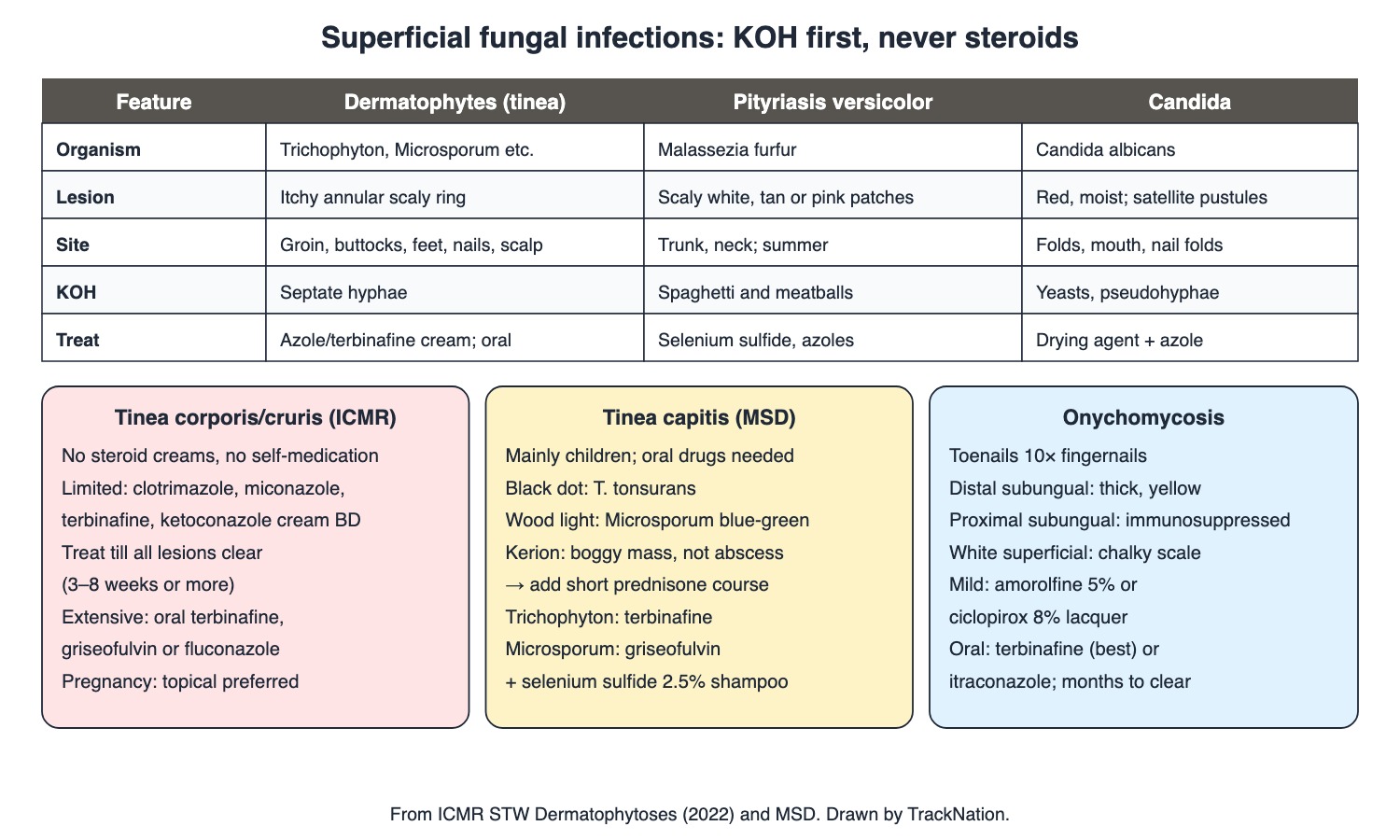
Dermatophytes, pityriasis versicolor and candida compared; ICMR tinea treatment; tinea capitis; onychomycosis. Drawn by TrackNation.
Dermatophytes and Tinea (ICMR)
Dermatophytes — Trichophyton, Microsporum, Epidermophyton — are moulds that need keratin and so infect skin, hair and nails. Tinea corporis/cruris: itchy annular (ring-like) lesions with variable scaling and redness. Always examine groins, buttocks, nails, palms and soles, and ask about family members.
Doubtful cases: KOH microscopy of scales shows septate hyphae; culture is not needed routinely.
Steroid-modified tinea (tinea incognito): self-applied steroid or combination creams leave an incomplete ring, little scale and prominent pigmentation. ICMR: never use steroid-containing creams bought over the counter and do not self-medicate.
Tinea cruris is commoner in men (scrotum against thigh) and usually spares the scrotum, which is often inflamed in candidal intertrigo. Tinea pedis: interdigital (lateral 3 toes), moccasin (T. rubrum), vesiculobullous; often one-sided with nail involvement; can lead to cellulitis. Advise no barefoot walking in public baths and drying toe webs.
General measures: daily bath, dry well, do not share towels or clothes, wash clothes in hot water and sun-dry, finish the full course.
Situation (ICMR) | Treatment |
Limited tinea corporis/cruris | Clotrimazole 1–2%, miconazole 2%, terbinafine 1% or ketoconazole 2% cream twice daily until all lesions clear (3–8 weeks or more) |
Extensive disease | Oral terbinafine, griseofulvin or fluconazole (adult doses in the STW), creams only on the most troublesome lesions |
Children | Look for infection in caregivers; topical for young children; weight-based oral dosing |
Pregnancy | Preferably topical (miconazole, clotrimazole); fluconazole if a systemic drug is unavoidable |
Refer | Very extensive, no improvement after 4 weeks, recurrent, comorbidities, prolonged steroid use |
Onychomycosis | Under 50% of nail, lunula spared: amorolfine 5% weekly or ciclopirox 8% lacquer; otherwise oral terbinafine (6 weeks fingernails, 12 weeks toenails) or itraconazole (continuous or monthly pulses) |
Tinea Capitis and Onychomycosis
Tinea capitis mainly affects children, is contagious and can be epidemic. T. tonsurans causes black-dot ringworm (hairs break at the scalp) and does not fluoresce; Microsporum canis and M. audouinii give blue-green Wood light fluorescence. A kerion is a boggy inflammatory mass that can be mistaken for an abscess — do not drain it; it can scar.
Treatment must be oral: terbinafine for Trichophyton, griseofulvin for Microsporum in children; add selenium sulfide 2.5% shampoo twice weekly to limit spread and a short prednisone course for kerion. Children may attend school.
Onychomycosis: toenails are 10 times more often affected. Distal subungual (thick yellow nail, debris, onycholysis), proximal subungual (a marker of immunosuppression), white superficial (chalky scale). Confirm with KOH, culture, PAS histology or PCR. Terbinafine gives better cure rates than azoles. Treat especially if there was previous cellulitis or diabetes. Nails take months to look normal.
Pityriasis Versicolor and Candidiasis
Pityriasis (tinea) versicolor: Malassezia furfur, a normal commensal yeast; asymptomatic scaly white, tan, brown or pink patches on trunk, neck and abdomen, noticed in summer. Hypopigmentation is from tyrosinase inhibition and recovers over months to years. KOH: hyphae with budding cells — "spaghetti and meatballs". Treat with selenium sulfide 2.5% or ketoconazole 2%; oral fluconazole for extensive disease. Recurrence is frequent. Differential: vitiligo.
Cutaneous candidiasis (Candida albicans): red, macerated lesions in folds with satellite papules and pustules; risk with moisture, occlusion, immunosuppression, antibiotics. KOH shows yeasts and pseudohyphae. Chronic paronychia in people whose hands are often wet (e.g. kitchen workers); oral thrush — creamy white patches that bleed when scraped; diaper rash. Treat with a drying agent and topical azole; frequent diaper changes; oral fluconazole for extensive disease.
Traps the Examiner Sets
Steroid-antifungal combination creams worsen and disguise tinea — never prescribe them.
Scrotum spared = tinea; scrotum involved = candida.
Tinea capitis needs oral therapy; a "scalp abscess" in a child may be a kerion.
Proximal subungual onychomycosis: think immunosuppression (HIV).
Memory Hooks & Shortcuts
Shortcuts to lock in this article's numbers and lists. Each one only re-packages facts proven above.
🧠 Dermatophytes 'TEM': Trichophyton, Epidermophyton, Microsporum — genera
🧠 'Tinea Spares the Scrotum; Candida Covers it' — groin rash
🧠 Wood light: 'Microsporum Makes it glow green' — tinea capitis
🧠 Capitis drugs: 'Trich → Terbinafine; Micro → griseofulvin' — treatment
🧠 Versicolor KOH: 'spaghetti and meatballs' — pityriasis versicolor
Rapid-Revision Cards
Dermatophytes
Trichophyton, Microsporum, Epidermophyton.
Need
Keratin: skin, hair, nails.
KOH tinea
Septate hyphae.
Tinea incognito
Steroid-modified: incomplete ring.
Steroid creams
Never in fungal infection.
Topical duration
Until clear: 3–8 weeks+.
Tinea cruris
Spares scrotum.
Moccasin foot
T. rubrum.
Black dot
T. tonsurans; no fluorescence.
Wood light green
Microsporum.
Kerion
Boggy mass; don't drain; add prednisone.
Capitis treatment
Oral: terbinafine (Trich), griseofulvin (Micro).
Toenails
10× fingernails.
Proximal subungual
Immunosuppression.
Onycho drug
Terbinafine > azoles.
Nail lacquer
Amorolfine 5%, ciclopirox 8%.
Versicolor
Malassezia; summer; recurs.
Versicolor KOH
Spaghetti and meatballs.
Hypopigmentation
Tyrosinase inhibition.
Candida
Satellite pustules; pseudohyphae.
Paronychia
Wet hands; candida.
Sources
Facts in this article were checked against these documents.
Standard Treatment Workflow: Dermatophytoses — Indian Council of Medical Research, DHR, 2022 (link)
MSD Manual Professional: Dermatophytoses; Tinea Capitis; Tinea Cruris; Tinea Pedis; Onychomycosis; Tinea Versicolor; Mucocutaneous Candidiasis — Merck & Co. (MSD Manuals), reviewed 2025–26 (link)
Competency Based Undergraduate Curriculum, Dermatology (DR 7) — National Medical Commission, 2024
Test Yourself: Practice Questions
Thirty questions in NEET PG style, most of them clinical vignettes.
Practice Questions (NEET PG pattern)
Original questions written in the style of the exam: +4 for a correct answer, −1 for a wrong one. Every answer was checked against the sources listed above. NEET PG papers are not published by NBEMS, so these are not past-paper questions.
Q1. Dermatophytes infect skin, hair and nails because they
(a) need sebum
(b) need melanin
(c) need keratin
(d) live in sweat glands
Show answer
Answer: (c) — Keratin-bearing structures.
Q2. Which genus is NOT a dermatophyte?
(a) Malassezia
(b) Microsporum
(c) Epidermophyton
(d) Trichophyton
Show answer
Answer: (a) — Malassezia is a yeast causing pityriasis versicolor.
Q3. A patient has an itchy annular scaly lesion on the thigh. KOH microscopy of scales would show
(a) budding yeasts only
(b) spaghetti and meatballs
(c) acantholytic cells
(d) septate hyphae
Show answer
Answer: (d) — Dermatophyte.
Q4. A patient used an over-the-counter steroid–antifungal cream for months; the lesions now have an incomplete ring, little scale and marked pigmentation. This is
(a) lichen planus
(b) steroid-modified tinea (tinea incognito)
(c) fixed drug eruption
(d) psoriasis
Show answer
Answer: (b) — Lesions lose classic features.
Q5. ICMR advice on steroid-containing creams for fungal infection is to
(a) use them with antifungals
(b) use them on the face only
(c) never use them
(d) use them for 1 week
Show answer
Answer: (c) — And never self-medicate.
Q6. Limited tinea corporis is treated (ICMR) with
(a) oral fluconazole once
(b) a topical azole or terbinafine cream twice daily until all lesions clear
(c) topical steroid
(d) oral griseofulvin for 3 days
Show answer
Answer: (b) — Often 3–8 weeks.
Q7. Topical treatment of tinea usually needs to continue for
(a) 3 days
(b) 3–8 weeks or more, until all lesions resolve
(c) 1 week exactly
(d) 6 months always
Show answer
Answer: (b) — Longer with palms/soles or prior steroid use.
Q8. A child has tinea corporis. ICMR asks you to
(a) avoid treatment
(b) do a biopsy
(c) give oral steroids
(d) look for infection in parents and caregivers
Show answer
Answer: (d) — Prefer topicals in young children.
Q9. If a pregnant woman with extensive tinea needs a systemic antifungal, ICMR suggests
(a) terbinafine
(b) fluconazole may be preferred
(c) itraconazole
(d) griseofulvin
Show answer
Answer: (b) — Prefer topicals in pregnancy.
Q10. A man has a scaly itchy rash in both groins with a raised edge; the scrotum is spared. The likely diagnosis is
(a) tinea cruris
(b) lichen simplex chronicus
(c) erythrasma
(d) candidal intertrigo
Show answer
Answer: (a) — Candida often involves the scrotum.
Q11. Scaling and thickening of the soles in a moccasin distribution is caused mainly by
(a) Trichophyton rubrum
(b) Microsporum canis
(c) Malassezia
(d) Candida albicans
Show answer
Answer: (a) — Chronic hyperkeratotic tinea pedis.
Q12. Interdigital tinea pedis matters in a diabetic because it can lead to
(a) vitiligo
(b) melanoma
(c) psoriasis
(d) cellulitis and lymphangitis
Show answer
Answer: (d) — Secondary bacterial infection.
Q13. A child has patchy scalp hair loss with black dots where hairs have broken at the surface; Wood light shows no fluorescence. The likely organism is
(a) Candida albicans
(b) Malassezia furfur
(c) Trichophyton tonsurans
(d) Microsporum canis
Show answer
Answer: (c) — Black-dot ringworm.
Q14. Blue-green fluorescence of scalp hairs under Wood light suggests
(a) Candida
(b) Trichophyton tonsurans
(c) pityriasis versicolor
(d) Microsporum canis or audouinii
Show answer
Answer: (d) — Ectothrix Microsporum.
Q15. A child has a boggy, tender, pustular scalp mass with hair loss, referred for incision of an 'abscess'. The likely diagnosis is
(a) kerion
(b) lipoma
(c) carbuncle
(d) pilar cyst
Show answer
Answer: (a) — Consider kerion before draining.
Q16. Tinea capitis must be treated with
(a) antibiotics
(b) topical cream alone
(c) steroid lotion
(d) oral antifungals (with topical adjuncts)
Show answer
Answer: (d) — Topicals only help limit spread.
Q17. For tinea capitis due to Microsporum in a child, the preferred oral drug is
(a) itraconazole
(b) fluconazole
(c) terbinafine
(d) griseofulvin
Show answer
Answer: (d) — Terbinafine for Trichophyton.
Q18. A kerion is treated with an oral antifungal plus
(a) incision and drainage
(b) a short course of oral prednisone
(c) oral antibiotics alone
(d) topical steroid alone
Show answer
Answer: (b) — Reduces symptoms and possibly scarring.
Q19. Which onychomycosis pattern is a marker of immunosuppression?
(a) white superficial
(b) candidal paronychia
(c) proximal subungual
(d) distal subungual
Show answer
Answer: (c) — Starts at the proximal nail.
Q20. Compared with terbinafine, azoles in onychomycosis have
(a) higher cure rates
(b) lower clinical and mycological cure rates
(c) no role
(d) the same cure rates always
Show answer
Answer: (b) — Terbinafine preferred.
Q21. ICMR topical option for limited onychomycosis (< 50% of nail, lunula spared) is
(a) permethrin
(b) amorolfine 5% or ciclopirox 8% nail lacquer
(c) clobetasol
(d) selenium sulfide
Show answer
Answer: (b) — Oral drugs otherwise.
Q22. Toenail onychomycosis compared with fingernail onychomycosis is
(a) never seen
(b) equally common
(c) rarer
(d) about 10 times more common
Show answer
Answer: (d) — Per MSD.
Q23. A patient has asymptomatic, finely scaly hypopigmented patches on the upper trunk that he noticed in summer. KOH of the scale shows
(a) hyphae and budding cells (spaghetti and meatballs)
(b) septate hyphae only
(c) acantholytic cells
(d) multinucleated giant cells
Show answer
Answer: (a) — Pityriasis versicolor.
Q24. Hypopigmentation in pityriasis versicolor is due to
(a) post-inflammatory change only
(b) inhibition of tyrosinase by Malassezia
(c) destruction of melanocytes
(d) vitamin deficiency
Show answer
Answer: (b) — Reversible over months to years.
Q25. A topical treatment for pityriasis versicolor is
(a) permethrin 5%
(b) selenium sulfide 2.5% or ketoconazole 2%
(c) benzoyl peroxide
(d) clobetasol
Show answer
Answer: (b) — Oral fluconazole if extensive.
Q26. Pityriasis versicolor frequently recurs because
(a) patients are immunodeficient
(b) it is sexually transmitted
(c) it is drug resistant
(d) Malassezia is a normal skin commensal
Show answer
Answer: (d) — Prophylactic measures lower recurrence.
Q27. A woman has red, macerated patches under the breasts with satellite papules and pustules. The likely diagnosis is
(a) psoriasis
(b) erythrasma
(c) cutaneous candidiasis (intertrigo)
(d) tinea corporis
Show answer
Answer: (c) — Satellite lesions.
Q28. KOH mount of scrapings in cutaneous candidiasis shows
(a) septate hyphae only
(b) yeast and pseudohyphae
(c) spaghetti and meatballs
(d) spores in hair shafts
Show answer
Answer: (b) — Diagnostic finding.
Q29. A cook whose hands are always wet has painful red swelling of the nail folds. The likely cause is
(a) herpetic whitlow
(b) scabies
(c) psoriasis
(d) Candida (chronic paronychia)
Show answer
Answer: (d) — Protect from wetness; antifungals.
Q30. Most intertriginous candidiasis is treated with
(a) permethrin
(b) oral griseofulvin
(c) a drying agent and a topical antifungal
(d) topical steroid alone
Show answer
Answer: (c) — Oral fluconazole for extensive disease.
Active Recall
From memory: name the dermatophytes and KOH findings, explain steroid-modified tinea and the ICMR treatment rules, describe tinea capitis, kerion and onychomycosis with their treatment, and contrast pityriasis versicolor and candidiasis.