Liver Disease for NEET PG Medicine: Viral Hepatitis, Jaundice, Cirrhosis, Ascites, SBP, Encephalopathy, Liver Failure
Start Here
🎯 Exam priority: High. Expect: hepatitis viruses compared, HBV serology and the window period, vertical HBV, HCV and HEV facts, jaundice patterns, Gilbert and Dubin-Johnson, AST:ALT in alcohol, steroids in alcoholic hepatitis, SAAG, ascites and SBP treatment, encephalopathy precipitants and drugs, and the definitions of acute and acute-on-chronic liver failure.
CBME mapping: GM 5.1–5.17. Liver pathology is in Pathology; variceal bleeding in article 13; ATT hepatitis in article 7.
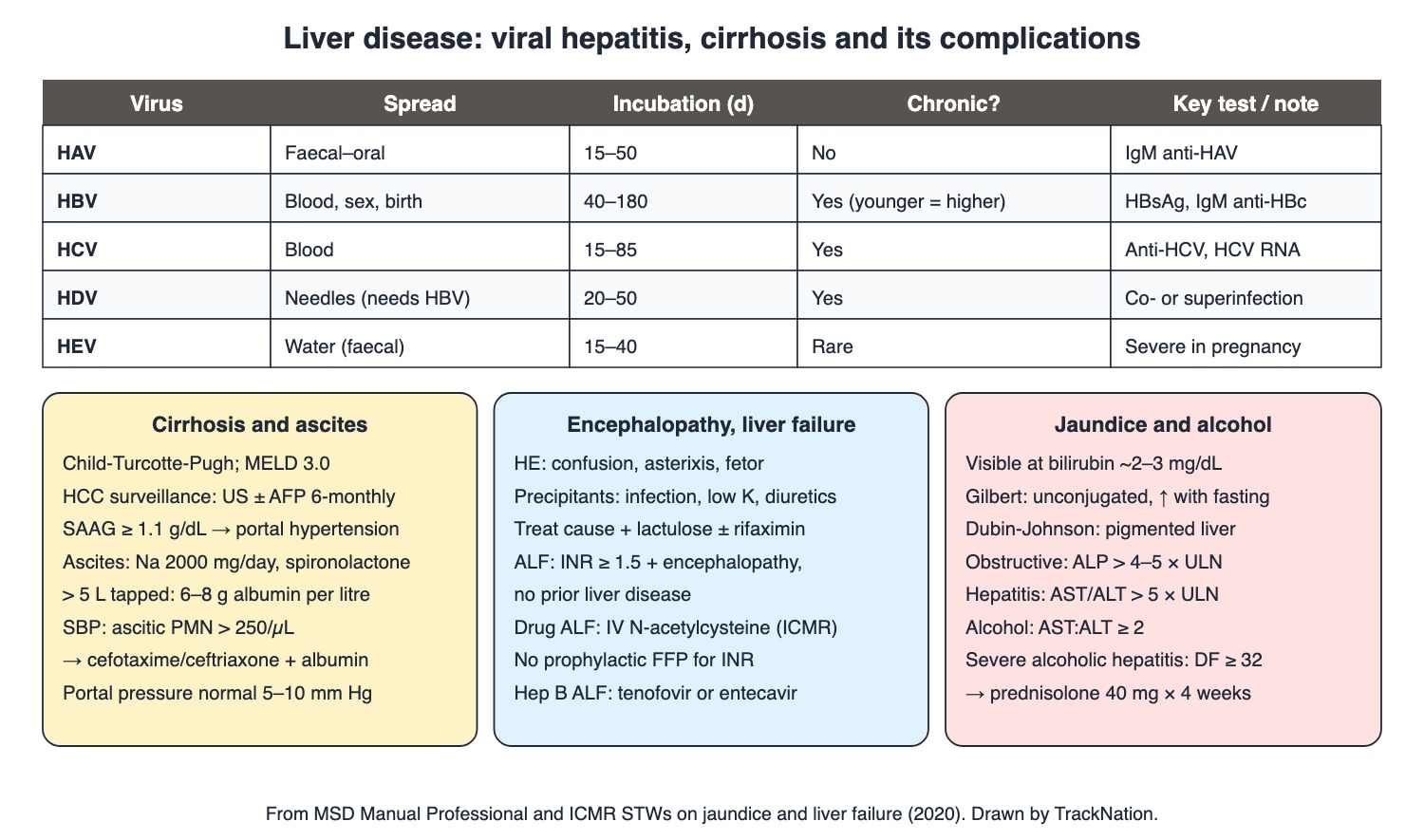
Hepatitis viruses, cirrhosis complications, encephalopathy, liver failure and jaundice. Drawn by TrackNation.
Viral Hepatitis
Acute hepatitis: a viral prodrome, anorexia and nausea; jaundice often appears as other symptoms settle.
HAV: faecal–oral, incubation 15–50 days, never chronic; diagnose with IgM anti-HAV.
HBV: blood, sex and birth (infants of infected mothers have a 70–90% risk at delivery without HBIG and vaccine). Chronic = > 6 months; the younger the age at infection, the higher the chance of chronicity. Treat chronic HBV with entecavir or tenofovir. HCC risk rises even without cirrhosis.
HCV: blood-borne, often chronic; pangenotypic sofosbuvir/velpatasvir or glecaprevir/pibrentasvir. Extrahepatic: mixed cryoglobulinaemia, glomerulonephritis, porphyria cutanea tarda.
HDV replicates only with HBV (co-infection or superinfection). HEV: waterborne outbreaks; acute liver failure and death are rare except in pregnancy.
Marker | Meaning (MSD) |
HBsAg | Appears in the incubation period, 1–6 weeks before illness; means the blood is infectious |
IgM anti-HBc | Recent infection; may be the only marker in the window between HBsAg loss and anti-HBs |
Anti-HBs | Appears after recovery and usually lasts for life — past infection or immunity |
HBeAg / anti-HBe | Help judge prognosis and guide antiviral therapy |
Jaundice and Alcohol
Jaundice is visible at bilirubin about 2–3 mg/dL.
ICMR patterns: isolated unconjugated rise with normal enzymes (haemolysis, congenital); obstructive — ALP > 4–5 × ULN with dilated ducts on ultrasound; hepatitis — AST/ALT usually > 5 × ULN (< 500 in alcoholic hepatitis). Refer if INR > 1.5, altered sensorium or bleeding.
Gilbert: mild unconjugated hyperbilirubinaemia that rises with fasting or stress; harmless. Crigler–Najjar type I: severe unconjugated jaundice from birth, kernicterus. Dubin–Johnson: conjugated; the liver is deeply pigmented.
Alcohol: AST:ALT ≥ 2 (vitamin B6 deficiency lowers ALT); Mallory hyaline. Severe alcoholic hepatitis (Maddrey DF ≥ 32) → prednisolone 40 mg/day for 4 weeks if no infection, GI bleed, renal failure or pancreatitis.
Cirrhosis, Portal Hypertension, Ascites, SBP
Signs of chronic liver disease: spider angiomas, gynaecomastia, axillary hair loss, testicular atrophy, Dupuytren contracture; caput medusae is rare. Severity: Child-Turcotte-Pugh and MELD 3.0. HCC surveillance: ultrasound ± AFP every 6 months.
Portal hypertension: normal portal pressure 5–10 mm Hg; cirrhosis is the commonest intrahepatic cause. Varices are managed with endoscopy and non-selective beta-blockers; TIPS if refractory.
Ascites: SAAG ≥ 1.1 g/dL = portal hypertension. Treat with sodium restriction (2000 mg/day) first, then spironolactone ± furosemide; large-volume paracentesis > 5 L needs 6–8 g albumin per litre removed.
SBP: ascitic neutrophils > 250/µL; usually E. coli or Klebsiella. Treat with ceftriaxone or cefotaxime plus albumin 1.5 g/kg on day 1 and 1 g/kg on day 3 (prevents hepatorenal syndrome).
Encephalopathy and Liver Failure
Hepatic encephalopathy: confusion, asterixis, coma, fetor hepaticus. Precipitants: infection, hypokalaemia, dehydration, diuretics, GI bleeding. Treat the cause plus lactulose and rifaximin.
Acute liver failure: INR ≥ 1.5 with encephalopathy in someone without prior liver disease (MSD). ICMR: jaundice for < 4 weeks with encephalopathy and INR ≥ 1.5. Causes in India include viral hepatitis (HEV in pregnancy), drugs such as ATT, and acute fatty liver of pregnancy/HELLP (deliver promptly).
ACLF (ICMR): known chronic liver disease with an acute insult — bilirubin ≥ 5 mg/dL and INR ≥ 1.5, plus ascites or encephalopathy within 4 weeks.
ICMR management: IV N-acetylcysteine in drug-induced ALF (150 mg/kg over 1 h); tenofovir or entecavir for hepatitis B; no prophylactic FFP for the INR; ceftriaxone for SBP.
Traps the Examiner Sets
Window period of HBV: only IgM anti-HBc is positive.
HAV and HEV are faecal–oral; HEV kills in pregnancy.
AST:ALT ≥ 2 suggests alcohol.
SAAG ≥ 1.1 = portal hypertension; SBP = neutrophils > 250.
Do not give FFP just to correct the INR in acute liver failure.
Memory Hooks & Shortcuts
Shortcuts to lock in this article's numbers and lists. Each one only re-packages facts proven above.
🧠 Vowels hit the bowels: hepatitis A and E are faecal–oral — hepatitis spread
🧠 HBV window: 'Core alone' — only IgM anti-HBc — window period
🧠 D is Dependent on B — HDV
🧠 E for Expecting mothers in danger — HEV pregnancy
🧠 Alcohol: 'S before L' — AST twice ALT — AST:ALT
🧠 SBP 250, SAAG 1.1 — ascites numbers
Rapid-Revision Cards
HAV
Faecal–oral, 15–50 d, never chronic; IgM anti-HAV.
HBsAg
Incubation; blood infectious.
HBV window
Only IgM anti-HBc positive.
Anti-HBs
Recovery or vaccine; lifelong.
Vertical HBV
70–90% without HBIG + vaccine.
Chronic hepatitis
> 6 months.
Chronic HBV drugs
Entecavir or tenofovir.
HCV drugs
Sofosbuvir/velpatasvir; glecaprevir/pibrentasvir.
HCV extrahepatic
Mixed cryoglobulinaemia, GN, PCT.
HDV
Needs HBV.
HEV
Waterborne; deadly in pregnancy.
Visible jaundice
Bilirubin ~2–3 mg/dL.
Gilbert
Unconjugated, rises with fasting.
Crigler–Najjar I
No enzyme; kernicterus.
Dubin–Johnson
Conjugated; deeply pigmented liver.
Obstructive pattern
ALP > 4–5 × ULN.
Alcohol LFTs
AST:ALT ≥ 2.
Alcoholic hepatitis steroids
DF ≥ 32 → prednisolone 40 mg × 4 wk.
HCC surveillance
US ± AFP 6-monthly.
SAAG ≥ 1.1
Portal hypertension.
Ascites Rx
Na 2000 mg/d → spironolactone ± furosemide.
LVP albumin
> 5 L: 6–8 g per litre.
SBP
PMN > 250; ceftriaxone + albumin 1.5 then 1 g/kg.
HE drugs
Lactulose + rifaximin.
ALF
INR ≥ 1.5 + encephalopathy, no prior liver disease.
ACLF (ICMR)
Bili ≥ 5, INR ≥ 1.5, ascites/HE ≤ 4 wk.
Sources
Facts in this article were checked against these documents.
Standard Treatment Workflows: Jaundice; Liver Failure — Indian Council of Medical Research, DHR, 2020 (link)
MSD Manual Professional: Hepatitis A–E; Cirrhosis; Ascites; Spontaneous Bacterial Peritonitis; Portal Hypertension; Portosystemic Encephalopathy; Acute Liver Failure; Jaundice; Inborn Metabolic Disorders Causing Hyperbilirubinemia; Alcohol-Related Liver Disease — Merck & Co. (MSD Manuals), reviewed 2025–26 (link)
Competency Based Undergraduate Curriculum, General Medicine (GM 5) — National Medical Commission, 2024
Test Yourself: Practice Questions
Thirty questions in NEET PG style, most of them clinical vignettes.
Practice Questions (NEET PG pattern)
Original questions written in the style of the exam: +4 for a correct answer, −1 for a wrong one. Every answer was checked against the sources listed above. NEET PG papers are not published by NBEMS, so these are not past-paper questions.
Q1. In a community with poor water treatment and sanitation, several people develop acute hepatitis. The virus that never causes chronic hepatitis and is diagnosed by IgM antibody is
(a) hepatitis A
(b) hepatitis C
(c) hepatitis B
(d) hepatitis D
Show answer
Answer: (a) — Faecal–oral; incubation 15–50 days.
Q2. In acute hepatitis B, HBsAg typically
(a) appears in the incubation period before illness and means the blood is infectious
(b) appears only after recovery
(c) indicates immunity
(d) is never detectable
Show answer
Answer: (a) — 1–6 weeks before clinical illness.
Q3. A patient recovering from acute hepatitis B is HBsAg-negative and anti-HBs-negative, but IgM anti-HBc is positive. This is the
(a) window period
(b) chronic carrier state
(c) vaccinated state
(d) false-positive result
Show answer
Answer: (a) — Between HBsAg disappearance and anti-HBs appearance.
Q4. A person who recovered from hepatitis B years ago will usually have
(a) HBeAg
(b) anti-HBs, which persists for life
(c) only IgM anti-HBc
(d) HBsAg for life
Show answer
Answer: (b) — Protective antibody.
Q5. Without immunoprophylaxis, an infant born to a mother with hepatitis B infection has a risk of acquiring HBV at delivery of about
(a) 70–90%
(b) 10%
(c) 1–2%
(d) 100%
Show answer
Answer: (a) — Give HBIG and vaccine at birth.
Q6. The risk that acute hepatitis B becomes chronic is
(a) higher the younger the age at infection
(b) zero in children
(c) the same at all ages
(d) highest in the elderly
Show answer
Answer: (a) — About 1–12% of immunocompetent adults overall.
Q7. First-line oral treatment for chronic hepatitis B is
(a) ribavirin
(b) sofosbuvir
(c) acyclovir
(d) entecavir or tenofovir
Show answer
Answer: (d) — Controls but does not cure; safe in decompensated disease.
Q8. A man with chronic hepatitis C asks about treatment. A first-line pangenotypic regimen is
(a) tenofovir
(b) lamivudine
(c) interferon alone
(d) sofosbuvir/velpatasvir
Show answer
Answer: (d) — Or glecaprevir/pibrentasvir.
Q9. A patient with chronic hepatitis C has cutaneous vasculitis, arthralgia and glomerulonephritis. The likely extrahepatic association is
(a) sarcoidosis
(b) amyloidosis
(c) mixed cryoglobulinaemia
(d) polymyositis
Show answer
Answer: (c) — Also porphyria cutanea tarda and lichen planus.
Q10. Hepatitis D virus can cause infection only
(a) after vaccination
(b) in the presence of hepatitis B virus
(c) in pregnancy
(d) with hepatitis C
Show answer
Answer: (b) — Co-infection or superinfection.
Q11. During a waterborne outbreak of acute hepatitis, the group with the highest risk of acute liver failure and death from hepatitis E is
(a) children under 5
(b) vaccinated adults
(c) pregnant women
(d) young men
Show answer
Answer: (c) — Otherwise ALF is rare.
Q12. A young adult has mild jaundice after fasting; bilirubin is mainly unconjugated and liver enzymes and blood counts are normal. The likely diagnosis is
(a) acute hepatitis
(b) Gilbert syndrome
(c) obstructive jaundice
(d) Dubin–Johnson syndrome
Show answer
Answer: (b) — Benign; rises with fasting and stress.
Q13. A neonate has severe unconjugated hyperbilirubinaemia from birth due to complete absence of the conjugating enzyme and is at risk of kernicterus. This is
(a) Crigler–Najjar syndrome type I
(b) Rotor syndrome
(c) Gilbert syndrome
(d) Dubin–Johnson syndrome
Show answer
Answer: (a) — Autosomal recessive.
Q14. In Dubin–Johnson syndrome, liver biopsy shows
(a) a deeply pigmented liver with otherwise normal histology
(b) granulomas
(c) fatty change
(d) cirrhosis
Show answer
Answer: (a) — Rotor syndrome looks similar but the liver is not pigmented.
Q15. Jaundice usually becomes clinically visible when serum bilirubin reaches about
(a) 0.5 mg/dL
(b) 20 mg/dL
(c) 2–3 mg/dL
(d) 10 mg/dL
Show answer
Answer: (c) — Scleral icterus first.
Q16. A patient with jaundice, pruritus and clay-coloured stools has a markedly raised alkaline phosphatase. The pattern per ICMR is
(a) hepatitic
(b) obstructive (ALP > 4–5 × ULN; look for dilated ducts)
(c) Gilbert
(d) haemolytic
Show answer
Answer: (b) — Then CT/MRCP; ERCP/PTBD/surgery.
Q17. In alcohol-related liver disease, the AST:ALT ratio is typically
(a) unrelated to alcohol
(b) exactly 1
(c) ≥ 2, because vitamin B6 deficiency lowers ALT
(d) < 1
Show answer
Answer: (c) — Values usually < 500 in alcoholic hepatitis.
Q18. A heavy drinker has severe alcoholic hepatitis with Maddrey discriminant function 45, no infection, bleeding, renal failure or pancreatitis. The drug that may improve outcome is
(a) prednisolone 40 mg/day for 4 weeks
(b) propranolol
(c) ursodeoxycholic acid
(d) metformin
Show answer
Answer: (a) — DF ≥ 32 or MELD > 20.
Q19. A patient with cirrhosis should be screened for hepatocellular carcinoma by
(a) CT every 5 years
(b) no screening
(c) ultrasound with or without AFP every 6 months
(d) AFP once at diagnosis
Show answer
Answer: (c) — HCC complicates cirrhosis of any cause.
Q20. Ascitic fluid analysis shows a serum–ascites albumin gradient of 1.6 g/dL. This indicates
(a) pancreatic ascites
(b) peritoneal tuberculosis
(c) peritoneal carcinomatosis
(d) ascites due to portal hypertension
Show answer
Answer: (d) — SAAG ≥ 1.1 g/dL.
Q21. The first and lowest-risk treatment for cirrhotic ascites is
(a) large-volume paracentesis
(b) TIPS
(c) dietary sodium restriction to 2000 mg/day
(d) fluid restriction to 500 mL
Show answer
Answer: (c) — Then spironolactone ± furosemide.
Q22. During therapeutic paracentesis of 8 L of ascites, the patient should receive
(a) 6–8 g of 25% albumin per litre removed
(b) no albumin
(c) FFP
(d) normal saline 8 L
Show answer
Answer: (a) — Prevents post-paracentesis circulatory dysfunction.
Q23. A cirrhotic patient with ascites has fever and abdominal pain. The ascitic neutrophil count that diagnoses spontaneous bacterial peritonitis is
(a) > 50 cells/µL
(b) > 10 cells/µL
(c) > 250 cells/µL
(d) > 1000 lymphocytes/µL
Show answer
Answer: (c) — Usually a single gram-negative organism.
Q24. The usual organisms of spontaneous bacterial peritonitis are
(a) anaerobes only
(b) Escherichia coli and Klebsiella pneumoniae
(c) Mycobacterium tuberculosis
(d) Candida
Show answer
Answer: (b) — Mixed flora suggests secondary peritonitis.
Q25. Along with ceftriaxone or cefotaxime, a patient with SBP should receive albumin
(a) 1.5 g/kg on day 1 and 1 g/kg on day 3
(b) only if albumin < 1 g/dL
(c) 10 g once
(d) never
Show answer
Answer: (a) — Reduces hepatorenal syndrome and improves survival.
Q26. Normal portal venous pressure is
(a) 25–30 mm Hg
(b) 15–20 mm Hg
(c) 5–10 mm Hg
(d) 0–2 mm Hg
Show answer
Answer: (c) — Higher values define portal hypertension.
Q27. A cirrhotic patient becomes confused with a flapping tremor of the outstretched hands after starting diuretics; serum potassium is low. Treatment includes correcting the precipitant and giving
(a) high-protein diet only
(b) morphine
(c) lactulose with rifaximin
(d) benzodiazepines
Show answer
Answer: (c) — Hypokalaemia and diuretics precipitate encephalopathy.
Q28. Acute liver failure is diagnosed by
(a) ascites in cirrhosis
(b) raised ALP
(c) INR ≥ 1.5 with encephalopathy in a patient without prior chronic liver disease
(d) bilirubin > 2 mg/dL alone
Show answer
Answer: (c) — Cardinal features: jaundice, coagulopathy, encephalopathy.
Q29. A patient with known cirrhosis develops jaundice (bilirubin 9 mg/dL), INR 2.0 and ascites within 3 weeks after an acute insult. Per ICMR this is
(a) acute-on-chronic liver failure
(b) Gilbert syndrome
(c) compensated cirrhosis
(d) acute liver failure
Show answer
Answer: (a) — ALF requires no prior liver disease.
Q30. In acute liver failure with a high INR but no bleeding, the ICMR workflow advises
(a) vitamin K only and no monitoring
(b) FFP to normalise the INR
(c) platelet transfusion
(d) no prophylactic fresh frozen plasma
Show answer
Answer: (d) — Bleeding is uncommon despite a high INR.
Active Recall
From memory: compare hepatitis A–E, interpret HBV markers and the window period, give treatments for chronic HBV and HCV, describe jaundice patterns, Gilbert and alcoholic liver disease, outline HCC surveillance, SAAG, ascites and SBP management, and define hepatic encephalopathy, acute liver failure and ACLF.