Leukaemias and Myeloproliferative Neoplasms for NEET PG Pathology: ALL, AML, CLL, CML, MDS, Polycythaemia Vera
Start Here
🎯 Exam priority: Very high. Expect: a child with bone pain and blasts (ALL), Auer rods, APL treated with tretinoin, an elderly man with lymphocytosis (CLL markers), massive spleen with Philadelphia chromosome, and a leukaemoid reaction vs CML.
CBME mapping: PA 18.1–18.2.
White-Cell Counts: Low and High
Neutropenia: below 1500/µL (lower normal in Black people); moderate 500–1000; severe < 500, when gut and mouth flora start causing infections.
Leukaemoid reaction: neutrophils > 50,000/µL without malignant transformation — usually from another cancer or a systemic infection; it can be mimicked by CML.
The Four Leukaemias
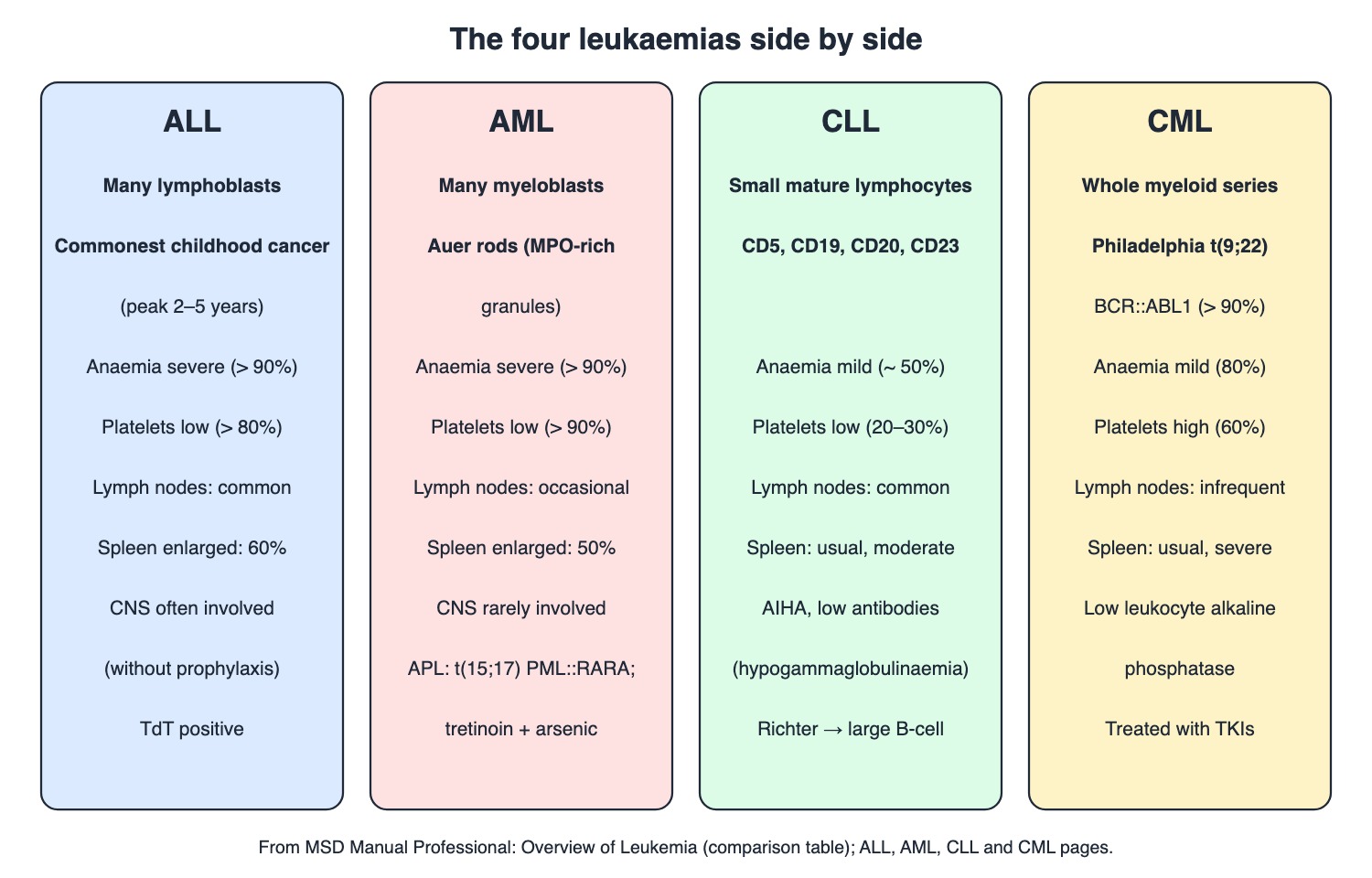
ALL, AML, CLL and CML compared, from MSD's comparison table. Drawn by TrackNation.
Acute leukaemias have immature blasts; chronic ones have more mature cells. Pancytopenia with blasts on the smear suggests acute leukaemia.
ALL: commonest childhood cancer; 60% of cases in children, peak 2–5 years; TdT positive (lymphoid); can infiltrate the CNS and testes.
AML: myeloperoxidase positive (myeloid); Auer rods are crystallised MPO granules. APL: t(15;17) PML::RARA, treated with tretinoin and arsenic trioxide.
CLL: CD5+ B cells expressing CD5, CD19, CD20, CD23; hypogammaglobulinaemia in up to two-thirds; autoimmune haemolysis; can transform to diffuse large B-cell lymphoma (Richter).
CML: t(9;22) — ABL from chromosome 9 fuses to BCR on 22 (Philadelphia chromosome, > 90%); low leukocyte alkaline phosphatase; rising basophils herald progression; treated with tyrosine kinase inhibitors.
Myelodysplastic and Myeloproliferative Neoplasms
MDS: marrow failure with < 20% blasts (not enough for AML); 40–60% evolve into AML. Del(5q): severe anaemia with thrombocytosis.
Polycythaemia vera: JAK2 (rarely CALR) mutation; aquagenic pruritus (itch after hot water); treated with phlebotomy, low-dose aspirin, ruxolitinib or interferon.
Essential thrombocythaemia: JAK2 V617F in about 50%.
Primary myelofibrosis: marrow fibrosis, extramedullary haematopoiesis in the spleen, teardrop and nucleated red cells.
Traps the Examiner Sets
TdT = lymphoid (ALL); myeloperoxidase and Auer rods = myeloid (AML).
APL: t(15;17), treated with tretinoin and arsenic.
Leukaemoid reaction vs CML: CML has the Philadelphia chromosome and low LAP.
Itching after a hot shower with high haemoglobin: polycythaemia vera (JAK2).
Memory Hooks & Shortcuts
Shortcuts to lock in this article's numbers and lists. Each one only re-packages facts proven above.
🧠 TdT = Toddler's leukaemia (ALL) — lymphoid marker
🧠 Auer = AML — MPO rods in myeloblasts
🧠 APL: 15 + 17, Retinoic and arsenic Rescue — t(15;17), tretinoin, arsenic
🧠 CML: 9 and 22, BCR-ABL, Philadelphia's Pair — t(9;22)
🧠 CLL: Five-Twenty-Three (CD5, CD23) — markers
🧠 PV: Hot shower Itch, JAK2 — aquagenic pruritus
Rapid-Revision Cards
Neutropenia grades
< 1500; moderate 500–1000; severe < 500.
Leukaemoid reaction
Neutrophils > 50,000, non-malignant; cancer or infection.
Acute vs chronic
Blasts vs more mature cells.
ALL
Commonest childhood cancer; peak 2–5 y; TdT+; CNS, testes.
AML
MPO+; Auer rods.
APL
t(15;17) PML::RARA; tretinoin + arsenic.
CLL
CD5, 19, 20, 23; hypogammaglobulinaemia; AIHA.
Richter syndrome
CLL → diffuse large B-cell lymphoma.
CML
t(9;22) BCR::ABL1; Ph+ > 90%; low LAP; TKI.
CML progression
Rising basophils and blasts.
MDS
< 20% blasts; 40–60% → AML.
Del(5q) MDS
Severe anaemia + thrombocytosis.
Polycythaemia vera
JAK2; aquagenic pruritus; phlebotomy, aspirin.
Essential thrombocythaemia
JAK2 V617F ~50%.
Myelofibrosis
Teardrop cells; splenic EMH.
Sources
Facts in this article were checked against these documents.
MSD Manual Professional: Overview of Leukemia; Acute Lymphoblastic Leukemia; Acute Myeloid Leukemia; Chronic Lymphocytic Leukemia; Chronic Myeloid Leukemia; Myelodysplastic Syndromes; Neutropenia; Polycythemia Vera; Essential Thrombocythemia; Primary Myelofibrosis — Merck & Co. (MSD Manuals), reviewed 2025–2026 (link)
Competency Based Undergraduate Curriculum, Pathology (PA 18) — National Medical Commission, 2024
Test Yourself: Practice Questions
Twenty-five questions in NEET PG style, most of them clinical vignettes.
Practice Questions (NEET PG pattern)
Original questions written in the style of the exam: +4 for a correct answer, −1 for a wrong one. Every answer was checked against the sources listed above. NEET PG papers are not published by NBEMS, so these are not past-paper questions.
Q1. A 4-year-old has fever, pallor, bruising and bone pain; the smear shows pancytopenia with blasts that are TdT positive. The diagnosis is
(a) acute myeloid leukaemia
(b) acute lymphoblastic leukaemia
(c) aplastic anaemia
(d) CLL
Show answer
Answer: (b) — Commonest childhood cancer; peak 2–5 years; TdT marks lymphoid cells.
Q2. The commonest cancer in children is
(a) retinoblastoma
(b) acute lymphoblastic leukaemia
(c) Wilms tumour
(d) neuroblastoma
Show answer
Answer: (b) — MSD.
Q3. Without prophylaxis, a leukaemia that commonly involves the central nervous system is
(a) CLL
(b) ALL
(c) CML
(d) AML
Show answer
Answer: (b) — MSD comparison table; also testicular infiltration.
Q4. A 50-year-old has blasts with linear azurophilic cytoplasmic inclusions that stain for myeloperoxidase. The inclusions are
(a) Heinz bodies
(b) Dohle bodies
(c) Howell-Jolly bodies
(d) Auer rods (AML)
Show answer
Answer: (d) — Crystallised MPO-rich granules.
Q5. Acute promyelocytic leukaemia carries the translocation
(a) t(11;14)
(b) t(15;17) PML::RARA
(c) t(8;14)
(d) t(9;22) BCR::ABL1
Show answer
Answer: (b) — MSD AML page.
Q6. APL is now commonly treated without conventional chemotherapy using
(a) hydroxyurea alone
(b) rituximab
(c) imatinib
(d) tretinoin and arsenic trioxide
Show answer
Answer: (d) — Very well tolerated.
Q7. A 70-year-old man has painless lymphadenopathy and a lymphocyte count of 40,000/µL; cells express CD5, CD19, CD20 and CD23. The diagnosis is
(a) chronic lymphocytic leukaemia
(b) CML
(c) infectious mononucleosis
(d) ALL
Show answer
Answer: (a) — CD5+ B cells.
Q8. A CLL patient has recurrent bacterial infections. A likely cause is
(a) neutrophilia
(b) iron overload
(c) hypogammaglobulinaemia (in up to two-thirds)
(d) hypersplenism only
Show answer
Answer: (c) — MSD.
Q9. A man with long-standing CLL suddenly develops rapidly enlarging nodes and fever; biopsy shows diffuse large B-cell lymphoma. This is
(a) Hodgkin lymphoma
(b) blast crisis of CML
(c) leukaemoid reaction
(d) Richter syndrome
Show answer
Answer: (d) — MSD.
Q10. A 45-year-old has massive splenomegaly, a very high white count with the whole myeloid series, and low leukocyte alkaline phosphatase. The key test is
(a) Philadelphia chromosome / BCR::ABL1
(b) JAK2 alone
(c) TdT staining
(d) flow cytometry for CD55
Show answer
Answer: (a) — CML: Ph-positive in > 90%.
Q11. In CML, the Philadelphia chromosome arises from
(a) t(8;14)
(b) t(9;22), fusing ABL from chromosome 9 to BCR on chromosome 22
(c) t(15;17)
(d) deletion of 5q
Show answer
Answer: (b) — MSD.
Q12. First-line treatment of chronic-phase CML is
(a) a tyrosine kinase inhibitor
(b) rituximab
(c) splenectomy
(d) tretinoin
Show answer
Answer: (a) — MSD.
Q13. In a patient with CML, increasing blood basophils and blasts suggest
(a) infection only
(b) progression to accelerated phase
(c) response to treatment
(d) iron deficiency
Show answer
Answer: (b) — MSD accelerated-phase features.
Q14. A man with severe pneumonia has neutrophils of 60,000/µL; no blasts or Philadelphia chromosome. This is
(a) AML
(b) a leukaemoid reaction
(c) CML
(d) CLL
Show answer
Answer: (b) — Neutrophils > 50,000/µL without malignant transformation.
Q15. A patient on chemotherapy has an absolute neutrophil count of 300/µL. The neutropenia is
(a) moderate
(b) normal
(c) mild
(d) severe (< 500), with risk of infection from own gut and mouth flora
Show answer
Answer: (d) — MSD grades.
Q16. MSD gives the usual lower limit of a normal absolute neutrophil count in adults (somewhat lower in some ethnic groups) as about
(a) 500/µL
(b) 1500/µL
(c) 4000/µL
(d) 100/µL
Show answer
Answer: (b) — Somewhat lower in Black patients.
Q17. An elderly patient has cytopenias, a dysplastic marrow and 12% blasts. The diagnosis is
(a) AML
(b) aplastic anaemia
(c) myelodysplastic syndrome (blasts < 20%)
(d) CLL
Show answer
Answer: (c) — 40–60% evolve into AML.
Q18. An older woman has severe anaemia with a raised platelet count; marrow cytogenetics shows deletion of the long arm of chromosome 5. This is
(a) CML
(b) essential thrombocythaemia
(c) MDS with isolated del(5q)
(d) iron deficiency
Show answer
Answer: (c) — MSD.
Q19. A man has a raised haemoglobin and itching after hot showers. The test to order is
(a) TdT
(b) JAK2 mutation
(c) BCR::ABL1
(d) CD5
Show answer
Answer: (b) — Polycythaemia vera: aquagenic pruritus.
Q20. Treatment of polycythaemia vera includes
(a) iron supplements
(b) splenectomy first
(c) erythropoietin
(d) phlebotomy and low-dose aspirin (ruxolitinib or interferon if needed)
Show answer
Answer: (d) — MSD.
Q21. In essential thrombocythaemia, the JAK2 V617F mutation is found in about
(a) 90%
(b) 5%
(c) 50% of patients
(d) 100%
Show answer
Answer: (c) — MSD.
Q22. A man with splenomegaly and marrow fibrosis has teardrop and nucleated red cells. The diagnosis is
(a) ALL
(b) primary myelofibrosis
(c) CML
(d) iron deficiency
Show answer
Answer: (b) — Extramedullary haematopoiesis mainly in the spleen.
Q23. Myeloperoxidase staining is positive in
(a) red cells
(b) lymphoid cells
(c) myeloid cells (AML)
(d) plasma cells
Show answer
Answer: (c) — TdT marks lymphoid cells.
Q24. Compared with acute leukaemias, chronic leukaemias have
(a) no spleen involvement
(b) more mature cells
(c) more blasts
(d) always pancytopenia
Show answer
Answer: (b) — MSD.
Q25. A patient with a very high white count and splenomegaly has a low leukocyte alkaline phosphatase (LAP) score. This favours
(a) primary myelofibrosis
(b) polycythaemia vera
(c) a reaction to infection
(d) chronic myeloid leukaemia
Show answer
Answer: (d) — MSD: raised LAP suggests a myeloproliferative neoplasm; decreased LAP suggests CML.
Active Recall
From memory: define neutropenia grades and a leukaemoid reaction; contrast ALL, AML, CLL and CML (cells, markers, counts, nodes, spleen, genetics, treatment); and describe MDS, polycythaemia vera, essential thrombocythaemia and myelofibrosis.