Lymph Nodes, Spleen, Lymphomas and Multiple Myeloma for NEET PG Pathology: Hodgkin, Reed-Sternberg, Burkitt, Bence Jones
Start Here
🎯 Exam priority: Very high. Expect: a young adult with neck nodes and Reed-Sternberg cells, CD15/CD30, a child with a fast-growing lymphoma and t(8;14), an elderly man with back pain, high calcium and rouleaux, causes of massive splenomegaly, and caseating nodes.
CBME mapping: PA 19.1–19.6, 20.3.
Lymph Nodes and Spleen
Lymphadenopathy: palpable nodes > 1 cm (> 2 cm in the groin); localized (one area) or generalized (≥ 2 areas). Generalized suggests systemic disease — infection (infectious mononucleosis), malignancy (lymphoma) or autoimmunity. Supraclavicular or epitrochlear nodes may herald cancer; cancer accounts for about 4% of unexplained nodes after age 40.
Tuberculous lymphadenitis (scrofula) is the commonest extrapulmonary TB; granulomas with caseous necrotic centres.
Splenomegaly: in the tropics, mostly infections (malaria, visceral leishmaniasis, schistosomiasis). Massive (> 8 cm below the costal margin): CLL, CML, Gaucher disease, hairy cell leukaemia, NHL, polycythaemia vera, primary myelofibrosis. A big spleen can cause cytopenias (hypersplenism).
Lymphomas and Myeloma
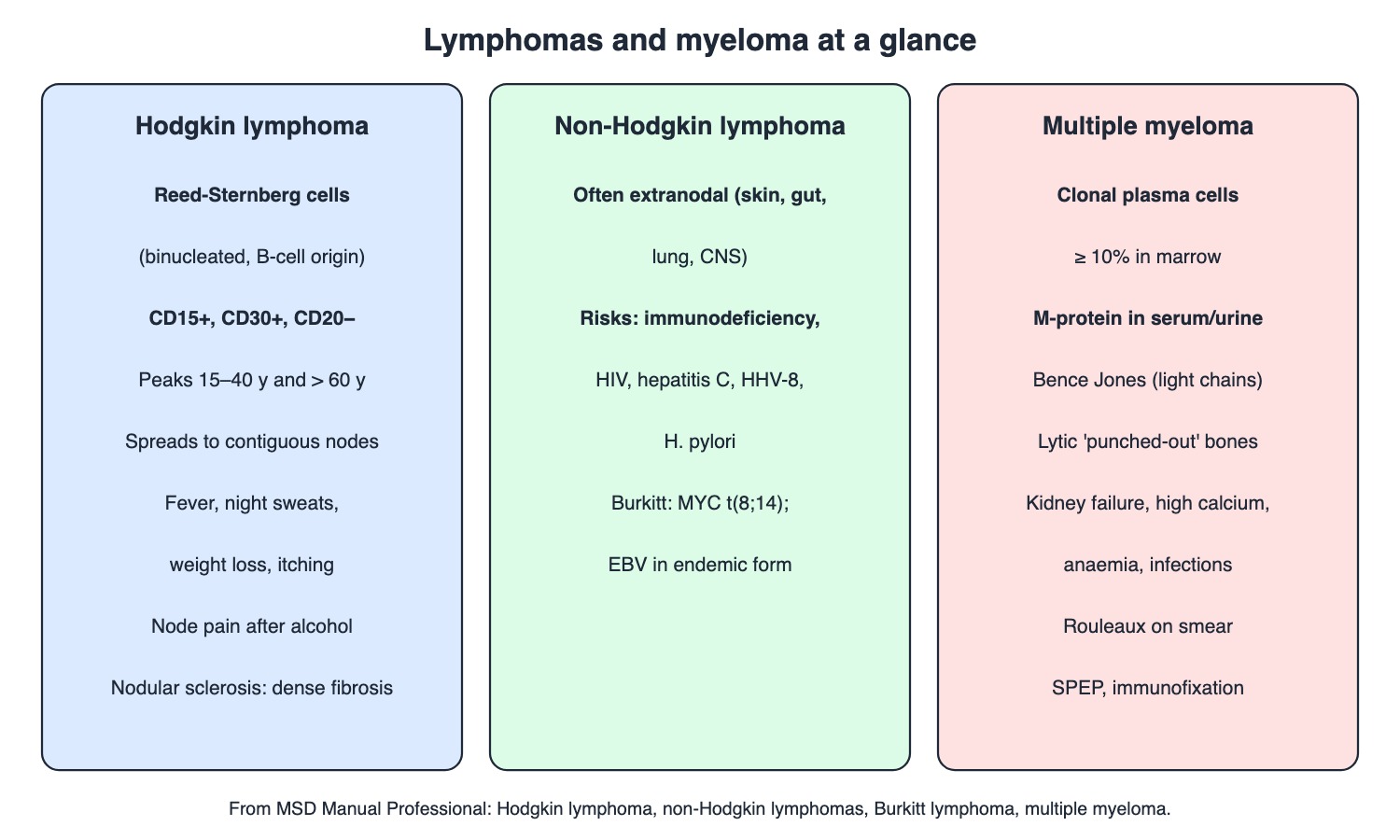
Hodgkin lymphoma, non-Hodgkin lymphoma and multiple myeloma compared. Drawn by TrackNation.
Hodgkin: binucleated Reed-Sternberg cells (B-cell origin), CD15+, CD30+, CD20−; peaks 15–40 and > 60 years; EBV and HIV raise risk; painless nodes, fever, night sweats, weight loss, itching; pain in nodes after alcohol; spreads to contiguous nodes. Subtypes include nodular sclerosis (dense fibrosis around nodules) and mixed cellularity. Diagnosis by node biopsy; usually curable.
Non-Hodgkin: may be extranodal (skin, gut, lung, CNS); risks include immunodeficiency, HIV, hepatitis C, HHV-8 and H. pylori. Burkitt: MYC (chromosome 8) translocated to the immunoglobulin heavy-chain locus on 14; EBV in the endemic form.
Multiple myeloma: plasma-cell cancer making monoclonal immunoglobulin (M-protein); lytic bone lesions, kidney failure, high calcium, anaemia, infections; Bence Jones protein = free light chains in urine; rouleaux; ≥ 10% marrow plasma cells; punched-out lesions in about 80%. Test with serum protein electrophoresis and immunofixation.
Traps the Examiner Sets
CD15 and CD30 positive, CD20 negative = Hodgkin (Reed-Sternberg).
Hodgkin spreads to the next node group; NHL often appears outside nodes.
Back pain + high calcium + kidney failure + anaemia in an older patient = myeloma.
Massive spleen in India: also think of malaria and kala-azar.
Memory Hooks & Shortcuts
Shortcuts to lock in this article's numbers and lists. Each one only re-packages facts proven above.
🧠 Reed-Sternberg wears 15 and 30 (CD15, CD30) — Hodgkin markers
🧠 Hodgkin Hops to the next node — contiguous spread
🧠 Burkitt: 8 meets 14 (MYC) — t(8;14)
🧠 Myeloma CRAB: Calcium, Renal, Anaemia, Bone — plus infections
🧠 Bence Jones = light chains in urine — free kappa or lambda
🧠 Massive spleen: Cs and Gs (CLL, CML, Gaucher) + hairy cell, PV, PMF, NHL — massive splenomegaly
Rapid-Revision Cards
Enlarged node
> 1 cm (> 2 cm groin).
Generalized nodes
≥ 2 areas: infection, lymphoma, autoimmune.
Red-flag nodes
Supraclavicular, epitrochlear.
Scrofula
Commonest extrapulmonary TB; caseating granulomas.
Tropical splenomegaly
Malaria, kala-azar, schistosomiasis.
Massive spleen
CLL, CML, Gaucher, hairy cell, NHL, PV, PMF.
Hypersplenism
Big spleen → cytopenias.
Reed-Sternberg
Binucleated, B-cell; CD15+, CD30+, CD20−.
Hodgkin ages
15–40 and > 60.
Hodgkin clues
B symptoms, itching, alcohol pain, contiguous spread.
Nodular sclerosis
Dense fibrous tissue around nodules.
NHL
Extranodal; HIV, HCV, HHV-8, H. pylori.
Burkitt
MYC t(8;14); EBV endemic.
Myeloma
M-protein; lytic bones, kidney, calcium, anaemia, infections.
Myeloma marrow
≥ 10% clonal plasma cells.
Bence Jones
Urinary free light chains.
Rouleaux
Stacks of 3–12 red cells.
Sources
Facts in this article were checked against these documents.
MSD Manual Professional: Lymphadenopathy; Tuberculosis; Splenomegaly; Hodgkin Lymphoma; Non-Hodgkin Lymphomas; Burkitt Lymphoma; Multiple Myeloma — Merck & Co. (MSD Manuals), reviewed 2025–2026 (link)
Competency Based Undergraduate Curriculum, Pathology (PA 19, 20.3) — National Medical Commission, 2024
Test Yourself: Practice Questions
Twenty-six questions in NEET PG style, most of them clinical vignettes.
Practice Questions (NEET PG pattern)
Original questions written in the style of the exam: +4 for a correct answer, −1 for a wrong one. Every answer was checked against the sources listed above. NEET PG papers are not published by NBEMS, so these are not past-paper questions.
Q1. A 24-year-old has painless neck nodes, night sweats and itching; biopsy shows large binucleated cells that are CD15+, CD30+, CD20−. The diagnosis is
(a) tuberculous lymphadenitis
(b) Hodgkin lymphoma
(c) Burkitt lymphoma
(d) CLL
Show answer
Answer: (b) — Reed-Sternberg cells.
Q2. Reed-Sternberg cells are of
(a) plasma-cell origin
(b) macrophage origin
(c) T-cell origin
(d) B-cell origin
Show answer
Answer: (d) — MSD.
Q3. A patient with lymphoma notices pain in his enlarged nodes after drinking alcohol. This rare clue suggests
(a) multiple myeloma
(b) CML
(c) Hodgkin lymphoma
(d) sarcoidosis
Show answer
Answer: (c) — MSD.
Q4. Hodgkin lymphoma typically spreads
(a) randomly to distant extranodal sites first
(b) to contiguous node groups
(c) never beyond one node
(d) only to bone
Show answer
Answer: (b) — Unlike NHL, which often involves extranodal sites.
Q5. The age pattern of Hodgkin lymphoma is
(a) constant at all ages
(b) only in children under 5
(c) commonest at 15–40 years with a second peak after 60
(d) only after 70
Show answer
Answer: (c) — Rare before age 10.
Q6. A node biopsy shows nodules of Hodgkin tissue surrounded by dense fibrous tissue. The subtype is
(a) lymphocyte-depleted
(b) mixed cellularity
(c) nodular sclerosis
(d) lymphocyte-rich
Show answer
Answer: (c) — MSD subtype table.
Q7. A 7-year-old has a rapidly growing lymphoma; cytogenetics shows MYC on chromosome 8 translocated to the immunoglobulin heavy-chain locus on 14. The diagnosis is
(a) Burkitt lymphoma
(b) CML
(c) Hodgkin lymphoma
(d) ALL
Show answer
Answer: (a) — Endemic form linked to EBV.
Q8. Endemic Burkitt lymphoma is closely associated with
(a) Epstein-Barr virus
(b) HTLV-1
(c) hepatitis B
(d) HPV
Show answer
Answer: (a) — MSD.
Q9. Which infection increases the risk of a gastric (extranodal) lymphoma?
(a) Giardia
(b) Helicobacter pylori
(c) Streptococcus pyogenes
(d) Candida
Show answer
Answer: (b) — MSD NHL page.
Q10. A 68-year-old has back pain, anaemia, raised calcium and creatinine; the smear shows rouleaux. The diagnosis is
(a) multiple myeloma
(b) metastatic prostate cancer only
(c) Hodgkin lymphoma
(d) CLL
Show answer
Answer: (a) — Lytic lesions, kidney failure, hypercalcaemia, anaemia, infections.
Q11. Rouleaux on a peripheral smear are
(a) fragmented red cells
(b) stacks of 3–12 red cells (myeloma)
(c) red cells with central dots
(d) clumped platelets
Show answer
Answer: (b) — MSD.
Q12. Bence Jones protein in myeloma is
(a) heavy chains in serum
(b) albumin
(c) haemoglobin in urine
(d) free monoclonal light chains in the urine
Show answer
Answer: (d) — 40% of IgG/IgA myeloma also have Bence Jones proteinuria.
Q13. Myeloma is diagnosed on marrow when clonal plasma cells are at least
(a) 50%
(b) 2%
(c) 90%
(d) 10%
Show answer
Answer: (d) — Marrow involvement is patchy.
Q14. A skull X-ray of a myeloma patient shows
(a) punched-out lytic lesions (about 80% have lytic lesions or osteoporosis)
(b) hair-on-end appearance only
(c) sun-ray trabeculae
(d) sclerotic metastases
Show answer
Answer: (a) — MSD.
Q15. The first laboratory test to detect an M-protein is
(a) Hb electrophoresis
(b) bone marrow biopsy
(c) skeletal survey
(d) serum protein electrophoresis with immunofixation
Show answer
Answer: (d) — MSD.
Q16. A spleen palpable 10 cm below the costal margin in a 60-year-old with a very high WBC count suggests
(a) infectious mononucleosis
(b) CML (a cause of massive splenomegaly)
(c) iron deficiency
(d) viral hepatitis
Show answer
Answer: (b) — Massive: CLL, CML, Gaucher, hairy cell, NHL, PV, myelofibrosis.
Q17. In the tropics, splenomegaly is most often caused by
(a) infections such as malaria, visceral leishmaniasis and schistosomiasis
(b) hairy cell leukaemia
(c) thalassaemia trait
(d) Gaucher disease
Show answer
Answer: (a) — MSD.
Q18. A patient with a large spleen has low platelets and white cells with a normal marrow. This is
(a) leukaemia
(b) aplastic anaemia
(c) megaloblastic anaemia
(d) hypersplenism
Show answer
Answer: (d) — Splenomegaly can cause cytopenias.
Q19. A young man from India has enlarged cervical nodes; biopsy shows epithelioid granulomas with caseous centres. The diagnosis is
(a) sarcoidosis only
(b) Burkitt lymphoma
(c) tuberculous lymphadenitis (scrofula)
(d) Hodgkin lymphoma
Show answer
Answer: (c) — Commonest extrapulmonary TB.
Q20. Lymph nodes are considered enlarged when they exceed
(a) 1 cm (2 cm in the groin)
(b) 5 cm
(c) 0.2 cm
(d) 3 cm everywhere
Show answer
Answer: (a) — MSD.
Q21. An isolated enlarged left supraclavicular node in a 55-year-old is concerning because it
(a) may herald cancer
(b) is normal at that age
(c) is always reactive
(d) means TB only
Show answer
Answer: (a) — Supraclavicular and epitrochlear nodes may herald cancer.
Q22. Lymphadenopathy in two or more body areas is called
(a) generalized, suggesting systemic disease
(b) localized
(c) normal
(d) reactive only
Show answer
Answer: (a) — Infection, malignancy or autoimmunity.
Q23. Hodgkin lymphoma risk is increased by infection with
(a) EBV or HIV
(b) hepatitis A
(c) rotavirus
(d) HPV
Show answer
Answer: (a) — MSD.
Q24. Hodgkin lymphoma is diagnosed by
(a) lymph node biopsy
(b) SPEP
(c) blood smear alone
(d) bone scan
Show answer
Answer: (a) — Treatment is curative in most cases.
Q25. A child in Africa has a tumour of the jaw; biopsy shows a lymphoma with a MYC translocation. This is
(a) endemic Burkitt lymphoma
(b) Hodgkin lymphoma
(c) CLL
(d) multiple myeloma
Show answer
Answer: (a) — The endemic African form often involves the jaw or facial bones and is linked to EBV.
Q26. In sporadic (non-endemic) Burkitt lymphoma, the commonest presentation is
(a) an abdominal mass, often near the ileocaecal valve
(b) lytic bone lesions
(c) isolated skin lesions
(d) a jaw tumour
Show answer
Answer: (a) — May cause bowel obstruction.
Active Recall
From memory: define lymphadenopathy and its red flags, describe tuberculous lymphadenitis, list causes of tropical and massive splenomegaly, contrast Hodgkin and non-Hodgkin lymphoma (cells, markers, spread, risks), give the Burkitt translocation, and list the features and diagnostic criteria of multiple myeloma.