Paediatric Emergencies and Poisoning for NEET PG: ICMR Septic Shock Fluid Ladder, CPR Numbers, Anaphylaxis and Paracetamol, Iron, Kerosene, Caustic, OP and Lead
Start Here
🎯 Exam priority: High. Expect: hypotension formula, fast-pulse cut-offs, fluid bolus volume and rate, when to stop fluids, adrenaline infusion rate, CPR ratios (30:2 vs 15:2) and depth, adrenaline doses in arrest and anaphylaxis, charcoal exceptions, toxic doses of paracetamol and iron, antidotes, and what never to do in kerosene and caustic ingestion.
CBME mapping: PE14, PE24, PE27. Fact-checked against the ICMR Standard Treatment Workflow for Sepsis and Septic Shock in Children (2019) and the MSD Manual.
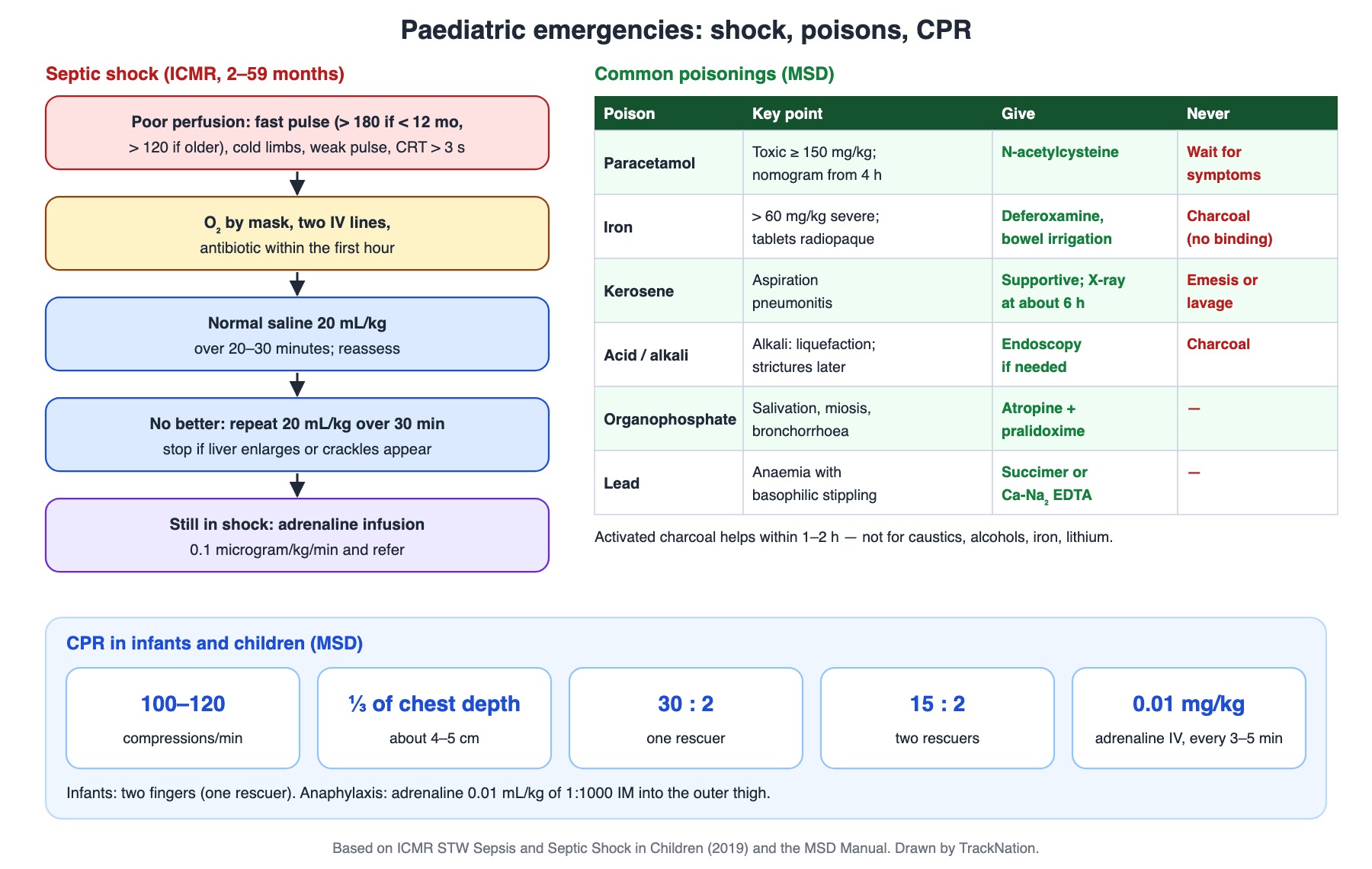
Septic shock ladder, common poisonings and paediatric CPR numbers. Drawn by TrackNation.
Sepsis and Septic Shock (ICMR)
Suspect sepsis (2–59 months) in any infection with poor feeding, lethargy, reduced responsiveness or unconsciousness, cold or bluish limbs, fast or shallow breathing, chest indrawing, stridor, excessive vomiting, low urine output, convulsions or stiff neck.
Poor perfusion: fast pulse (> 180 under 12 months, > 120 over 12 months), cold peripheries, weak pulse, CRT > 3 seconds. Hypotension: systolic < 70 under 1 year; above 1 year < 70 + 2 × age (years).
Ladder: oxygen, two IV lines, antibiotic within the first hour → normal saline 20 mL/kg over 20–30 min → reassess → repeat 20 mL/kg over 30 min, stopping if the liver enlarges, SpO₂ falls or crackles appear → still in shock: adrenaline 0.1 microgram/kg/min (0.3 × weight mg in 50 mL at 1 mL/h) and refer. With diarrhoea and a response to the first bolus: 70 mL/kg over 5 h (infant) or 2½ h (child).
Antibiotics: > 3 months ceftriaxone 100 mg/kg/day; < 3 months cefotaxime + gentamicin; add cloxacillin for soft-tissue infection.
CPR and Anaphylaxis (MSD)
Children hold their blood pressure longer by compensation — once hypotension appears, arrest can follow quickly (5-year-old: < 80 mm Hg = 70 + 2 × 5). Survival is far better after respiratory arrest alone than after cardiac arrest.
Compressions 100–120/min, depth one-third of the chest (≈ 4–5 cm); lone rescuer may use two fingers in infants. 30:2 with one rescuer, 15:2 with two (adults are always 30:2). Adrenaline 0.01 mg/kg IV every 3–5 minutes.
Anaphylaxis: adrenaline 0.01 mL/kg of 1:1000 IM, best into the anterolateral thigh, repeated every 5–15 min; watch for a biphasic reaction within 4–6 hours.
Poisoning: Principles (MSD)
Activated charcoal helps most within 1–2 hours; it is useless for caustics, alcohols, iron, lithium, cyanide and other metals. Multiple doses help drugs with enterohepatic recirculation (phenobarbital, theophylline).
Gastric emptying (ipecac or lavage) has not been shown to work and is rarely used.
Six Poisonings to Know
Paracetamol: toxic at ≥ 150 mg/kg; early stage (0–24 h) only nausea and vomiting, liver failure peaks at 72–96 h. Plot a level taken ≥ 4 hours after ingestion on the Rumack–Matthew nomogram; antidote N-acetylcysteine.
Iron: by elemental iron — < 20 mg/kg non-toxic, 20–60 mild–moderate, > 60 mg/kg severe; 5 stages; tablets are radiopaque; metabolic acidosis. Whole-bowel irrigation and IV deferoxamine; charcoal does not bind iron.
Kerosene and other hydrocarbons: mostly children < 5; danger is aspiration pneumonitis. No gastric emptying; X-ray and oximetry at about 6 h; well after 4–6 h → discharge; no antibiotics or steroids.
Caustics: alkalis cause liquefaction necrosis and hit the oesophagus more than the stomach; drooling, dysphagia, pain; endoscopy if needed; strictures can form weeks later.
Organophosphates: cholinesterase inhibition → salivation, lacrimation, urination, diarrhoea, emesis, bronchorrhoea, bronchospasm, bradycardia, miosis, fasciculations. Titrated high-dose atropine for secretions; pralidoxime for neuromuscular toxicity.
Lead: paint or glaze ingestion; cognitive deficits; anaemia with basophilic stippling; encephalopathy likely above 100 mcg/dL. Remove the source; chelate with succimer or calcium disodium EDTA (± dimercaprol).
Traps the Examiner Sets
Hypotension above 1 year is systolic < 70 + 2 × age; a falling BP is a late sign in children.
Two-rescuer paediatric CPR is 15:2 — not 30:2.
Iron toxicity is counted as elemental iron; charcoal is useless.
Never induce vomiting after kerosene — aspiration is the killer.
Paracetamol levels before 4 hours cannot be read on the nomogram.
Memory Hooks & Shortcuts
Shortcuts to lock in this article's numbers and lists. Each one only re-packages facts proven above.
🧠 Hypotension '70 + 2 × age' — and it comes late — BP
🧠 '20 and look' — 20 mL/kg, then check liver, lungs, pulse before the next 20 — fluids
🧠 Kids' CPR 'Two helpers, fifteen' — 15:2; alone, 30:2 — CPR
🧠 'Point-one' adrenaline everywhere: 0.01 mg/kg in arrest, 0.01 mL/kg 1:1000 IM in anaphylaxis, 0.1 µg/kg/min drip — adrenaline
🧠 Charcoal can't bind 'CAIL' — Caustics, Alcohols, Iron, Lithium — charcoal
Rapid-Revision Cards
Fast pulse
> 180 (< 12 mo); > 120 (older).
CRT
> 3 s = poor perfusion.
Hypotension
< 70 if < 1 yr; < 70 + 2 × age.
Bolus
NS 20 mL/kg over 20–30 min.
Stop fluids
Liver enlarges, crackles, SpO₂ falls.
Adrenaline drip
0.1 µg/kg/min.
Antibiotic timing
Within 1 hour.
Septic shock Abx
> 3 mo ceftriaxone; < 3 mo cefotaxime + gentamicin.
CPR rate / depth
100–120; ⅓ AP ≈ 4–5 cm.
CPR ratio
30:2 alone; 15:2 two rescuers.
Arrest adrenaline
0.01 mg/kg IV q3–5 min.
Anaphylaxis
0.01 mL/kg 1:1000 IM thigh.
Biphasic
Within 4–6 h.
Charcoal
Within 1–2 h.
Charcoal useless
Caustics, alcohols, iron, lithium.
Paracetamol
≥ 150 mg/kg; level at ≥ 4 h; NAC.
Iron
Elemental > 60 mg/kg severe; deferoxamine.
Kerosene
Aspiration; no emesis/lavage.
Caustic
Alkali liquefaction; strictures weeks later.
Organophosphate
Atropine + pralidoxime.
Lead
Stippling; succimer / CaNa₂EDTA.
Sources
Facts in this article were checked against these documents.
Standard Treatment Workflow: Sepsis and Septic Shock in Children — ICMR / Department of Health Research, MoHFW, 2019
MSD Manual Professional: CPR in Infants and Children; Anaphylaxis; General Principles of Poisoning; Acetaminophen, Iron, Hydrocarbon, Caustic, Organophosphate and Lead Poisoning — Merck & Co., 2025–2026 (link)
Test Yourself: Practice Questions
Thirty questions in NEET PG style, many of them casualty scenarios.
Practice Questions (NEET PG pattern)
Original questions written in the style of the exam: +4 for a correct answer, −1 for a wrong one. Every answer was checked against the sources listed above. NEET PG papers are not published by NBEMS, so these are not past-paper questions.
Q1. In the ICMR workflow, a fast pulse in an infant under 12 months means a heart rate above
(a) 180
(b) 160
(c) 120
(d) 100
Show answer
Answer: (a) — > 120 if older.
Q2. Hypotension in a 4-year-old is a systolic BP below
(a) 90 mm Hg
(b) 70 mm Hg
(c) 60 mm Hg
(d) 78 mm Hg
Show answer
Answer: (d) — 70 + 2 × 4.
Q3. Delayed capillary refill suggesting poor perfusion is longer than
(a) 10 seconds
(b) 3 seconds
(c) 5 seconds
(d) 1 second
Show answer
Answer: (b) — ICMR.
Q4. The first fluid bolus in paediatric septic shock (ICMR) is
(a) 10% dextrose 2 mL/kg
(b) normal saline 20 mL/kg over 20–30 minutes
(c) 60 mL/kg in 5 minutes
(d) albumin 5 mL/kg
Show answer
Answer: (b) — Then reassess.
Q5. During fluid boluses, stop fluids if
(a) heart rate falls
(b) urine output rises
(c) the liver enlarges or crackles appear
(d) peripheries warm
Show answer
Answer: (c) — Fluid overload.
Q6. Shock persisting after two boluses is treated with adrenaline infusion at
(a) 0.1 microgram/kg/min
(b) 10 microgram/kg/min
(c) 1 mg/kg/min
(d) 0.01 mg/kg once
Show answer
Answer: (a) — And refer.
Q7. Antibiotics in suspected septic shock should be given within
(a) after culture reports
(b) 24 hours
(c) 6 hours
(d) the first hour
Show answer
Answer: (d) — ICMR.
Q8. Empirical antibiotic for septic shock in a child over 3 months (ICMR) is
(a) ceftriaxone 100 mg/kg/day
(b) amoxicillin oral
(c) azithromycin
(d) vancomycin alone
Show answer
Answer: (a) — < 3 months: cefotaxime + gentamicin.
Q9. For a 2-month-old with septic shock, ICMR's antibiotics are
(a) cefotaxime plus gentamicin
(b) oral amoxicillin
(c) cloxacillin alone
(d) ceftriaxone alone
Show answer
Answer: (a) — ICMR.
Q10. Paediatric chest compressions are given at
(a) 60–80 per minute
(b) 100–120 per minute
(c) 140–160 per minute
(d) 30 per minute
Show answer
Answer: (b) — Like adults.
Q11. Compression depth in infants and children is
(a) 6–7 cm
(b) one-third of the chest's AP diameter (≈ 4–5 cm)
(c) half the chest depth
(d) 2 cm
Show answer
Answer: (b) — MSD.
Q12. Two health workers resuscitate a 3-year-old without an advanced airway. The ratio is
(a) 5:1
(b) 3:1
(c) 30:2
(d) 15:2
Show answer
Answer: (d) — 30:2 if alone.
Q13. Adrenaline dose in paediatric cardiac arrest is
(a) 0.01 mg/kg IV every 3–5 minutes
(b) 1 mg IV once
(c) 0.5 mg/kg IV
(d) 0.1 mg/kg IM
Show answer
Answer: (a) — MSD.
Q14. Why is hypotension a late sign in shocked children?
(a) they compensate with heart rate and vascular resistance
(b) it is not true
(c) their BP is always low
(d) they have no baroreceptors
Show answer
Answer: (a) — MSD.
Q15. Adrenaline for anaphylaxis in a child is
(a) 1 mL of 1:10,000 IV push
(b) 0.1 mL/kg subcutaneous in the arm
(c) oral adrenaline
(d) 0.01 mL/kg of 1:1000 IM in the anterolateral thigh
Show answer
Answer: (d) — Repeat every 5–15 min.
Q16. A biphasic anaphylactic reaction typically recurs within
(a) 30 minutes
(b) 3 days
(c) 4–6 hours
(d) 2 weeks
Show answer
Answer: (c) — Observe.
Q17. Activated charcoal is most useful when given within
(a) 1–2 hours of ingestion
(b) any time
(c) 12 hours
(d) 24 hours
Show answer
Answer: (a) — MSD.
Q18. Activated charcoal does NOT bind
(a) iron
(b) theophylline
(c) phenobarbital
(d) paracetamol
Show answer
Answer: (a) — Also caustics, alcohols, lithium.
Q19. Multiple-dose activated charcoal helps in poisoning with
(a) kerosene
(b) lithium
(c) phenobarbital
(d) iron
Show answer
Answer: (c) — Enterohepatic recirculation.
Q20. The acute toxic dose of paracetamol is
(a) ≥ 15 mg/kg
(b) ≥ 50 mg/kg
(c) ≥ 150 mg/kg
(d) ≥ 500 mg/kg
Show answer
Answer: (c) — MSD.
Q21. A paracetamol level for the nomogram should be taken at least how long after ingestion?
(a) 24 hours
(b) 4 hours
(c) 30 minutes
(d) 1 hour
Show answer
Answer: (b) — Rumack–Matthew.
Q22. The antidote for paracetamol poisoning is
(a) atropine
(b) flumazenil
(c) deferoxamine
(d) N-acetylcysteine
Show answer
Answer: (d) — MSD.
Q23. In paracetamol poisoning, liver enzymes peak with liver failure at
(a) 0–24 hours
(b) 72–96 hours
(c) 2 weeks
(d) 6 hours
Show answer
Answer: (b) — Stage III.
Q24. Severe iron poisoning is expected above how much elemental iron?
(a) 20 mg/kg
(b) 60 mg/kg
(c) 5 mg/kg
(d) 150 mg/kg
Show answer
Answer: (b) — 20–60 mild–moderate.
Q25. Chelation for significant iron poisoning is with
(a) succimer
(b) IV deferoxamine
(c) dimercaprol
(d) penicillamine
Show answer
Answer: (b) — Plus whole-bowel irrigation.
Q26. A 2-year-old swallowed kerosene and is coughing. What should NOT be done?
(a) induce vomiting or gastric lavage
(b) monitor oximetry
(c) give oxygen if hypoxic
(d) observe and X-ray
Show answer
Answer: (a) — Aspiration risk.
Q27. The main danger of hydrocarbon ingestion is
(a) renal failure
(b) methaemoglobinaemia
(c) liver failure
(d) aspiration pneumonitis
Show answer
Answer: (d) — MSD.
Q28. Alkali ingestion causes
(a) liquefaction necrosis, mainly of the oesophagus
(b) no tissue injury
(c) only gastric injury
(d) coagulation necrosis with eschar
Show answer
Answer: (a) — Strictures may follow.
Q29. A child with pinpoint pupils, drooling and wheeze after playing in a sprayed field needs
(a) naloxone
(b) N-acetylcysteine
(c) atropine titrated to secretions plus pralidoxime
(d) flumazenil
Show answer
Answer: (c) — Organophosphate.
Q30. A child who eats old paint flakes has anaemia with basophilic stippling. Chelation is with
(a) atropine
(b) deferoxamine
(c) N-acetylcysteine
(d) succimer or calcium disodium EDTA
Show answer
Answer: (d) — Lead.
Active Recall
From memory: list signs of sepsis and poor perfusion, the hypotension formula, the ICMR fluid and adrenaline ladder and antibiotics, paediatric CPR rate, depth, ratios and adrenaline dose, anaphylaxis treatment, charcoal rules, and the key facts and antidotes for paracetamol, iron, kerosene, caustic, OP and lead.