Neoplasia for NEET PG Pathology: Oncogenes, Tumour Suppressors, Carcinogens, Paraneoplastic Syndromes, Tumour Markers, Grade vs Stage
Start Here
🎯 Exam priority: Very high. Expect: which gene goes with which cancer, the two-hit hypothesis, carcinogen–cancer pairs, cancer viruses, paraneoplastic syndromes from lung cancer, tumour markers and their limits, and grade versus stage.
CBME mapping: PA 6.1–6.7, 7.1.
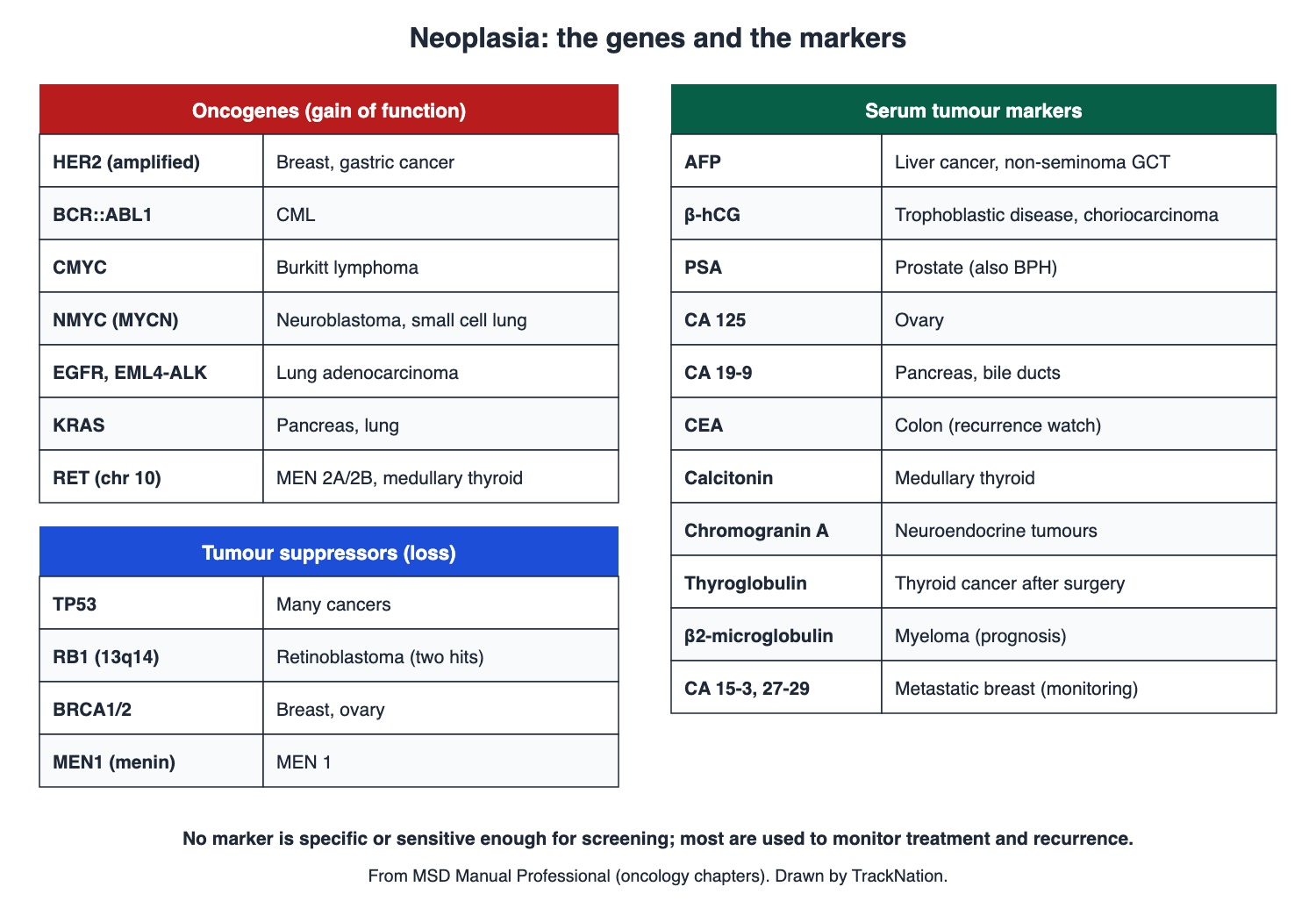
Oncogenes and tumour suppressor genes with their cancers, and serum tumour markers. Drawn by TrackNation.
The Words That Get Tested
Hyperplasia: more cells that look normal. Metaplasia: cells change to a type not normally found in that tissue. Dysplasia: abnormal cells, not yet cancer, graded mild to severe. Carcinoma in situ: cancer-like cells that have not spread beyond where they formed.
Cancer (MSD): lack of differentiation, local invasion and metastasis. Benign tumours may grow but do not spread. Most cancer deaths are from metastases, not the primary. Tumours release VEGF to grow new vessels.
Carcinoma arises from skin or the linings of organs; sarcoma from bone and soft tissue (fat, muscle, cartilage, vessels, fibrous tissue). A teratoma is a germ cell tumour with several tissues such as hair, muscle and bone.
Grade = how abnormal the cells look (nuclei, nucleoli, mitoses, necrosis). Stage = extent of disease; TNM: T = size and local spread, N = regional nodes, M = distant metastasis. Stage guides treatment and prognosis.
Genes: Accelerators and Brakes
Oncogenes are abnormal forms of proto-oncogenes, activated by point mutation (e.g. chemicals), amplification or translocation. RAS is abnormal in about 25% of cancers; HER2 is amplified in breast and gastric cancer; BCR::ABL1 in CML; CMYC in Burkitt; NMYC in neuroblastoma and small cell lung cancer; EGFR and EML4-ALK in lung adenocarcinoma; KRAS in pancreatic cancer; RET (chromosome 10) in MEN 2.
Tumour suppressors: p53 stops replication of damaged DNA and triggers apoptosis; BRCA1/2 loss raises breast and ovarian cancer risk; MEN1 (menin) loss causes MEN 1.
Two-hit model (RB1, 13q14): in hereditary retinoblastoma one allele is mutated in every cell and a later somatic hit knocks out the other. Children present with leukocoria; survivors of the hereditary form can get second cancers such as osteosarcoma.
Step-wise carcinogenesis: in familial polyposis, hyperproliferation starts with loss of a suppressor gene on chromosome 5, then RAS activation and losses on 18 and 17. FAP is autosomal dominant with ≥ 100 polyps; nearly all get colon cancer by 40.
Telomerase lets cancer cells divide without limit. DNA-repair defects (Bloom, Fanconi, Down syndrome; xeroderma pigmentosum for UV) raise cancer risk.
MEN syndromes (all autosomal dominant): MEN 1 = parathyroid, pancreatic islet, pituitary; MEN 2A = medullary thyroid, phaeochromocytoma, parathyroid; MEN 2B = medullary thyroid, phaeochromocytoma, mucosal neuromas, marfanoid habitus.
Carcinogens
UV light causes thymidine dimers. Co-carcinogens have little effect alone but boost another carcinogen. Chronic inflammation (e.g. ulcerative colitis) raises cancer risk. IARC groups: 1 = carcinogenic to humans, 2A = probably, 2B = possibly, 3 = not classifiable.
Agent (MSD) | Cancer |
Aromatic amines | Bladder |
Asbestos | Lung, mesothelioma |
Benzene | Leukaemia |
Vinyl chloride | Hepatic angiosarcoma |
Arsenic | Lung, skin |
Betel nut | Oropharynx |
Diethylstilbestrol in utero | Cervicovaginal cancer |
EBV | Burkitt, Hodgkin, nasopharyngeal carcinoma |
HBV, HCV | Hepatocellular carcinoma |
HPV | Cervix, anus, penis, vulva, tonsil |
HTLV-1 | Adult T-cell lymphoma |
KSHV (HHV-8) | Kaposi sarcoma, primary effusion lymphoma |
H. pylori | Gastric adenocarcinoma, MALT lymphoma |
Schistosoma haematobium | Bladder |
Effects on the Host: Paraneoplastic Syndromes
Up to 20% of cancer patients get paraneoplastic syndromes; lung cancer, especially small cell, is the commonest cause. Peripheral neuropathy is the commonest neurological one; anti-Hu is found in some lung cancer patients. Lambert-Eaton weakness improves with repeated nerve stimulation (CMAP amplitude rises > 200% at > 10 Hz).
Paraneoplastic syndrome (MSD) | Typical tumour |
Cushing syndrome (ectopic ACTH) | Small cell lung cancer |
Hyponatraemia (vasopressin) | Lung cancer |
Hypercalcaemia (PTHrP) | Squamous cell lung, head and neck, bladder |
Erythrocytosis (erythropoietin) | Kidney cancer, hepatoma |
Lambert-Eaton (presynaptic, IgG) | Small cell lung cancer |
Cerebellar degeneration, anti-Yo | Breast or ovary cancer in women |
Opsoclonus | Childhood neuroblastoma |
Acanthosis nigricans (rapid, widespread) | Gastrointestinal cancer |
Leser-Trélat (sudden many seborrhoeic keratoses) | Lymphoma, gastrointestinal cancer |
Diagnosis, Markers and Immunity
Diagnosis needs biopsy and histology. Lymphoma needs a core or excision biopsy to keep the node architecture. Bone scans miss purely lytic tumours such as myeloma.
Markers: no marker is specific or sensitive enough for screening. AFP — liver cancer, non-seminomatous germ cell tumours; β-hCG — gestational trophoblastic disease; PSA — prostate, but also BPH and prostatitis; CA 125 — ovary; CA 19-9 — pancreas; CEA — colon, also raised in heavy smokers, best for recurrence after surgery; calcitonin — medullary thyroid; chromogranin A — neuroendocrine tumours; thyroglobulin — after thyroidectomy; β2-microglobulin — myeloma prognosis.
Immunity: immune surveillance removes early cancers; T cells, macrophages and NK cells kill tumour cells. Tumours escape via PD-L1 binding PD-1 on T cells — checkpoint inhibitors block this. CAR-T works best in B-cell cancers.
Traps the Examiner Sets
Grade = microscopy; stage = spread.
Small cell lung: ACTH, vasopressin, Lambert-Eaton. Squamous lung: PTHrP hypercalcaemia.
CEA and PSA are not screening tests for everyone; CEA rises in smokers, PSA in BPH.
RB1 is a tumour suppressor (two hits); RET is an oncogene (one activating hit).
Memory Hooks & Shortcuts
Shortcuts to lock in this article's numbers and lists. Each one only re-packages facts proven above.
🧠 Grade = Gaze down the microscope; Stage = Spread — grade vs stage
🧠 Two hits to blind the eye — RB1 two-hit, retinoblastoma
🧠 RET Raises the thyroid's Calcitonin — RET, MEN 2, medullary thyroid, calcitonin
🧠 Small cell is the Sly cell: ACTH, ADH, Lambert-Eaton — small cell paraneoplastic syndromes
🧠 Squamous = Stones (calcium) — PTHrP hypercalcaemia
🧠 Yo-Yo for the ladies' cerebellum — anti-Yo, breast/ovary
🧠 Vinyl in the Veins of the liver — vinyl chloride, angiosarcoma
Rapid-Revision Cards
Metaplasia
Cells change to a type not normal for that tissue.
Carcinoma in situ
Cancer-like cells that have not spread beyond where they formed.
Grade vs stage
Grade = microscopy; stage = extent (TNM).
Carcinoma vs sarcoma
Linings/skin vs bone and soft tissue.
Teratoma
Germ cell tumour with hair, muscle, bone.
HER2
Amplified — breast, gastric.
EML4-ALK / EGFR
Lung adenocarcinoma.
KRAS
Pancreas, lung.
MYCN
Neuroblastoma (2p24); poor prognosis if amplified.
RB1
13q14; two hits; leukocoria; later osteosarcoma.
p53
Stops damaged-DNA replication; triggers apoptosis.
FAP
AD; ≥ 100 polyps; cancer by 40; chromosome 5 suppressor first.
MEN 1
Parathyroid, pancreas, pituitary — menin.
MEN 2A / 2B
Medullary thyroid + phaeo (+ parathyroid / + neuromas, marfanoid) — RET.
Vinyl chloride
Hepatic angiosarcoma.
Aromatic amines
Bladder.
UV
Thymidine dimers; xeroderma pigmentosum.
Small cell lung paraneoplastic
ACTH, vasopressin, Lambert-Eaton.
Squamous lung
PTHrP hypercalcaemia.
Anti-Yo
Cerebellar degeneration — breast/ovary.
AFP / β-hCG
Liver, non-seminoma / trophoblastic disease.
CA 125 / CA 19-9 / CEA
Ovary / pancreas / colon recurrence.
Checkpoint inhibitors
Block PD-1/PD-L1 or CTLA-4.
Sources
Facts in this article were checked against these documents.
MSD Manual Professional: Overview of Cancer; Cellular and Molecular Basis of Cancer; Paraneoplastic Syndromes; Cancer Diagnosis — Merck & Co. (MSD Manuals), reviewed 2024–26 (link)
MSD Manual Professional: Tumor Antigens; Tumor Immunodiagnosis; Host Response to Tumors; MEN syndromes; Retinoblastoma; Neuroblastoma; FAP — Merck & Co. (MSD Manuals), reviewed 2024–26 (link)
NCI Dictionary of Cancer Terms — National Cancer Institute, accessed 2026 (link)
Agents Classified by the IARC Monographs — International Agency for Research on Cancer (WHO), accessed 2026 (link)
Competency Based Undergraduate Curriculum, Pathology (PA 6, 7) — National Medical Commission, 2024
Test Yourself: Practice Questions
Forty-six questions in NEET PG style, most of them clinical vignettes.
Practice Questions (NEET PG pattern)
Original questions written in the style of the exam: +4 for a correct answer, −1 for a wrong one. Every answer was checked against the sources listed above. NEET PG papers are not published by NBEMS, so these are not past-paper questions.
Q1. Biopsy shows a change of cells into a type that does not normally occur in that tissue, with no atypia. This is
(a) metaplasia
(b) hyperplasia
(c) dysplasia
(d) carcinoma in situ
Show answer
Answer: (a) — Hyperplasia = more normal-looking cells; dysplasia = abnormal cells.
Q2. A biopsy shows cells that look like cancer cells but are confined to where they formed, without spread into nearby tissue. This is
(a) carcinoma in situ
(b) metaplasia
(c) invasive carcinoma
(d) hyperplasia
Show answer
Answer: (a) — Not yet spread beyond where it formed.
Q3. The three prominent properties of cancer listed by MSD are
(a) hyperplasia, metaplasia and atrophy
(b) lack of differentiation, local invasion and metastasis
(c) fever, weight loss and anaemia
(d) encapsulation, slow growth and no spread
Show answer
Answer: (b) — Benign tumours may grow but do not spread.
Q4. A pathology report grades a tumour as 'high grade'. Grade is based on
(a) distant metastasis
(b) tumour size
(c) how abnormal the cells look — nuclei, nucleoli, mitoses and necrosis
(d) lymph node spread
Show answer
Answer: (c) — Stage = extent of disease.
Q5. In TNM staging, 'N' describes
(a) number of mitoses
(b) spread to nearby lymph nodes
(c) tumour size
(d) nuclear grade
Show answer
Answer: (b) — T = size/local spread; M = distant metastasis.
Q6. A malignant tumour arising from skeletal muscle, fat or bone is called a
(a) sarcoma
(b) carcinoma
(c) lymphoma
(d) teratoma
Show answer
Answer: (a) — Carcinoma arises from skin or organ linings.
Q7. An ovarian mass contains hair, muscle and bone. This is a
(a) carcinoma in situ
(b) lymphoma
(c) sarcoma
(d) teratoma (germ cell tumour)
Show answer
Answer: (d) — May be mature or immature.
Q8. Most patients with cancer die from
(a) paraneoplastic syndromes
(b) tumour markers
(c) metastases
(d) the primary tumour itself
Show answer
Answer: (c) — MSD.
Q9. A woman's breast cancer shows amplification of a growth factor receptor gene. The gene most likely amplified is
(a) TP53
(b) HER2
(c) BRCA1
(d) RB1
Show answer
Answer: (b) — HER2 is also amplified in gastric cancer.
Q10. A lung adenocarcinoma carries a chimeric fusion gene. The likely fusion is
(a) BCR::ABL1
(b) EML4-ALK
(c) PML::RARA
(d) CMYC-IGH
Show answer
Answer: (b) — EGFR mutations also occur in lung adenocarcinoma.
Q11. The oncogene most associated with pancreatic cancer is
(a) KRAS
(b) RET
(c) NMYC
(d) HER2
Show answer
Answer: (a) — RAS is abnormal in about 25% of all cancers.
Q12. A young child has an abdominal mass and raised urinary catecholamine breakdown products. Amplification of which gene correlates with poor outcome?
(a) MYCN (chromosome 2p24)
(b) RET
(c) BRCA2
(d) RB1
Show answer
Answer: (a) — Neuroblastoma; MYCN amplification correlates with progression.
Q13. A baby has a white pupillary reflex; the father had the same tumour as a child. The gene and model are
(a) TP53 — one hit
(b) RET — one activating mutation
(c) RB1 on 13q14 — germline first hit, somatic second hit
(d) BRCA1 — X-linked
Show answer
Answer: (c) — Retinoblastoma; hereditary cases risk second cancers (e.g. osteosarcoma).
Q14. A survivor of hereditary retinoblastoma is at particular risk later of
(a) osteosarcoma and other sarcomas
(b) hepatocellular carcinoma
(c) CML
(d) no further cancers
Show answer
Answer: (a) — About a third develop second cancers over 50 years.
Q15. The normal function of p53 is to
(a) stimulate cell division
(b) stop replication of damaged DNA and trigger apoptosis
(c) activate RAS
(d) lengthen telomeres
Show answer
Answer: (b) — TP53 is defective in many cancers.
Q16. Cancer cells avoid the normal limit on the number of cell divisions by activating
(a) telomerase
(b) caspases
(c) BRCA1
(d) p53
Show answer
Answer: (a) — Telomere shortening normally limits division.
Q17. A 20-year-old has hundreds of adenomatous polyps carpeting the colon; his mother had the same condition. The inheritance and risk are
(a) sporadic; no risk
(b) autosomal recessive; risk only after 70
(c) autosomal dominant; nearly all develop colon cancer by 40
(d) X-linked; low risk
Show answer
Answer: (c) — FAP: ≥ 100 polyps; total proctocolectomy is advised.
Q18. A young man has medullary thyroid carcinoma, a phaeochromocytoma, multiple mucosal neuromas and a marfanoid build. The syndrome and gene are
(a) FAP — APC
(b) MEN 2B — RET proto-oncogene
(c) MEN 2A — RB1
(d) MEN 1 — menin
Show answer
Answer: (b) — MEN 2A: medullary thyroid, phaeochromocytoma, parathyroid.
Q19. A patient has hyperparathyroidism, a pancreatic islet tumour and a pituitary adenoma. The gene involved encodes
(a) RET (oncogene)
(b) p53
(c) menin (MEN1, tumour suppressor)
(d) HER2
Show answer
Answer: (c) — MEN 1; autosomal dominant.
Q20. A worker with long industrial chemical exposure develops angiosarcoma of the liver. The likely carcinogen is
(a) aromatic amines
(b) asbestos
(c) benzene
(d) vinyl chloride (hepatic angiosarcoma)
Show answer
Answer: (d) — MSD carcinogen table.
Q21. Occupational exposure to aromatic amines increases the risk of
(a) hepatic angiosarcoma
(b) mesothelioma
(c) bladder cancer
(d) nasopharyngeal carcinoma
Show answer
Answer: (c) — Asbestos → mesothelioma; benzene → leukaemia.
Q22. A patient with chronic urinary schistosomiasis is at increased risk of
(a) colon cancer
(b) bladder cancer
(c) lymphoma
(d) liver cancer
Show answer
Answer: (b) — Chronic inflammation and fibrosis of the bladder.
Q23. Which pairing of virus and cancer is correct?
(a) HTLV-1 — adult T-cell lymphoma
(b) HPV — hepatocellular carcinoma
(c) EBV — Kaposi sarcoma
(d) HBV — cervical cancer
Show answer
Answer: (a) — EBV: Burkitt, Hodgkin, nasopharyngeal; HBV/HCV: liver; HPV: cervix, anus; KSHV: Kaposi.
Q24. A child with xeroderma pigmentosum develops multiple skin cancers at a young age. The UV damage that cannot be repaired is
(a) RAS activation
(b) telomere shortening
(c) chromosome translocation
(d) thymidine dimers
Show answer
Answer: (d) — Defective DNA repair.
Q25. In the IARC classification, 'Group 2A' means the agent is
(a) carcinogenic to humans
(b) probably carcinogenic to humans
(c) possibly carcinogenic
(d) not classifiable
Show answer
Answer: (b) — Group 1 = carcinogenic; 2B = possibly; 3 = not classifiable.
Q26. A patient with lung cancer has hypokalaemia, hypertension and a moon face. The likely tumour and mechanism are
(a) small cell lung cancer — ectopic ACTH
(b) carcinoid — serotonin
(c) adenocarcinoma — erythropoietin
(d) squamous cell lung cancer — PTHrP
Show answer
Answer: (a) — Small cell also causes hyponatraemia (vasopressin) and Lambert-Eaton.
Q27. A patient with lung cancer has calcium of 13.5 mg/dL, constipation and polyuria, without bone metastases. The tumour type and mediator are most likely
(a) small cell — ACTH
(b) carcinoid — VIP
(c) adenocarcinoma — calcitonin
(d) squamous cell carcinoma — PTH-related peptide
Show answer
Answer: (d) — PTHrP also comes from head and neck and bladder cancers.
Q28. A man with proximal leg weakness, dry mouth and absent reflexes has a small cell lung cancer. Repetitive nerve stimulation increases CMAP amplitude by 250%. The defect is
(a) postsynaptic receptor loss (myasthenia gravis)
(b) presynaptic — impaired acetylcholine release (Lambert-Eaton)
(c) demyelination
(d) muscle necrosis
Show answer
Answer: (b) — IgG antibody; CMAP increase > 200% at > 10 Hz.
Q29. A woman develops progressive ataxia and dysarthria; serum shows anti-Yo antibodies. Search for a cancer of the
(a) breast or ovary
(b) lung
(c) pancreas
(d) kidney
Show answer
Answer: (a) — Paraneoplastic cerebellar degeneration; Purkinje cell loss.
Q30. A patient with a kidney tumour has a haematocrit of 58%. The mechanism is
(a) iron overload
(b) ectopic erythropoietin production
(c) dehydration only
(d) JAK2 mutation
Show answer
Answer: (b) — Also seen with hepatoma.
Q31. A young man has a testicular mass and raised serum alpha-fetoprotein. This favours
(a) a non-seminomatous germ cell tumour
(b) Leydig cell tumour
(c) pure seminoma
(d) lymphoma
Show answer
Answer: (a) — AFP also rises in hepatocellular cancer.
Q32. A heavy smoker with no cancer has a mildly raised CEA. This shows that CEA
(a) measures smoking dose
(b) proves colon cancer
(c) is a screening test for everyone
(d) is non-specific and best used to watch for recurrence after surgery
Show answer
Answer: (d) — Also raised in cirrhosis and ulcerative colitis.
Q33. The marker more sensitive for pancreatic than colorectal cancer, used mainly to judge treatment response, is
(a) CA 19-9
(b) CA 125
(c) PSA
(d) AFP
Show answer
Answer: (a) — Also raised in bile duct cancer and cholestasis.
Q34. After total thyroidectomy for differentiated thyroid cancer, recurrence is monitored with serum
(a) thyroglobulin
(b) chromogranin A
(c) calcitonin
(d) CEA
Show answer
Answer: (a) — Calcitonin is for medullary thyroid carcinoma.
Q35. Tumour cells evade T-cell attack by expressing a ligand that binds PD-1 on T cells. Drugs that block this are called
(a) alkylating agents
(b) checkpoint inhibitors
(c) tyrosine kinase inhibitors
(d) antimetabolites
Show answer
Answer: (b) — CTLA-4 is another checkpoint target.
Q36. A patient with suspected lymphoma has an enlarged node. The preferred sample is
(a) fine-needle aspiration only
(b) a blood smear
(c) serum LDH
(d) a core biopsy or whole-node excision to keep the architecture
Show answer
Answer: (d) — MSD.
Q37. A woman with a pelvic mass has a raised serum CA 125. The marker is used mainly for
(a) colon cancer screening
(b) diagnosing and monitoring ovarian cancer (also raised by peritoneal inflammation)
(c) screening all women for cancer
(d) liver cancer
Show answer
Answer: (b) — Any peritoneal inflammation and some other cancers can raise it.
Q38. A 66-year-old man has a raised PSA. Which statement is correct?
(a) a raised PSA proves prostate cancer
(b) PSA is made by the bladder
(c) PSA also rises in benign prostatic hyperplasia, prostatitis and after instrumentation
(d) PSA is less sensitive than acid phosphatase
Show answer
Answer: (c) — Raised in about 90% of advanced prostate cancer; used to monitor recurrence.
Q39. After evacuation of a molar pregnancy, the marker followed to detect gestational trophoblastic neoplasia is
(a) CA 125
(b) CEA
(c) β-hCG
(d) AFP
Show answer
Answer: (c) — Also raised in about two-thirds of men with testicular embryonal cancer or choriocarcinoma.
Q40. A patient with MEN 2A is being followed for medullary thyroid carcinoma. The tumour marker is
(a) calcitonin
(b) chromogranin A only
(c) thyroglobulin
(d) CA 19-9
Show answer
Answer: (a) — Thyroglobulin is for differentiated thyroid cancer after thyroidectomy.
Q41. A patient with flushing and diarrhoea has a suspected neuroendocrine (carcinoid) tumour. A useful serum marker is
(a) CA 125
(b) chromogranin A
(c) PSA
(d) AFP
Show answer
Answer: (b) — Can also rise in lung and prostate cancer and some benign conditions.
Q42. In multiple myeloma, serum β2-microglobulin is used mainly for
(a) prognosis
(b) diagnosis of the M-protein
(c) screening
(d) detecting bone lesions
Show answer
Answer: (a) — Also raised in some lymphomas.
Q43. A patient with small cell lung cancer has a serum sodium of 118 mmol/L. The paraneoplastic mechanism is
(a) erythropoietin
(b) insulin-like growth factor
(c) ectopic PTHrP
(d) tumour production of vasopressin
Show answer
Answer: (d) — Small cell lung cancer also makes ACTH.
Q44. An older man suddenly develops dozens of 'stuck-on' seborrhoeic keratoses. This Leser-Trélat sign should prompt a search for
(a) lymphoma or gastrointestinal cancer
(b) diabetes only
(c) kidney stones
(d) melanoma only
Show answer
Answer: (a) — Rapid, widespread acanthosis nigricans also suggests GI cancer.
Q45. A toddler develops chaotic, rapid eye movements (opsoclonus). The associated tumour is
(a) medulloblastoma
(b) neuroblastoma
(c) Wilms tumour
(d) retinoblastoma
Show answer
Answer: (b) — A rare paraneoplastic cerebellar syndrome.
Q46. The commonest neurological paraneoplastic syndrome is
(a) Lambert-Eaton syndrome
(b) peripheral neuropathy
(c) cerebellar degeneration
(d) opsoclonus
Show answer
Answer: (b) — Usually a distal sensorimotor polyneuropathy.
Active Recall
From memory: define metaplasia, dysplasia and carcinoma in situ; contrast grade and stage; name the oncogene or suppressor in breast, lung, pancreatic cancer, neuroblastoma, retinoblastoma and MEN; pair carcinogens and viruses with cancers; list the paraneoplastic syndromes of lung cancer; and give the use and limits of the main tumour markers.