Inflammation and Repair for NEET PG Pathology: Leukocyte Steps, Mediators, Granulomas, Phagocyte Defects, Wound Healing
Start Here
🎯 Exam priority: High. Expect: steps of leukocyte emigration and their molecules, mediator actions, pyrogens, the three phagocyte defects by their clues, giant-cell types, caseating vs non-caseating granulomas, and keloid vs hypertrophic scar.
CBME mapping: PA 3.1–3.4, 4.1.
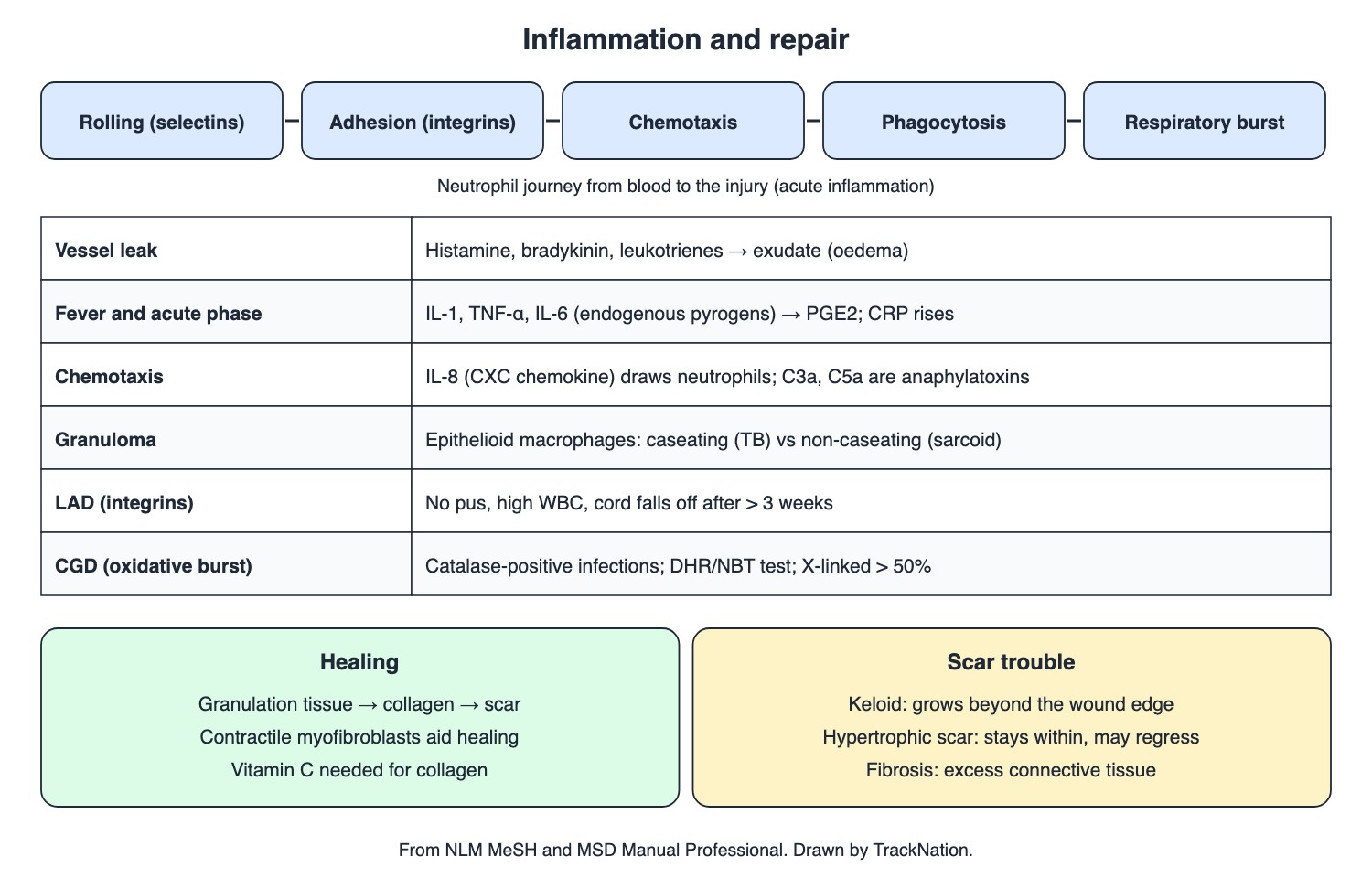
Leukocyte steps, mediators, granulomas, phagocyte defects and healing. Drawn by TrackNation.
Acute Inflammation
Cardinal signs: pain, heat, redness, swelling and loss of function.
Exudate: fluid, cells and proteins slowly leaving vessels in inflamed tissue. Transudate: thin, watery, few cells or proteins. Oedema = abnormal fluid in tissues or body cavities.
Neutrophil journey: rolling on endothelium (selectins) → activation by chemokines, flattening and firm attachment (integrins) → chemotaxis up a chemical gradient (e.g. IL-8) → phagocytosis → killing by the respiratory burst (NADPH oxidase makes superoxide).
Mediator (MeSH/MSD) | Main action |
Histamine (from histidine) | Vasodilator, bronchoconstrictor |
Bradykinin | Arteriolar dilation, more capillary permeability (short-lived) |
Prostaglandins (COX pathway) | Potent mediators; PGE2 drives fever |
Leukotrienes (5-lipoxygenase) | Immediate hypersensitivity, inflammation |
Platelet-activating factor | Platelet aggregation, anaphylactic symptoms |
IL-8 (CXC chemokine) | Neutrophil chemotaxis |
IL-1, TNF-α, IL-6 | Endogenous pyrogens |
C3a, C5a | Anaphylatoxins |
Fever and the Acute-Phase Response
Exogenous pyrogens (e.g. endotoxin, the lipopolysaccharide of Gram-negative bacteria) release endogenous pyrogens — IL-1, TNF-α, IL-6 — and PGE2 resets the hypothalamic thermostat. A rise without a reset set point is hyperthermia, not fever.
The liver changes acute-phase protein output; CRP rises in inflammation and tissue damage. ESR measures how fast red cells settle. Leukocytosis is a transient rise in white cells. An abscess is a collection of pus.
When Phagocytes Fail
Phagocyte defect (MSD/MeSH) | Defect | Clue |
Leukocyte adhesion deficiency (AR) | β2 integrins (CD11/CD18) → neutrophils cannot leave vessels | No pus, high WBC, cord separation > 3 weeks |
Chronic granulomatous disease (> 50% X-linked) | No oxidative burst (NADPH oxidase) → ingest but cannot kill | Catalase-positive infections, Aspergillus; DHR/NBT test |
Chédiak-Higashi syndrome (AR) | Abnormal lysosomes | Oculocutaneous albinism, pyogenic infections, lymphoreticular cancers |
Chronic and Granulomatous Inflammation
A granuloma is a small nodule of grouped mononuclear phagocytes. Epithelioid cells are macrophages activated by prolonged antigen exposure; they fuse into giant cells.
Langhans giant cells: nuclei in a peripheral horseshoe — TB, syphilis, sarcoidosis, deep fungal infection. Foreign-body giant cells: nuclei scattered irregularly, around foreign material.
TB: epithelioid granulomas with caseous centres. Sarcoidosis: non-caseating granulomas, cause unknown, mostly lungs and lymph nodes; macrophages activate vitamin D → hypercalcaemia; ACE may be raised but is non-specific.
Repair and Healing
Regeneration replaces tissue; repair restores integrity with connective tissue. Granulation tissue = new capillaries with lymphocytes, macrophages and plasma cells on a healing surface. Contractile myofibroblasts work in granulation tissue and in fibrosis. Collagen is about one-third of body protein.
Keloid: fibroblastic overgrowth that extends beyond the wound margins (earlobes, shoulders, upper arms, chest). Hypertrophic scar: stays within the wound and may regress. Fibrosis: fibrous tissue invading an organ after injury.
Scurvy (vitamin C deficiency): defective collagen in small vessels — bleeding, spongy gums, anaemia, impaired wound healing.
Traps the Examiner Sets
Selectins = rolling; integrins = firm adhesion (LAD = CD18).
CGD: phagocytes engulf but cannot kill; catalase-positive bugs. LAD: no pus and late cord fall.
Langhans = horseshoe nuclei; foreign-body = scattered nuclei.
Keloid crosses the wound edge; hypertrophic scar does not.
Memory Hooks & Shortcuts
Shortcuts to lock in this article's numbers and lists. Each one only re-packages facts proven above.
🧠 Selectins Slow them, Integrins Imprison them — rolling vs firm adhesion
🧠 Eight calls the neutrophils to the fight — IL-8 chemotaxis
🧠 CGD: Can Grab, Doesn't digest — CGD mechanism
🧠 LAD: Leukocytes Aren't Departing (no pus, late cord) — leukocyte adhesion deficiency
🧠 Langhans = Lucky horseshoe — Langhans giant cells
🧠 Keloid Keeps going beyond the edge — keloid vs hypertrophic
🧠 1, 6 and TNF light the fire — pyrogens
Rapid-Revision Cards
Cardinal signs
Pain, heat, redness, swelling, loss of function.
Exudate vs transudate
Cells + protein vs thin, watery, few cells.
Rolling
Selectins.
Firm adhesion
Integrins (CD11/CD18).
Neutrophil chemokine
IL-8.
Respiratory burst
NADPH oxidase → superoxide.
Histamine
Vasodilator, bronchoconstrictor.
Bradykinin
Dilation + permeability, short-lived.
COX vs 5-LOX
Prostaglandins vs leukotrienes.
Endogenous pyrogens
IL-1, TNF-α, IL-6 → PGE2.
Hyperthermia
High temperature, set point unchanged.
CRP / ESR
Acute-phase protein / red-cell settling.
LAD
AR; CD18; no pus; cord > 3 weeks.
CGD
> 50% X-linked; catalase+; DHR/NBT.
Chédiak-Higashi
AR; albinism; abnormal lysosomes.
Epithelioid cell
Activated macrophage.
Langhans
Horseshoe nuclei — TB, sarcoid.
Foreign-body giant cell
Scattered nuclei.
Sarcoidosis
Non-caseating; vitamin D activation; ACE non-specific.
Granulation tissue
Capillaries + lymphocytes, macrophages, plasma cells.
Keloid vs hypertrophic
Beyond vs within margins.
Scurvy
Collagen defect; gums, bleeding, poor healing.
Sources
Facts in this article were checked against these documents.
Medical Subject Headings (MeSH) scope notes — US National Library of Medicine, accessed 2026 (link)
MSD Manual Professional: Fever; Chronic Granulomatous Disease; Leukocyte Adhesion Deficiency; Sarcoidosis; Keloids; Vitamin C Deficiency — Merck & Co. (MSD Manuals), reviewed 2025–26 (link)
MSD Manual Professional: Complement System; Tuberculosis — Merck & Co. (MSD Manuals), reviewed 2025–26 (link)
Competency Based Undergraduate Curriculum, Pathology (PA 3–4) — National Medical Commission, 2024
Test Yourself: Practice Questions
Thirty-two questions in NEET PG style, most of them clinical vignettes.
Practice Questions (NEET PG pattern)
Original questions written in the style of the exam: +4 for a correct answer, −1 for a wrong one. Every answer was checked against the sources listed above. NEET PG papers are not published by NBEMS, so these are not past-paper questions.
Q1. The classic signs of acute inflammation are
(a) fever only
(b) pallor, cold and numbness
(c) itching and scaling
(d) pain, heat, redness, swelling and loss of function
Show answer
Answer: (d) — MeSH definition of inflammation.
Q2. Fluid from a patient's swollen ankles is thin and watery with very few cells and little protein. It is
(a) an exudate
(b) pus
(c) a transudate
(d) chyle
Show answer
Answer: (c) — Exudates carry cells and proteins from inflamed vessels.
Q3. The first loose contact of neutrophils with inflamed endothelium, in which they tumble along the vessel wall, depends mainly on
(a) selectins
(b) integrins
(c) immunoglobulins
(d) collagen
Show answer
Answer: (a) — Rolling; then chemokine activation and firm adhesion.
Q4. An infant has recurrent infections without pus, a persistently high white count and the umbilical cord fell off after 4 weeks. The defect is in
(a) lysosomes
(b) NADPH oxidase
(c) β2 integrins (CD11/CD18) — leukocyte adhesion deficiency
(d) complement C5
Show answer
Answer: (c) — Neutrophils cannot leave vessels; autosomal recessive.
Q5. The chemokine that chiefly draws neutrophils to a site of acute inflammation is
(a) IL-10
(b) IL-4
(c) IL-8 (a CXC chemokine)
(d) interferon-γ
Show answer
Answer: (c) — Chemotaxis follows a chemical gradient.
Q6. Neutrophils kill ingested bacteria by a sudden rise in oxygen use that makes superoxide. The enzyme is
(a) myeloperoxidase alone
(b) cyclooxygenase
(c) NADPH oxidase (respiratory burst)
(d) lysozyme
Show answer
Answer: (c) — Defective in chronic granulomatous disease.
Q7. A boy has recurrent abscesses and lung granulomas; cultures grow Staphylococcus aureus and Aspergillus. The DHR test shows no oxidative burst. The diagnosis is
(a) complement C5 deficiency
(b) chronic granulomatous disease
(c) Chédiak-Higashi syndrome
(d) leukocyte adhesion deficiency
Show answer
Answer: (b) — Catalase-positive organisms; Aspergillus is the leading cause of death.
Q8. In chronic granulomatous disease, phagocytes
(a) ingest bacteria but fail to kill and digest them
(b) are absent
(c) cannot leave blood vessels
(d) cannot ingest bacteria
Show answer
Answer: (a) — More than half of cases are X-linked recessive.
Q9. A child with oculocutaneous albinism has recurrent pyogenic infections; many cell types contain abnormal lysosomes. The diagnosis is
(a) Down syndrome
(b) Chédiak-Higashi syndrome (autosomal recessive)
(c) chronic granulomatous disease
(d) leukocyte adhesion deficiency
Show answer
Answer: (b) — High incidence of lymphoreticular neoplasms.
Q10. Bradykinin contributes to inflammatory swelling by
(a) arteriolar dilation and increased capillary permeability
(b) neutrophil chemotaxis only
(c) platelet aggregation
(d) fever only
Show answer
Answer: (a) — Potent but short-lived.
Q11. Prostaglandins are made from arachidonic acid by the
(a) kinin system
(b) cyclooxygenase pathway
(c) complement cascade
(d) 5-lipoxygenase pathway
Show answer
Answer: (b) — Leukotrienes come from 5-lipoxygenase.
Q12. Leukotrienes are formed from arachidonic acid by
(a) 5-lipoxygenase
(b) phospholipase only
(c) NADPH oxidase
(d) cyclooxygenase
Show answer
Answer: (a) — Involved in immediate hypersensitivity and inflammation.
Q13. A phospholipid mediator from platelets, basophils and macrophages that causes platelet aggregation and anaphylactic hypotension is
(a) IL-8
(b) histamine
(c) bradykinin
(d) platelet-activating factor
Show answer
Answer: (d) — MeSH.
Q14. The endogenous pyrogens that cause fever in infection are
(a) IL-4 and IL-13
(b) IgE and histamine
(c) IL-10 and TGF-β
(d) IL-1, TNF-α and IL-6 (acting through PGE2)
Show answer
Answer: (d) — They reset the hypothalamic set point.
Q15. A patient's temperature is 41 °C but the hypothalamic set point has not been reset. This is
(a) fever from endogenous pyrogens
(b) a PGE2-mediated fever
(c) hyperthermia, not fever
(d) septic fever
Show answer
Answer: (c) — Fever requires a reset set point.
Q16. The classic exogenous pyrogen from Gram-negative bacteria is
(a) flagellin only
(b) peptidoglycan only
(c) teichoic acid
(d) lipopolysaccharide (endotoxin)
Show answer
Answer: (d) — S. aureus toxic shock toxin is another.
Q17. A plasma protein made by the liver that rises during inflammation and after tissue damage is
(a) C-reactive protein
(b) albumin
(c) prealbumin
(d) transferrin
Show answer
Answer: (a) — Acute-phase proteins can rise or fall.
Q18. The ESR measures
(a) white cell count
(b) the rate at which red cells settle in blood
(c) CRP concentration
(d) platelet function
Show answer
Answer: (b) — MeSH: Blood Sedimentation.
Q19. A granuloma is
(a) a scar
(b) a blood clot
(c) a collection of pus
(d) a small nodular collection of grouped mononuclear phagocytes
Show answer
Answer: (d) — Caused by infectious and non-infectious agents.
Q20. Epithelioid cells in a granuloma are
(a) epithelial cells
(b) plasma cells
(c) neutrophils
(d) activated macrophages after prolonged antigen stimulation
Show answer
Answer: (d) — They fuse to form giant cells.
Q21. A lymph node granuloma contains multinucleated giant cells with nuclei arranged in a peripheral horseshoe. These are
(a) Langhans giant cells
(b) foreign-body giant cells
(c) Touton cells
(d) Reed-Sternberg cells
Show answer
Answer: (a) — Seen in TB, syphilis, sarcoidosis, deep fungal infection.
Q22. Around foreign material in the skin, giant cells with many nuclei scattered irregularly in the cytoplasm are
(a) Langhans giant cells
(b) megakaryocytes
(c) foreign-body giant cells
(d) Reed-Sternberg cells
Show answer
Answer: (c) — They form around exogenous material.
Q23. A young adult with lung and lymph node involvement has granulomas without central necrosis; tests for infection are negative. The likely diagnosis is
(a) sarcoidosis
(b) tuberculosis
(c) foreign-body reaction
(d) lymphoma
Show answer
Answer: (a) — Non-caseating granulomas; lungs and lymphatics most often.
Q24. A patient with sarcoidosis has hypercalcaemia. The mechanism is
(a) bone metastases
(b) macrophages convert vitamin D to its active 1,25 form
(c) thiazide use
(d) PTH-related peptide from tumour
Show answer
Answer: (b) — Hypercalciuria may occur even with normal serum calcium.
Q25. In suspected sarcoidosis, a raised serum ACE is
(a) diagnostic
(b) a marker of TB
(c) always present
(d) suggestive but non-specific
Show answer
Answer: (d) — Also raised in hyperthyroidism, diabetes, silicosis, mycobacterial and fungal disease.
Q26. The pink, granular tissue on the base of a healing ulcer is made of
(a) fat cells
(b) epithelium only
(c) dense mature collagen only
(d) new capillaries with lymphocytes, macrophages and plasma cells
Show answer
Answer: (d) — Granulation tissue.
Q27. Spindle-shaped cells with contractile proteins that help heal wounds and also appear in fibrosis are
(a) plasma cells
(b) epithelioid cells
(c) mast cells
(d) myofibroblasts
Show answer
Answer: (d) — Found in granulation tissue.
Q28. Months after ear piercing, a firm scar grows well beyond the edges of the original wound. This is
(a) a hypertrophic scar
(b) a granuloma
(c) granulation tissue
(d) a keloid
Show answer
Answer: (d) — Hypertrophic scars stay within the wound and may regress.
Q29. An elevated scar that stays within the wound margins and later regresses by itself is
(a) a hypertrophic scar
(b) fibrosis
(c) a keloid
(d) a sarcoma
Show answer
Answer: (a) — MeSH.
Q30. A man on a very poor diet has bleeding gums, easy bruising and wounds that will not heal. The defect is in
(a) clotting factor VIII
(b) collagen formation (vitamin C deficiency)
(c) iron absorption
(d) platelet production
Show answer
Answer: (b) — Scurvy: defective collagen in small vessels.
Q31. Collagen makes up about what fraction of total body protein?
(a) half
(b) one-third
(c) two-thirds
(d) one-tenth
Show answer
Answer: (b) — Main constituent of skin, connective tissue, bone and teeth.
Q32. A localised collection of pus in a tissue is called
(a) a transudate
(b) a keloid
(c) a granuloma
(d) an abscess
Show answer
Answer: (d) — Usually with signs of infection.
Active Recall
From memory: list the cardinal signs and contrast exudate and transudate; describe neutrophil rolling, adhesion, chemotaxis and killing with their molecules; give the action of each major mediator and the pyrogens; match LAD, CGD and Chédiak-Higashi to their defects; describe granulomas and giant cells in TB and sarcoidosis; and explain granulation tissue, keloids and scurvy.