Kidney II for NEET PG Pathology: ATN, Interstitial Nephritis, Pyelonephritis, Polycystic Kidney, Stones, HUS, Renal Cell Carcinoma, Wilms, Bladder Cancer
Start Here
🎯 Exam priority: High. Expect: ATN casts and causes, drug-induced interstitial nephritis, myeloma cast nephropathy, papillary necrosis settings, ADPKD genes and extrarenal features, stone types (struvite and staghorn), HUS vs TTP, RCC risk factors and paraneoplastic syndromes, Wilms associations, and bladder cancer risk factors.
CBME mapping: PA 27.8–27.16. Glomerular disease, AKI and CKD are in article 21; urine examination in article 16; haemolytic anaemias and TTP from the blood side in article 14.
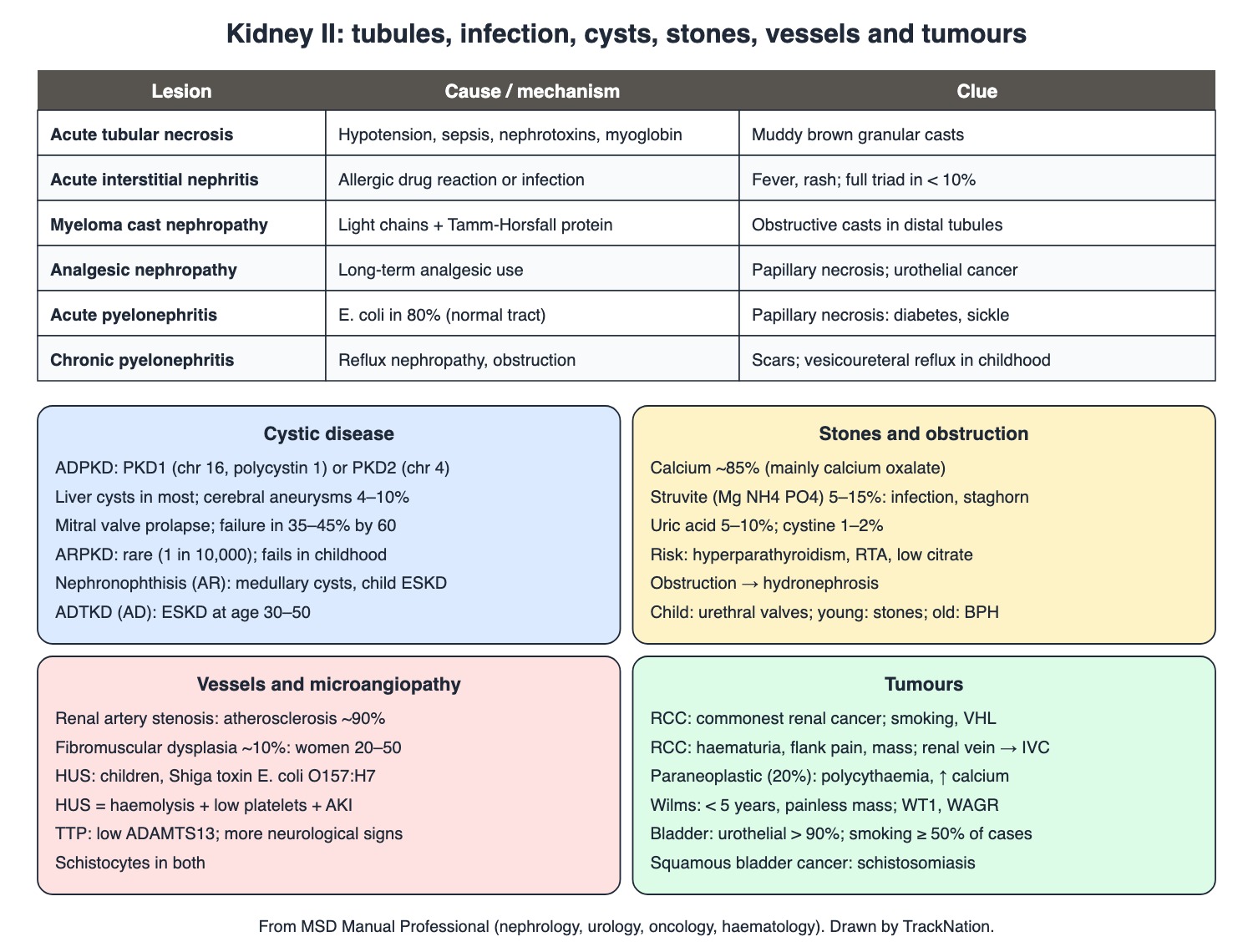
Tubules, infection, cysts, stones, vessels and tumours of the kidney and bladder. Drawn by TrackNation.
Tubules and Interstitium
Acute tubular necrosis: from hypotension or sepsis (renal hypoperfusion) and nephrotoxic drugs; also myoglobin (rhabdomyolysis), haemoglobin (massive haemolysis), burns, tumour lysis and myeloma. Sediment: muddy brown granular casts and epithelial cells; urine sodium high, FENa above 1–2%.
Acute interstitial nephritis: mostly allergic drug reactions or infections. Fever and urticarial rash come early, but the full triad of fever, rash and eosinophilia is seen in fewer than 10%. Latency ranges from 1 day (rifampicin) to 18 months (NSAIDs).
Myeloma kidney: filtered light chains (Bence Jones protein) overwhelm the proximal tubule and bind Tamm-Horsfall protein distally to form obstructive casts — cast nephropathy.
Analgesic nephropathy: chronic interstitial disease; papillary necrosis late; higher risk of urothelial (transitional cell) carcinoma. Contrast nephropathy: creatinine rises 24–48 hours after IV contrast, usually temporary.
Renal tubular acidosis: type 1 (distal) — poor hydrogen ion excretion; type 2 (proximal) — poor bicarbonate reabsorption; type 4 — aldosterone deficiency or resistance.
Pyelonephritis and Vessels
Acute pyelonephritis: in a normal urinary tract, E. coli strains with adhesins for urothelium cause 80%; others are Klebsiella, Proteus, occasionally Pseudomonas. White cell casts show inflammation. Papillary necrosis complicates pyelonephritis with diabetes, obstruction, sickle cell disease, transplants, candidiasis or analgesic nephropathy.
Chronic pyelonephritis (reflux nephropathy): scarring and atrophy from repeated inflammation, mostly with major anatomic abnormalities and strongly linked to vesicoureteral reflux in childhood.
Renal artery stenosis: about 90% atherosclerotic (often bilateral); about 10% fibromuscular dysplasia (often unilateral, women 20–50). Renal infarcts are wedge-shaped. Hypertensive arteriolar nephrosclerosis is a leading diagnosis in kidney failure.
Thrombotic microangiopathy: HUS = microangiopathic haemolytic anaemia, thrombocytopenia and AKI, usually in children after Shiga toxin–producing E. coli O157:H7 haemorrhagic colitis. TTP: low ADAMTS13, Coombs-negative haemolysis; neurological signs commoner and renal failure less common than in HUS.
Cysts, Stones and Obstruction
ADPKD: PKD1 (chromosome 16, polycystin 1) in most, PKD2 (chromosome 4) in the rest. Kidney failure in 35–45% by age 60. Extrarenal: liver cysts in most, cerebral (berry) aneurysms in 4–10%, mitral valve prolapse, aortic regurgitation, diverticula, hernias.
ARPKD: rare (1 in 10,000), kidney failure in childhood. Nephronophthisis (autosomal recessive) and ADTKD (autosomal dominant): cysts confined to the medulla or corticomedullary junction; end-stage disease in childhood vs at 30–50.
Stones: see the table. A staghorn calculus fills the whole calyceal system and is typically struvite. Struvite stones are infected foreign bodies and must be removed completely.
Obstructive uropathy → hydronephrosis. Commonest cause by age: children — anatomic (posterior urethral valves in boys, junction stenosis); young adults — stones; older adults — prostatic enlargement or cancer.
Stone | Share | Usual cause |
Calcium oxalate / phosphate | ~85% (calcium) | Hypercalciuria, hyperparathyroidism, low citrate, renal tubular acidosis |
Struvite (magnesium ammonium phosphate) | 5–15% | Infection with urea-splitting bacteria (Proteus, Klebsiella); staghorn |
Uric acid | 5–10% | Urine pH < 5.5; hyperuricosuria |
Cystine | 1–2% | Cystinuria only |
Renal and Urothelial Tumours
Renal cell carcinoma: the commonest renal cancer (men 2:1, diagnosed 65–74). Risks: smoking (doubles risk), obesity, hypertension, acquired cystic disease on dialysis, von Hippel-Lindau and tuberous sclerosis. Haematuria, flank pain, mass, fever of unknown origin — often found incidentally. Tumour thrombus grows into the renal vein and sometimes the IVC. Paraneoplastic syndromes in 20%: polycythaemia (erythropoietin), hypercalcaemia, anaemia. Spread: nodes, lung, adrenal, liver, brain, bone.
Wilms tumour (nephroblastoma): embryonal tumour with blastemal, stromal and epithelial elements; children under 5; painless abdominal mass; bilateral in 5–10%. WT1 deletion; WAGR = Wilms, aniridia, genitourinary malformations and intellectual disability; also hemihypertrophy.
Bladder cancer: urothelial (transitional cell) carcinoma > 90%, mostly papillary; presents with haematuria. Risks: smoking (≥ 50% of cases), long-term cyclophosphamide, dye-industry aromatic amines, chronic irritation. Squamous carcinoma goes with schistosomiasis and chronic irritation.
Traps the Examiner Sets
Muddy brown casts = ATN; white cell casts = pyelonephritis or interstitial inflammation; red cell casts = glomerulonephritis.
Staghorn = struvite = Proteus (urea splitting).
ADPKD gene on chromosome 16; berry aneurysm is the feared extrarenal killer.
HUS: child + bloody diarrhoea + kidney; TTP: low ADAMTS13, brain more than kidney.
Bladder squamous carcinoma = schistosomiasis; urothelial = smoking.
Memory Hooks & Shortcuts
Shortcuts to lock in this article's numbers and lists. Each one only re-packages facts proven above.
🧠 Muddy brown = Many dead tubules (ATN) — casts
🧠 Staghorn = Struvite = Splitting urea (Proteus) — stones
🧠 PKD1 = 16 letters? — Polycystic Kidney Disease 1 sits on chromosome 16 — ADPKD gene
🧠 HUS = Hamburger, Uraemia, Small child — HUS
🧠 TTP = Thinking (neuro) more than peeing (renal) — TTP vs HUS
🧠 WAGR = Wilms, Aniridia, Genitourinary, and the R for intellectual disability — Wilms
🧠 Schisto makes Squamous — bladder cancer
Rapid-Revision Cards
ATN
Hypotension, sepsis, nephrotoxins, myoglobin; muddy brown casts.
Acute interstitial nephritis
Drug allergy; fever, rash; triad < 10%.
Myeloma kidney
Light chains + Tamm-Horsfall → casts.
Analgesic nephropathy
Papillary necrosis late; urothelial cancer.
Contrast nephropathy
Creatinine ↑ at 24–48 h.
UTI organism
E. coli 80% (normal tract).
Papillary necrosis
Diabetes, obstruction, sickle, analgesics.
Chronic pyelonephritis
Reflux nephropathy; scars; VUR.
Renal artery stenosis
90% atherosclerosis; 10% FMD (women 20–50).
HUS
Child, O157:H7, MAHA + low platelets + AKI.
TTP
Low ADAMTS13; neuro > renal.
ADPKD genes
PKD1 chr 16 (most); PKD2 chr 4.
ADPKD extrarenal
Liver cysts, berry aneurysm, MVP.
ARPKD
1 in 10,000; childhood failure.
Nephronophthisis
AR; medullary cysts; child ESKD.
Stones
Ca 85%, struvite 5–15%, urate 5–10%, cystine 1–2%.
Staghorn
Struvite; Proteus, Klebsiella.
Obstruction by age
Child valves; young stones; old prostate.
RCC risks
Smoking, obesity, HTN, dialysis cysts, VHL.
RCC paraneoplastic
20%: polycythaemia, hypercalcaemia.
Wilms
< 5 yr; painless mass; WT1; WAGR; bilateral 5–10%.
Bladder cancer
Urothelial > 90%; smoking ≥ 50%.
Squamous bladder
Schistosomiasis.
Sources
Facts in this article were checked against these documents.
MSD Manual Professional: Acute Tubular Necrosis; Tubulointerstitial Nephritis; Myeloma-Related Kidney Disease; Analgesic Nephropathy; Contrast Nephropathy; Renal Tubular Acidosis — Merck & Co. (MSD Manuals), reviewed 2024–26 (link)
MSD Manual Professional: Bacterial Urinary Tract Infections; Reflux Nephropathy — Merck & Co. (MSD Manuals), reviewed 2026 (link)
MSD Manual Professional: Renal Artery Stenosis; Hypertensive Arteriolar Nephrosclerosis; ADPKD; Nephronophthisis and ADTKD — Merck & Co. (MSD Manuals), reviewed 2025–26 (link)
MSD Manual Professional: Hemolytic-Uremic Syndrome; Thrombotic Thrombocytopenic Purpura — Merck & Co. (MSD Manuals), reviewed 2025–26 (link)
MSD Manual Professional: Urinary Calculi; Obstructive Uropathy; Renal Cell Carcinoma; Bladder Cancer; Wilms Tumor — Merck & Co. (MSD Manuals), reviewed 2025–26 (link)
Competency Based Undergraduate Curriculum, Pathology (PA 27) — National Medical Commission, 2024
Test Yourself: Practice Questions
Thirty-two questions in NEET PG style, most of them clinical vignettes.
Practice Questions (NEET PG pattern)
Original questions written in the style of the exam: +4 for a correct answer, −1 for a wrong one. Every answer was checked against the sources listed above. NEET PG papers are not published by NBEMS, so these are not past-paper questions.
Q1. After a prolonged hypotensive episode during sepsis, a patient becomes oliguric; urine shows muddy brown granular casts and epithelial cells. The lesion is
(a) prerenal azotaemia
(b) minimal change disease
(c) acute glomerulonephritis
(d) acute tubular necrosis
Show answer
Answer: (d) — Prerenal sediment is normal or has hyaline casts.
Q2. After a crush injury, a patient passes tea-coloured urine and develops acute kidney injury. The pigment damaging the tubules is
(a) myoglobin
(b) bilirubin
(c) haemosiderin
(d) melanin
Show answer
Answer: (a) — Haemoglobin from massive haemolysis does the same.
Q3. Days after starting a new antibiotic, a patient develops fever, an urticarial rash and rising creatinine. The likely renal lesion is
(a) acute (allergic) interstitial nephritis
(b) ADPKD
(c) post-streptococcal GN
(d) renal artery stenosis
Show answer
Answer: (a) — The full fever-rash-eosinophilia triad appears in fewer than 10%.
Q4. In drug-induced acute interstitial nephritis, the classic triad of fever, rash and eosinophilia is present in
(a) nearly all patients
(b) fewer than 10% of patients
(c) only children
(d) about half
Show answer
Answer: (b) — So its absence does not exclude the diagnosis.
Q5. In a patient with multiple myeloma, distal tubules are blocked by casts. The casts form when light chains combine with
(a) Tamm-Horsfall protein
(b) IgA
(c) fibrin
(d) albumin only
Show answer
Answer: (a) — Tamm-Horsfall protein is secreted by the thick ascending limb.
Q6. A long-term analgesic user with chronic kidney disease is at increased risk of which cancer?
(a) transitional cell carcinoma of the urinary tract
(b) renal cell carcinoma only
(c) Wilms tumour
(d) prostate cancer
Show answer
Answer: (a) — Papillary necrosis appears late.
Q7. Contrast nephropathy typically appears as a creatinine rise
(a) after 3 months
(b) 24–48 hours after IV contrast, usually temporary
(c) only with oral contrast
(d) within 10 minutes
Show answer
Answer: (b) — Isotonic saline before and after may help prevent it.
Q8. In patients with a structurally normal urinary tract, the organism causing about 80% of urinary infections is
(a) Escherichia coli
(b) Proteus mirabilis
(c) Staphylococcus saprophyticus
(d) Pseudomonas aeruginosa
Show answer
Answer: (a) — Strains with adhesins for urothelium.
Q9. A diabetic with acute pyelonephritis is found to have necrosis of the renal papillae. This complication is called
(a) renal vein thrombosis
(b) nephrocalcinosis
(c) papillary necrosis
(d) renal cell carcinoma
Show answer
Answer: (c) — Also with obstruction, sickle cell disease and analgesic nephropathy.
Q10. Coarse cortical scars with atrophy in a young adult who had vesicoureteral reflux in childhood indicate
(a) ADPKD
(b) reflux nephropathy (chronic pyelonephritis)
(c) renal infarcts from emboli
(d) diabetic nephropathy
Show answer
Answer: (b) — It occurs almost only with major anatomic abnormalities.
Q11. A 30-year-old woman has hypertension from a unilateral renal artery stenosis caused by irregular, mainly medial wall thickening. The cause is most likely
(a) renal vein thrombosis
(b) atherosclerosis
(c) Takayasu arteritis
(d) fibromuscular dysplasia
Show answer
Answer: (d) — Atherosclerosis causes about 90% overall, usually in older patients.
Q12. Most renal artery stenosis is due to
(a) fibromuscular dysplasia (90%)
(b) trauma
(c) atherosclerosis (about 90%, often bilateral)
(d) vasculitis
Show answer
Answer: (c) — Fibromuscular dysplasia accounts for almost 10%.
Q13. After bloody diarrhoea, a 4-year-old develops haemolytic anaemia with red cell fragments, thrombocytopenia and acute kidney injury. The likely organism is
(a) Vibrio cholerae
(b) Salmonella typhi
(c) rotavirus
(d) Shiga toxin–producing E. coli O157:H7
Show answer
Answer: (d) — Haemolytic uraemic syndrome: haemolysis, low platelets, AKI.
Q14. Thrombotic thrombocytopenic purpura is distinguished from HUS by
(a) positive direct Coombs test
(b) high platelet count
(c) absence of schistocytes
(d) severely reduced ADAMTS13 activity
Show answer
Answer: (d) — Neurological features are commoner in TTP; renal failure in HUS.
Q15. An adult with bilateral enlarged cystic kidneys has a family history of kidney failure on dialysis in his father. The commonest mutated gene and its chromosome are
(a) WT1 on chromosome 11
(b) PKD1 on chromosome 16
(c) PKD2 on chromosome 4 in most cases
(d) PKHD1 on chromosome 6
Show answer
Answer: (b) — PKD2 (chromosome 4) causes most of the rest.
Q16. The intracranial lesion that makes ADPKD dangerous, present in about 4–10% of patients, is
(a) arachnoid cyst only
(b) brain metastasis
(c) cerebral (berry) aneurysm
(d) meningioma
Show answer
Answer: (c) — Cerebral aneurysms are present in about 4–10%.
Q17. The commonest extrarenal finding in ADPKD is
(a) lung cysts
(b) splenic cysts
(c) hepatic cysts
(d) pancreatic cancer
Show answer
Answer: (c) — Liver function is usually normal.
Q18. A cardiac lesion associated with ADPKD is
(a) Ebstein anomaly
(b) tetralogy of Fallot
(c) coarctation
(d) mitral valve prolapse
Show answer
Answer: (d) — Aortic regurgitation too, in 25–30% overall.
Q19. A child with polyuria, polydipsia and progressive kidney failure has normal-sized or small kidneys with cysts at the corticomedullary junction; the inheritance is autosomal recessive. This is
(a) ADTKD
(b) nephronophthisis
(c) ADPKD
(d) simple cysts
Show answer
Answer: (b) — ADTKD is dominant and reaches end-stage at 30–50.
Q20. The commonest composition of urinary stones is
(a) uric acid
(b) calcium (mainly calcium oxalate)
(c) cystine
(d) struvite
Show answer
Answer: (b) — About 85%.
Q21. A woman with recurrent Proteus urinary infections has a large stone filling the entire calyceal system. Its composition is most likely
(a) uric acid
(b) calcium oxalate
(c) magnesium ammonium phosphate (struvite)
(d) cystine
Show answer
Answer: (c) — Urea-splitting bacteria; a staghorn calculus.
Q22. Stones that form only in the presence of an inherited amino acid transport defect are
(a) uric acid stones
(b) cystine stones
(c) calcium oxalate stones
(d) struvite stones
Show answer
Answer: (b) — Cystinuria; 1–2% of stones.
Q23. The commonest cause of urinary obstruction in a newborn boy is
(a) bladder cancer
(b) benign prostatic hyperplasia
(c) posterior urethral valves
(d) renal stones
Show answer
Answer: (c) — In young adults stones; in older adults the prostate.
Q24. A 65-year-old smoker has haematuria, flank pain and a renal mass; haemoglobin is raised. The tumour and the cause of polycythaemia are
(a) Wilms tumour — androgens
(b) renal cell carcinoma — erythropoietin
(c) angiomyolipoma — EPO always
(d) urothelial carcinoma — PTHrP
Show answer
Answer: (b) — Paraneoplastic syndromes occur in 20%.
Q25. A familial syndrome strongly predisposing to renal cell carcinoma is
(a) Peutz-Jeghers syndrome
(b) von Hippel-Lindau disease
(c) Lynch syndrome
(d) Li-Fraumeni syndrome
Show answer
Answer: (b) — Tuberous sclerosis too.
Q26. Renal cell carcinoma characteristically spreads by
(a) spreading along nerves
(b) growing into the renal vein and sometimes the inferior vena cava
(c) seeding the peritoneum
(d) direct invasion of the colon only
Show answer
Answer: (b) — Metastases go to nodes, lung, adrenal, liver, brain and bone.
Q27. A long-term dialysis patient develops a solid renal mass. A recognised predisposing condition is
(a) minimal change disease
(b) renal artery stenosis
(c) nephronophthisis
(d) acquired cystic kidney disease
Show answer
Answer: (d) — Smoking, obesity and hypertension are other risks.
Q28. A 3-year-old has a painless abdominal mass, absent irises (aniridia) and genital anomalies. The tumour and deleted gene are
(a) Wilms tumour — WT1
(b) retinoblastoma — RB1
(c) hepatoblastoma — APC
(d) neuroblastoma — MYCN
Show answer
Answer: (a) — WAGR syndrome.
Q29. Microscopy of a childhood renal tumour shows blastemal, stromal and epithelial elements. The tumour is
(a) oncocytoma
(b) angiomyolipoma
(c) renal cell carcinoma
(d) Wilms tumour
Show answer
Answer: (d) — Bilateral in 5–10%.
Q30. The single most common risk factor for bladder cancer is
(a) cigarette smoking
(b) schistosomiasis
(c) bladder stones
(d) cyclophosphamide
Show answer
Answer: (a) — It causes at least half of new cases.
Q31. A man with long-standing urinary schistosomiasis develops bladder cancer. The likely histological type is
(a) adenocarcinoma always
(b) urothelial carcinoma in situ only
(c) small cell carcinoma
(d) squamous cell carcinoma
Show answer
Answer: (d) — Chronic irritation drives squamous change.
Q32. The commonest histological type of bladder cancer is
(a) adenocarcinoma
(b) urothelial (transitional cell) carcinoma
(c) squamous cell carcinoma
(d) sarcoma
Show answer
Answer: (b) — Over 90%, mostly papillary.
Active Recall
From memory: list causes and casts of ATN; describe drug-induced interstitial nephritis and myeloma kidney; give the organism and complications of pyelonephritis and define reflux nephropathy; contrast atherosclerotic and fibromuscular renal artery stenosis and HUS with TTP; describe ADPKD genetics and extrarenal features; rank stone types; and summarise RCC, Wilms tumour and bladder cancer risks and features.